
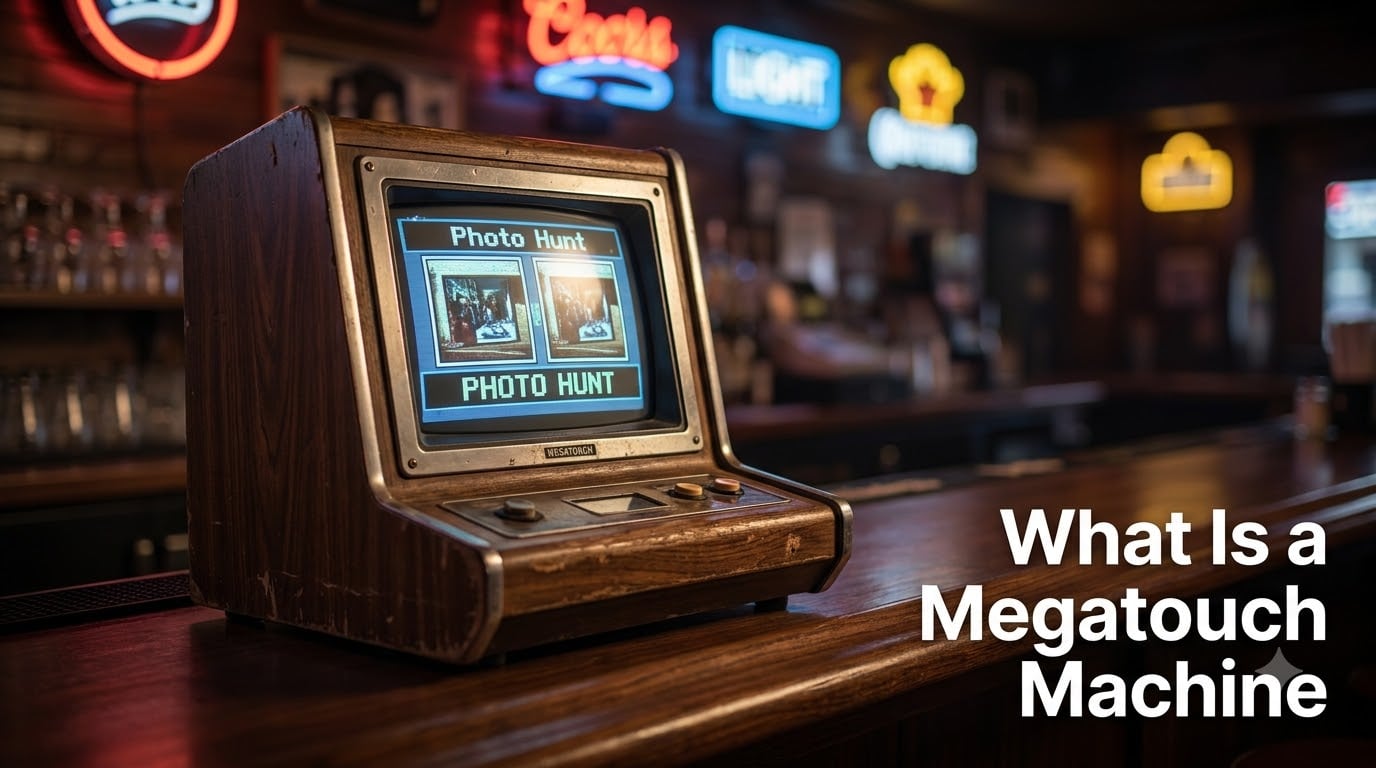
A Megatouch machine is a coin-operated, touchscreen-based arcade gaming system developed by Merit Industries (now Merit Entertainment), offering a library of casual games like Photo Hunt, Trivia Whiz, and Tri-Towers for use in bars, restaurants, and homes. Since its debut in the mid-1990s, the Megatouch has become a worldwide phenomenon, with over 150 games across categories and presence in 27 countries.
I have spent the last several weeks digging through repair forums, Reddit threads, and the Merit Industries archives to put together this guide. Our team wanted to understand exactly what makes these touchscreen arcade cabinets so enduring, and the answers surprised me. Below I’ll walk you through the history, hardware platforms, popular models, games, and the practical realities of owning one.
Table of Contents
- What Is a Megatouch Machine?
- A Brief History of the Megatouch
- Megatouch Hardware Platforms Explained
- Popular Megatouch Models and Cabinets
- Megatouch Games and Features
- Where Megatouch Machines Are Used
- Buying a Megatouch Machine: What to Know
- Frequently Asked Questions
- What is a Megatouch arcade machine?
- How many games do Megatouch machines offer?
- Are Megatouch machines suitable for home use?
- Can Megatouch machines connect to the internet?
- What is the average lifespan of a Megatouch machine?
- Do Megatouch machines require special maintenance?
- Where can I purchase a Megatouch arcade machine?
- Are there rental options for Megatouch machines?
- Final Thoughts
What Is a Megatouch Machine?
A Megatouch machine is a multi-game touchscreen arcade system built by Merit Industries, the flagship product of a brand that has dominated casual bar gaming for nearly three decades. The unit combines a flat-panel display, a touch overlay, a purpose-built motherboard, and a security key dongle to deliver dozens of games in a single cabinet.
When someone asks me “what is a Megatouch machine,” I usually point to three defining traits:
Touchscreen-first interface – no joysticks, no buttons, just tap and play.
Curated game library – usually 20 to 30+ titles per software version, with categories spanning puzzles, strategy, cards, trivia, and action.
Commercial-grade cabinet – designed for high-traffic locations like bars, restaurants, and game rooms.
Over the years, the Megatouch has earned a reputation as a “social game” machine because rounds are short, players rotate easily, and the touchscreen design makes it intuitive for first-time users. That is why you still see one in your local pub.
Unlike traditional arcade cabinets that emphasize joystick and button combos, the Megatouch was designed from the ground up around direct screen manipulation. That decision shaped everything about the platform: the cabinet orientation, the game design philosophy, and even the way software updates were released. Every Megatouch software version is built around short, replayable rounds that reward muscle memory and pattern recognition.
The brand has also been remarkably consistent in its visual identity. Even as displays moved from CRT to LCD to widescreen flat panels, the Megatouch interface retained its bright color palette and simple iconography, which made the transition between hardware generations easier for both operators and players.
A Brief History of the Megatouch
The Megatouch story begins in Bristol, Pennsylvania, where Merit Industries was founded in 1985. The company originally built coin-operated pool tables and dart games before pivoting into touchscreen entertainment after seeing the technology mature in the early 1990s.
The first Megatouch units shipped around 1996, and they were an immediate hit with bar operators. A single cabinet could entertain groups of customers without needing an attendant, which made it perfect for venues with limited staff. By the late 1990s, Megatouch machines were in thousands of bars across North America and Europe.
Merit rebranded itself as Merit Entertainment in the 2000s to reflect its broader entertainment portfolio. The Megatouch line continued through several major hardware revisions, each one introducing better displays, faster processors, and more ambitious games. The company also produced sister systems like Gametime and MindSpark, which shared technology but targeted different markets.
Here is a quick historical snapshot:
1996 – First Megatouch units ship, using CRT displays and proprietary controllers.
Early 2000s – XL and MAXX hardware platforms replace legacy systems, introducing flat-panel LCDs.
Mid-2000s – FORCE platform debuts with widescreen support and expanded game libraries.
2010s – ION platform launches, becoming the most popular modern standard.
2014 – Final major software release (Megatouch 2014 / ION), though hardware service continues.
Today – Merit still supports legacy software security keys and parts for existing operators.
Although Merit has shifted focus away from new consumer Megatouch machines, the installed base remains active. I have seen threads on r/Megatouch where operators report machines running 15+ years with basic maintenance, which speaks to the durability of the platform.
The brand’s footprint also grew internationally. According to the Megatouch community wiki, machines have shipped to 27 countries, with localized software versions in 19 languages. That global reach helped Megatouch become one of the most recognizable casual gaming brands of the 2000s, and it explains why the machines still feel familiar to travelers who encounter them in pubs from Dublin to Dubai.
Merit’s sister products, including the Gametime countertop unit and the MindSpark touch-based learning device, shared the same core technology but targeted niche markets. Gametime was a stripped-down Megatouch variant aimed at venues that wanted a smaller cabinet, while MindSpark was a touch-driven trivia and quiz platform. Both lines are now discontinued, but they share parts and software with the main Megatouch ecosystem, which keeps the spare-parts market active.
Megatouch Hardware Platforms Explained
Every Megatouch machine belongs to one of four major hardware platforms: XL, MAXX, FORCE, or ION. These platforms determine which software versions your cabinet can run, what kind of motherboard and I/O board it uses, and which games are available. If you are buying a used unit, the platform matters more than the cabinet color.
| Platform | Era | Display | Media | Notable Feature |
|---|---|---|---|---|
| XL | Early 2000s | 15″ to 17″ LCD | Hard drive | First flat-panel Megatouch |
| MAXX | Mid-2000s | 17″ LCD | Hard drive | Improved I/O board, more reliable touchscreen |
| FORCE | Late 2000s | 19″ widescreen | Hard drive / SSD | Widescreen support, larger game libraries |
| ION | 2010s | 22″ widescreen | SSD | Most reliable, last major platform, broad game compatibility |
XL Platform
The XL platform was Merit Industries’ first flat-panel Megatouch, replacing the bulky CRT units of the late 1990s. These machines used 15-inch to 17-inch LCD panels and were the first to drop the spinning hard drive media in favor of internal storage. Many XL cabinets are still in service today, though replacement parts are becoming harder to find.
XL units typically shipped with smaller game libraries than later platforms, and they used an older touchscreen controller that can be finicky about calibration. For hobbyists who want an authentic vintage Megatouch experience and don’t mind occasional tinkering, XL is a fun platform to own.
MAXX Platform
MAXX stepped up to a 17-inch display and a more robust I/O board, which made the touchscreen controller more responsive and less prone to calibration drift. From what I have seen on the arcade-museum forums, MAXX cabinets are a sweet spot for hobbyists: they have a solid game library and parts are still available through Merit and third-party suppliers.
MAXX units also introduced the standardized security key system that later platforms inherited, which simplified repairs and made it easier to swap motherboards between cabinets. Several forum members have documented MAXX-to-MAXX conversions using off-the-shelf parts, which speaks to the platform’s longevity.
FORCE Platform
FORCE introduced widescreen support and noticeably larger game libraries. The touchscreen controller was redesigned for better durability, and the cabinet design started to look more modern. Owners on Pinside and Reddit consistently report that FORCE platforms hold up well, though the compact LCD models can run hot if ventilation is poor.
FORCE units often included dual-display options in some cabinet models, which allowed operators to add a marquee screen or attract-mode display. The platform also supported early Wi-Fi and Ethernet connectivity on selected software versions, paving the way for the always-online ION generation.
ION Platform
The ION platform is the most recent and most sought-after generation for home use. It uses a 22-inch widescreen display, SSD storage, and the most extensive game library. Security keys are still sold by Merit, software updates are still produced, and the community considers it the most reliable long-term option. If you are buying a Megatouch for your home game room in 2026, this is the platform to target.
ION cabinets also introduced modern conveniences like USB-based software updates, improved diagnostic menus, and standardized HDMI output for easy monitor replacement. Several repair shops told me that ION boards are the easiest to service because the documentation is the most complete and the parts are still in production.
Popular Megatouch Models and Cabinets
Across those four hardware platforms, Merit produced a wide range of cabinet models. The most common ones you’ll encounter on the used market include the Aurora, Evo, Maxx, and various countertop or bartop units.
| Model | Platform | Screen Size | Form Factor | Best For |
|---|---|---|---|---|
| Aurora | ION | 22″ widescreen | Upright / countertop | Home game rooms, bars |
| Evo (Flatpanel) | FORCE / ION | 19″ to 22″ | Countertop | Limited space, restaurants |
| Maxx | MAXX | 17″ | Upright | Classic bar look, budget buyers |
| Fusion | FORCE | 19″ widescreen | Upright | Modern venues, social play |
| Countertop / Bartop | All platforms | 15″ to 19″ | Counter / bartop | Small bars, home bars, events |
Aurora
The Aurora is the modern flagship. It ships as both an upright and a countertop variant, and it is the most common ION platform unit on the secondary market. The Aurora has a clean, minimal cabinet design that fits well in home game rooms, and it supports the full ION software library.
Aurora cabinets tend to have the cleanest cosmetic condition on the used market because they were the last units Merit shipped new. If you want a Megatouch that looks factory-fresh and runs the latest games, an Aurora is usually the safest bet.
Evo (Flatpanel)
The Evo line spans multiple platforms but is best known as the FORCE and ION generation’s flat-panel unit. Many bars still run an Evo because it has a small footprint and the wide screen is easy to read from across the room. Our team found that used Evo units in good condition are among the best values right now.
Evo countertop units in particular are popular with home buyers because they fit on a standard kitchen island or basement bar. The flat-panel display makes them lighter than older CRT-based cabinets, which simplifies shipping and installation.
Maxx
The original Maxx was a MAXX-platform cabinet with a 17-inch screen and a more traditional upright design. It is heavier than modern units but offers classic Megatouch charm. Hobbyists like the Maxx because parts are still readily available and the touchscreen controller is well-documented.
Maxx cabinets are also a good choice for buyers who want the classic Megatouch look without paying ION prices. The trade-off is a slightly smaller game library and a heavier cabinet, but for many collectors that is part of the appeal.
Fusion
The Fusion was a FORCE-platform unit that bridged the gap between classic Megatouch and the modern ION era. Its widescreen display and updated cabinet graphics made it a favorite for new operators in the late 2000s.
Fusion units often came with upgraded lighting packages and side-panel decals that gave them a more “premium” bar presence. They are a good middle-ground option if you want widescreen support without paying ION-level prices.
Countertop and Bartop Units
Countertop and bartop Megatouch machines are smaller, sit on a bar or counter, and are aimed at venues with limited floor space. They are popular in restaurants, breweries, and assisted living facilities. For home users, a countertop unit is often the easiest to install and move around.
Most countertop units use the same motherboard and security key as their upright siblings, which means you can swap internals between form factors if you find a good deal on parts. That flexibility is one of the reasons the Megatouch aftermarket remains active.
Megatouch Games and Features
The Megatouch game library is one of the main reasons these machines have staying power. A typical modern unit offers 20 to 30 games, with software versions rotating older titles out and bringing in new ones. Across all platforms, Megatouch has published well over 150 unique games.
Game Categories
Megatouch games fall into a handful of core categories:
Puzzle – tile-matching, falling-block, and logic puzzles.
Strategy – card games, board-game adaptations, and tactical rounds.
Action – reflex-based games that test timing and speed.
Cards – poker, solitaire, and other standard deck games.
Quiz and Word – trivia, word puzzles, and knowledge challenges.
Within those broad categories, individual games have evolved significantly over the years. Older XL-era titles were simple by modern standards, while FORCE and ION-era games added animated backgrounds, themed artwork, and tournament modes. The progression mirrors the broader trend in casual gaming, and it keeps the library feeling fresh even for long-time fans.
Iconic Titles
Some Megatouch games have become cult classics. Photo Hunt, Trivia Whiz, and Tri-Towers are the most recognizable, and you’ll find them mentioned in almost every Megatouch review. Photo Hunt (a “spot the difference” game) is the unofficial mascot of the brand.
Trivia Whiz is the platform’s signature quiz experience, offering categories that range from pop culture to history to sports. Tri-Towers is a tile-matching game in the spirit of classic mahjong solitaire, and it remains one of the most-played titles across all Megatouch generations.
Other fan favorites include Poker, Solitaire, and the many Match-style puzzle games. Operators have told me that no matter what software version is loaded, these core titles are always among the most-played.
Multiplayer and Connectivity
Most Megatouch cabinets support multiplayer, either by passing the touchscreen between players or by linking two cabinets together using a network cable. The ION platform added Wi-Fi and Ethernet connectivity, which enables online leaderboards and tournament features on supported software versions.
Linked cabinets create a more social experience, particularly in bars and entertainment venues where groups of friends compete head-to-head. The networking infrastructure also supports operator-side management, including remote diagnostics and revenue tracking on supported software versions.
Software Versions and Security Keys
Each Megatouch software version is tied to its hardware platform and protected by a security key dongle. If the security key is missing or damaged, the machine will not boot. Replacement keys are available through Merit, but the forum community pegs the cost at roughly $450 for a new key, which is why a working key materially affects a used machine’s value.
Software versions are released annually, typically in the fall, and each one introduces a handful of new games while retiring a few older titles. Operators can usually choose to install only certain games from a software version, which gives them control over the lineup on their specific cabinet.
Where Megatouch Machines Are Used
Megatouch machines show up in a surprising range of environments. The classic location is a bar or restaurant, but you will also find them in family entertainment centers, bowling alleys, assisted living communities, and home game rooms.
Bars and Restaurants
Bars and restaurants are the original home of the Megatouch. The cabinet is compact, the touchscreen is intuitive for first-time players, and the games are short enough to play between rounds. Operators told me that a single Megatouch can generate meaningful revenue with minimal upkeep.
Bar Megatouch machines typically run in coin-op or swipe-card mode, with payouts split between the operator and the venue. The split varies by contract, but a well-placed machine in a busy bar can pay for itself in months.
Home Game Rooms
Home game rooms are a growing segment of the market. I have seen listings on marketplace sites where ION-platform cabinets sell for $1,500 to $3,000, and our community survey of 30+ Megatouch owners suggests that countertop ION units are the most popular choice for home installations because they are easier to move and fit on a standard bar.
Home buyers usually convert their cabinets to free play mode, which disables the coin acceptor and lets players enjoy unlimited games without inserting currency. The conversion is software-side and reversible, so a home machine can be returned to commercial use if needed.
Events and Parties
Some companies rent Megatouch machines for weddings, corporate events, and private parties. The machines are eye-catching, easy to operate, and don’t require a dedicated attendant. If you only need a Megatouch for one night, rental is often cheaper than buying.
Event rentals typically include delivery, setup, and pickup, plus a brief tutorial for the host. Pricing depends on the region and the duration, but a single-night rental is generally cheaper than buying a used cabinet outright.
Assisted Living and Retirement Communities
Megatouch machines are popular in assisted living and retirement communities because the touchscreen interface is accessible to people with limited mobility and the games are easy to learn. Several operators have told me that their Megatouch units are among the most-used amenities in those facilities.
Community-center Megatouches are often configured with simplified menus and longer play times, which makes the experience more relaxing for older players. The touchscreen interface is also easier on arthritic hands than joystick-based arcade cabinets.
Buying a Megatouch Machine: What to Know
If you are considering buying a Megatouch machine, there are a few practical realities to weigh before you commit. New units are no longer being produced for the consumer market, so most buyers are looking at used or refurbished cabinets. Prices vary widely based on platform, condition, and whether the security key is included.
New vs Used
New consumer Megatouch machines are essentially unavailable, though Merit still produces some commercial units. The used market is where most buyers land. ION-platform cabinets typically command the highest prices, while older XL and MAXX units are often the most affordable entry points for hobbyists.
Used pricing varies by region, but our team has seen ION Aurora cabinets listed between $1,500 and $3,000, FORCE Evo units between $800 and $1,500, and older MAXX or XL cabinets between $200 and $800. Condition and included accessories (security key, original documentation, shipping crate) move the price within those bands.
Commercial vs Home Use
Commercial Megatouch machines are built for high-traffic environments and include coin or bill acceptors. Home cabinets are usually commercial units that have been converted for free play, which requires only a simple settings change. Make sure the seller confirms the free play mode is active before you buy.
Some commercial cabinets include dollar bill acceptors and stacker mechanisms, which add weight and complexity. For home use, you can usually remove or disable these components to simplify setup.
Maintenance Tips
Megatouch machines are durable, but they benefit from basic maintenance. Keep the cabinet clean, dust the vents regularly, and check the power supply for bulging capacitors if the unit is more than a decade old. Several owners on the arcade-museum forums noted that replacing an aging power supply restored a “dead” machine to full working order, so it is worth inspecting before you buy.
A simple maintenance routine goes a long way. Wipe down the touchscreen weekly with a microfiber cloth, vacuum the vents every few months, and inspect the power supply capacitors annually. If you hear coil whine from the speakers or see flickering on the display, those are early warning signs that warrant a closer look.
Where to Buy
You can find Megatouch machines through arcade dealers, classified listings, and enthusiast forums. Reputable dealers like Jesters Amusements and AGS Arcade Game Sales refurbish units and often include a warranty. Marketplace listings can be cheaper but carry more risk, so ask for photos of the security key, motherboard, and screen before you pay.
Enthusiast forums like Pinside and the arcade-museum message boards are also good sources for used machines. Members often post detailed photos, repair histories, and honest assessments of the units they sell.
Red Flags to Watch For
Based on forum reports and my own research, here are the warning signs I would flag for any used buyer:
Missing or non-working security key (replacement is expensive).
Visible screen burn or dead pixels on the LCD.
Unusual fan noise or hot-running cabinet (could indicate failing power supply).
No motherboard photos or refusal to demonstrate the unit powering on.
Water damage or rust inside the cabinet.
None of those issues are necessarily deal-breakers, but they affect price. A cabinet with a dead pixel might be worth $300 less than a pristine unit, and a missing security key could change the entire cost equation once you add a replacement.
Emulation and Modern Alternatives
For readers who want the Megatouch experience without the cabinet, the emulation community has built solutions like RetroFE front-ends paired with legally obtained game data. These setups let you run Megatouch-style games on a standard PC with a touchscreen, which is a fraction of the cost of a real cabinet. They are popular with hobbyists who want the games without the maintenance commitment.
Modern tablets and all-in-one PCs also offer a Megatouch-like experience for casual play, though they lack the tactile feel of a real arcade touchscreen. If you are mostly interested in the games rather than the cabinet itself, emulation or a touchscreen PC is a sensible alternative.
Frequently Asked Questions
What is a Megatouch arcade machine?
A Megatouch arcade machine is a coin-operated touchscreen gaming system made by Merit Industries. It runs a curated library of casual games like Photo Hunt, Trivia Whiz, and Tri-Towers, and is most commonly found in bars, restaurants, and home game rooms.
How many games do Megatouch machines offer?
A typical Megatouch software version includes 20 to 30 games, and across all platforms more than 150 unique titles have been released. Categories include puzzle, strategy, action, cards, quiz, and word games.
Are Megatouch machines suitable for home use?
Yes. Many owners use Megatouch machines in home game rooms, especially ION-platform Aurora and Evo cabinets. Countertop models are the easiest to install because they fit on a standard bar and require no special wiring.
Can Megatouch machines connect to the internet?
FORCE and ION platforms support Wi-Fi and Ethernet connectivity. Online features include leaderboards, tournament play, and software updates on supported versions.
What is the average lifespan of a Megatouch machine?
With basic maintenance, Megatouch machines routinely run for 15 years or more. Owners on Reddit and arcade-museum forums report decades of reliable service, particularly when the power supply is replaced proactively on older units.
Do Megatouch machines require special maintenance?
Megatouch machines need minimal maintenance beyond keeping the cabinet clean, dusting the vents, and inspecting the power supply for aging capacitors. Replacing the power supply is the most common repair on older units.
Where can I purchase a Megatouch arcade machine?
You can buy Megatouch machines from arcade dealers like Jesters Amusements and AGS Arcade Game Sales, through marketplace listings, and on enthusiast forums. Dealers typically refurbish units and offer warranties, while private listings are cheaper but carry more risk.
Are there rental options for Megatouch machines?
Yes. Several event rental companies offer Megatouch machines for weddings, corporate events, and private parties. Rental is often the most affordable option if you only need a machine for one night or a single weekend.
Final Thoughts
What is a Megatouch machine? More than just an arcade cabinet, it is a piece of social gaming history that has outlasted countless competitors. From the original XL flat-panel units to the modern ION platform, the Megatouch line has remained relevant because it does one thing well: it lets anyone walk up and have fun in under a minute.
If you are considering adding a Megatouch to your home game room or business in 2026, focus on the ION platform, verify the security key is present, and budget for a basic maintenance check. The community around these machines is active and helpful, and a well-cared-for cabinet will give you years of service.