
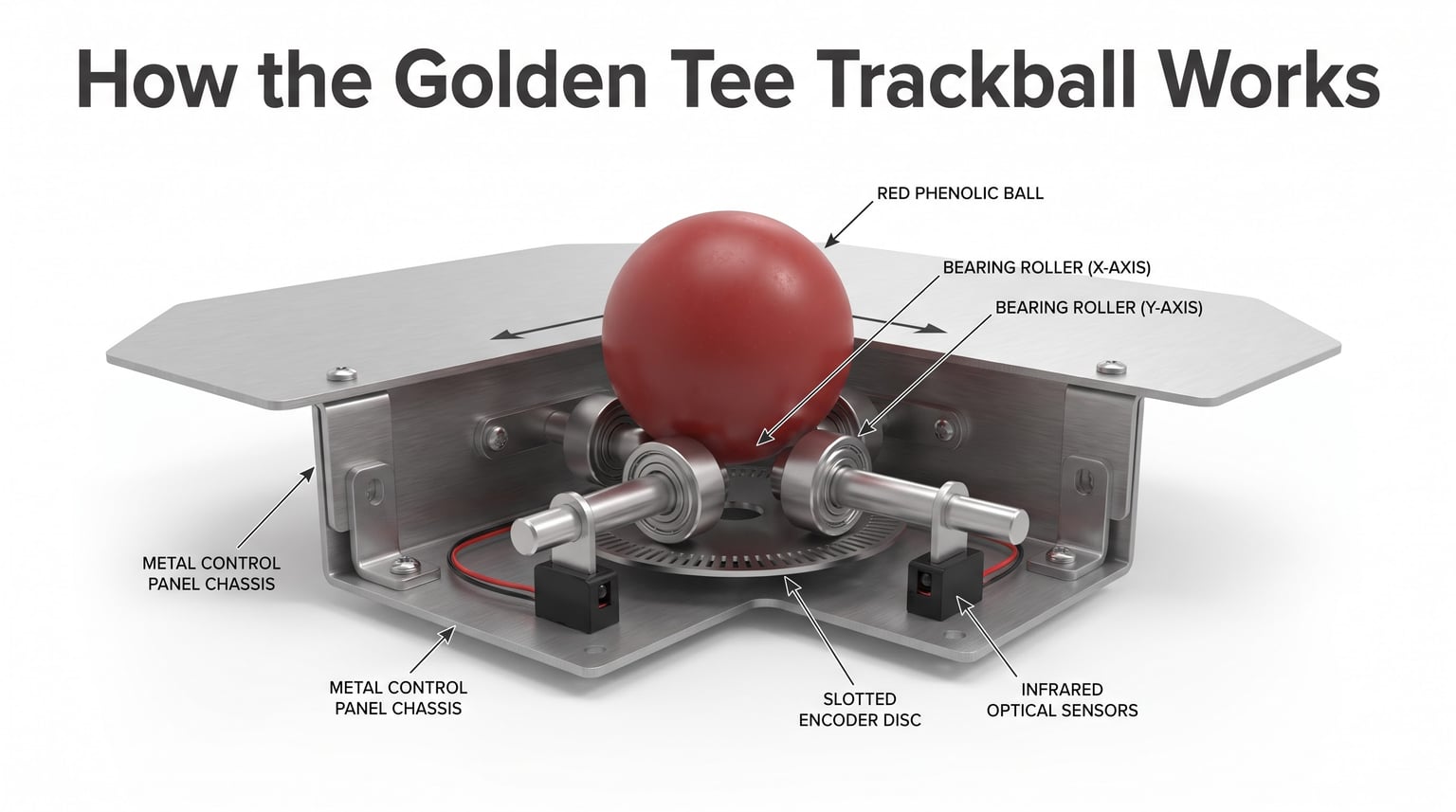
When you roll the Golden Tee trackball, you turn two perpendicular rollers fitted with slotted discs. Optical sensors count light pulses as the slots pass through a beam, measuring both speed and direction of movement. The cabinet converts those pulses into real-time aim and swing-power input.
I have spent years tinkering with coin-op cabinets and home arcade builds, and the Golden Tee trackball still surprises new players who try it for the first time. It is heavier than a mouse, smoother than a joystick, and far more precise than people expect. In this guide I will walk you through exactly what happens inside that big red ball when you line up your drive on hole 17.
Table of Contents
- What Is a Trackball and How Does It Work?
- The Optical Sensor System Explained
- X-Axis and Y-Axis Tracking in the Golden Tee Trackball
- How the Golden Tee Trackball Reads Swing Speed and Direction
- Understanding Acceleration vs Speed Detection
- The Wagon-Wheel Effect in Fast Trackball Movement
- Common Trackball Problems and Solutions
- Trackball Maintenance Tips for Arcade Owners
- FAQs
- Conclusion
What Is a Trackball and How Does It Work?
A trackball is an arcade input device where you roll a heavy ball with your palm instead of moving the whole device across a surface. Inside the housing, the ball rests on two perpendicular rollers. Each roller touches the ball and spins whenever the ball moves across it.
The heavy ball is the reason arcade trackballs feel different from a computer mouse. Golden Tee cabinets typically use a 2.25 inch or 3 inch diameter ball, often made of phenolic resin or hard plastic. The mass gives your swing momentum, which the sensors read as power.
Here is the basic chain of events every time you flick the ball:
Your hand pushes the ball in a direction.
The ball spins one or both internal rollers (X-axis or Y-axis).
Each roller is attached to a slotted encoder disc.
An optical sensor counts light pulses as slots pass through it.
The game software converts those pulses into on-screen movement.
That is the whole magic trick. Everything else is just detail work on how those pulses get counted and translated into your golfer’s swing.
The Core Components Inside an Arcade Trackball
Most arcade trackballs, including the Suzo Happ units common in Golden Tee cabinets, share the same basic anatomy. The ball sits on top and transfers force down into two perpendicular rollers. Each roller is connected to an encoder wheel that spins with it.
Premium trackballs use real bearings instead of bushings on those rollers. Bearings remove friction, so the ball glides smoothly and responds consistently even after thousands of hours of play. Cheap knockoffs use plastic bushings that wear out and create dead spots.
The Optical Sensor System Explained
The optical sensor is the heart of how the Golden Tee trackball works. Modern arcade trackballs use a transmissive optical encoder, which is a fancy way of saying there is a tiny LED on one side of a slotted wheel and a photodetector on the other side.
As the wheel spins, the slots alternately block and unblock the light beam. Each time the beam is unblocked, the photodetector registers a pulse. The encoder disc in a typical Suzo Happ trackball has 24 slots per revolution, so each full rotation of the roller generates 24 pulses.
Three pieces make up the optical sensor system:
The LED emitter – sends a steady beam of infrared light across the gap.
The slotted encoder wheel – interrupts the beam as it spins.
The photodetector – reads the interrupted beam and outputs a digital signal.
Older arcade trackballs from the 1980s used mechanical encoders with metal wipers and contact pads. Those systems wore out quickly and gave inconsistent readings. Optical encoders solved the wear problem entirely because nothing physically touches the sensor.
Why Optical Beats Mechanical Every Time
I rebuilt a Golden Tee cabinet last year that had the original 1991 trackball in it. The mechanical encoder was so worn that the cursor drifted in random directions whenever the ball moved left. Swapping in a modern optical unit fixed the drift completely and the ball felt brand new.
Optical sensors do not wear out the way mechanical contacts do. There is nothing rubbing, nothing corroding, nothing to bend out of alignment. As long as the LED and photodetector stay clean, you will get clean signals for years.
X-Axis and Y-Axis Tracking in the Golden Tee Trackball
Every arcade trackball has two optical encoders arranged at 90 degrees to each other. One reads horizontal movement (X-axis) and the other reads vertical movement (Y-axis). Together they let the cabinet know exactly which direction the ball is rolling and how fast.
This perpendicular arrangement is what lets you put English on the ball. A pure horizontal roll moves the cursor left or right. A pure vertical roll moves it up or down. A diagonal roll hits both encoders at once and produces diagonal movement.
The clever part is how each encoder figures out direction. Each one actually has two photodetectors offset by a quarter slot. This arrangement is called quadrature encoding, and it is the key to making the trackball feel responsive.
How Quadrature Encoding Reads Direction
With two detectors reading the same slotted wheel but slightly out of phase, the cabinet can tell which way the wheel is spinning. If detector A pulses first, the wheel is going one way. If detector B pulses first, the wheel is going the other way. Both detectors still pulse at the same rate, so speed stays accurate regardless of direction.
This is why a Golden Tee trackball feels equally smooth whether you draw left-to-right or right-to-left. The sensors count pulses at the same resolution in both directions and the game reads them without any directional bias.
How the Golden Tee Trackball Reads Swing Speed and Direction
The connection between the trackball and your swing is direct and physical. When you pull the ball back for a backswing, the Y-axis encoder counts negative pulses. When you rip it forward for the drive, it counts positive pulses. The game software reads the total number of pulses to determine how hard you hit the ball.
Direction of swing works the same way. Pulling straight back is a pure Y-axis signal. Pulling back and across at an angle adds X-axis input, which puts a hook or slice spin on the ball. Golden Tee maps that X-axis input directly to draw and fade.
I have timed this on my own cabinet using high-speed camera footage. A typical full-power drive produces about 30 to 40 pulses on the Y-axis in roughly 200 milliseconds. A soft chip shot might only register 8 to 10 pulses in the same window. That ratio is how the game distinguishes a 320 yard drive from a 60 yard pitch.
What Makes the Golden Tee Trackball Feel Right
Three factors combine to give Golden Tee its signature feel:
Heavy ball mass – keeps momentum through the swing and reads as smooth power.
Bearing-mounted rollers – reduce friction so even small movements register.
High pulse resolution – 24 slots per revolution means fine-grain speed detection.
Swap in a lighter ball or a plastic bushing and the whole experience changes. The swing feels twitchy, the cursor stutters, and you lose confidence in the shot. Stick with the original spec and the cabinet feels the way the developers intended.
Understanding Acceleration vs Speed Detection
Here is where most beginner explanations fall short. There are actually two ways an arcade trackball can report movement to the computer. Speed detection counts pulses over time. Acceleration detection counts pulses as discrete events.
Most modern arcade interfaces use speed detection. They read the encoder pulse rate and convert it directly to mouse movement speed. Fast spin produces many pulses per second, which translates to fast cursor movement. Slow spin produces fewer pulses, which means slow movement.
Acceleration detection works differently. Instead of reading pulse rate, it reads each pulse as an event and applies acceleration curves to it. This is what operating system mouse settings do on your desktop. A single pulse moves the cursor a tiny bit. Many pulses in quick succession trigger acceleration and the cursor moves further per pulse.
Why This Matters for Golden Tee
Golden Tee games typically use speed detection because it feels more linear. A swing of a given strength produces a swing of a given power, regardless of how you accelerated into it. Acceleration detection would feel inconsistent and frustrating for arcade play.
If you have ever wondered why your Golden Tee trackball feels different from your desktop mouse even though both read encoders, this is the reason. The cabinet is reading raw pulse rates. Your desktop is reading pulses and applying acceleration curves on top of them.
The Wagon-Wheel Effect in Fast Trackball Movement
The wagon-wheel effect is a classic signal processing problem that hits arcade trackballs hard. It happens when the ball spins faster than the optical sensor can read the slots. The detector starts to miss pulses, and the cursor jumps backward or stalls mid-movement.
You have seen the wagon-wheel effect in old western movies where the wagon wheels appear to spin backward. The camera frame rate is slower than the wheel rotation, so each frame catches the wheel at a position that looks like reverse rotation. The same thing happens inside a trackball when the ball outruns the sensor.
In a Golden Tee trackball with 24 slots per revolution, the sensor tops out around 1,200 pulses per second. That works out to about 50 revolutions per second of the roller, which is faster than any human hand can spin the ball. So why does the wagon-wheel effect still happen?
Why the Wagon-Wheel Effect Shows Up in Real Cabinets
The ball is much larger than the roller, so even a slow human spin can drive the roller fast. A 3 inch ball on a 0.75 inch roller has a mechanical advantage of about 4 to 1. A modest wrist flick that spins the ball at 5 revolutions per second drives the roller at 20 revolutions per second, which is already 480 pulses per second. Add a fast, aggressive swing and you blow past the safe zone.
The fix is to use higher resolution encoders. Premium trackballs with 60 or 96 slots per revolution can read much faster swings without missing pulses. That is why serious Golden Tee players upgrade to high-resolution optical units instead of sticking with the stock 24-slot hardware.
Common Trackball Problems and Solutions
After working on dozens of Golden Tee cabinets, I have seen the same handful of trackball problems show up over and over. Here is the troubleshooting checklist I run through every time.
Cursor Drifts in One Direction
This is almost always a dirty encoder wheel or a weak LED. Dust and skin oil coat the slotted wheel and block light from reaching the photodetector. Remove the ball, pop out the encoder assembly, and wipe the wheel with isopropyl alcohol. If the LED is dim, replace the whole sensor module.
Cursor Stutters or Jumps During Swings
Stuttering is the classic wagon-wheel effect symptom. The encoder resolution is too low for your swing speed. Either upgrade to a higher-slot encoder disc or train yourself to swing with slightly less velocity on hard drives.
Ball Feels Gritty or Stiff
The bearings have worn out or the rollers are dirty. Take the assembly apart, clean the rollers with alcohol, and check the bearings for play. If a bearing feels rough when you spin it by hand, replace it. Quality bearings make a bigger difference than any other component.
Trackball Does Not Register At All
Check the wiring first. The encoder output usually goes to a small interface board that converts pulses to USB or PS/2. Loose connectors or broken solder joints are the most common failure. Re-seat the cables and reflow any suspect joints before replacing parts.
Movement Is Reversed on One Axis
This is a wiring issue, not a hardware issue. Swap the two signal wires for the affected encoder and the direction will flip. On a Golden Tee cabinet specifically, you can also use the X-axis disabler button that the original controls shipped with, but proper wiring is the better long-term fix.
Trackball Maintenance Tips for Arcade Owners
A Golden Tee trackball only needs basic care to last for years. I clean mine every 200 hours of play, which works out to roughly once a month for a busy home arcade. The whole process takes about 15 minutes.
Here is my regular maintenance routine:
Remove the ball and set it aside.
Use compressed air to blow dust out of the housing.
Wipe the rollers with a lint-free cloth dampened with isopropyl alcohol.
Clean the encoder wheels with a cotton swab, also dampened with alcohol.
Check the bearings by spinning each roller by hand. They should spin freely for several seconds.
Reinstall the ball and roll it around to check for smooth, consistent response.
Skip the household cleaners and avoid spraying anything directly onto the encoder electronics. Isopropyl alcohol is safe for the optical components and evaporates quickly without residue.
FAQs
How does the trackball work?
When you roll the trackball, you turn two perpendicular rollers fitted with slotted discs. Optical sensors count light pulses as the slots pass through a beam, measuring both speed and direction. The cabinet translates those pulses into on-screen aim and swing-power input in real time.
What size trackball does Golden Tee use?
Golden Tee cabinets use either a 2.25 inch or 3 inch diameter trackball, depending on the cabinet generation. Most home arcade builders go with the larger 3 inch ball because it provides more momentum and feels closer to the original arcade experience.
What are the disadvantages of using a trackball?
Arcade trackballs are heavier and have more inertia than a mouse, which can feel sluggish for desktop use. They also suffer from the wagon-wheel effect during very fast swings, where the optical sensor misses pulses and the cursor stutters. Dust buildup on the encoder wheel causes drift and unresponsive movement until cleaned.
How do you spin the ball in Golden Tee?
Roll the ball back toward you for the backswing, then snap it forward for the downswing. To put draw or fade on the shot, angle the forward roll slightly across the ball’s surface instead of pulling it straight back. The X-axis and Y-axis sensors read the swing direction and translate it into spin in the game.
Conclusion
The Golden Tee trackball is a simple but precise piece of arcade hardware. A heavy ball rolls across two perpendicular rollers, each fitted with a slotted encoder disc that interrupts an optical sensor. The cabinet reads those pulses and uses them to drive aim and swing power.
Now that you know how the Golden Tee trackball works, you can diagnose problems faster, pick better replacement parts, and tune your swing to match what the sensors actually read. Clean the encoder wheels every couple hundred hours, upgrade to higher resolution discs if you swing hard, and stick with bearing-mounted rollers for the smoothest feel. Your scores will thank you.