
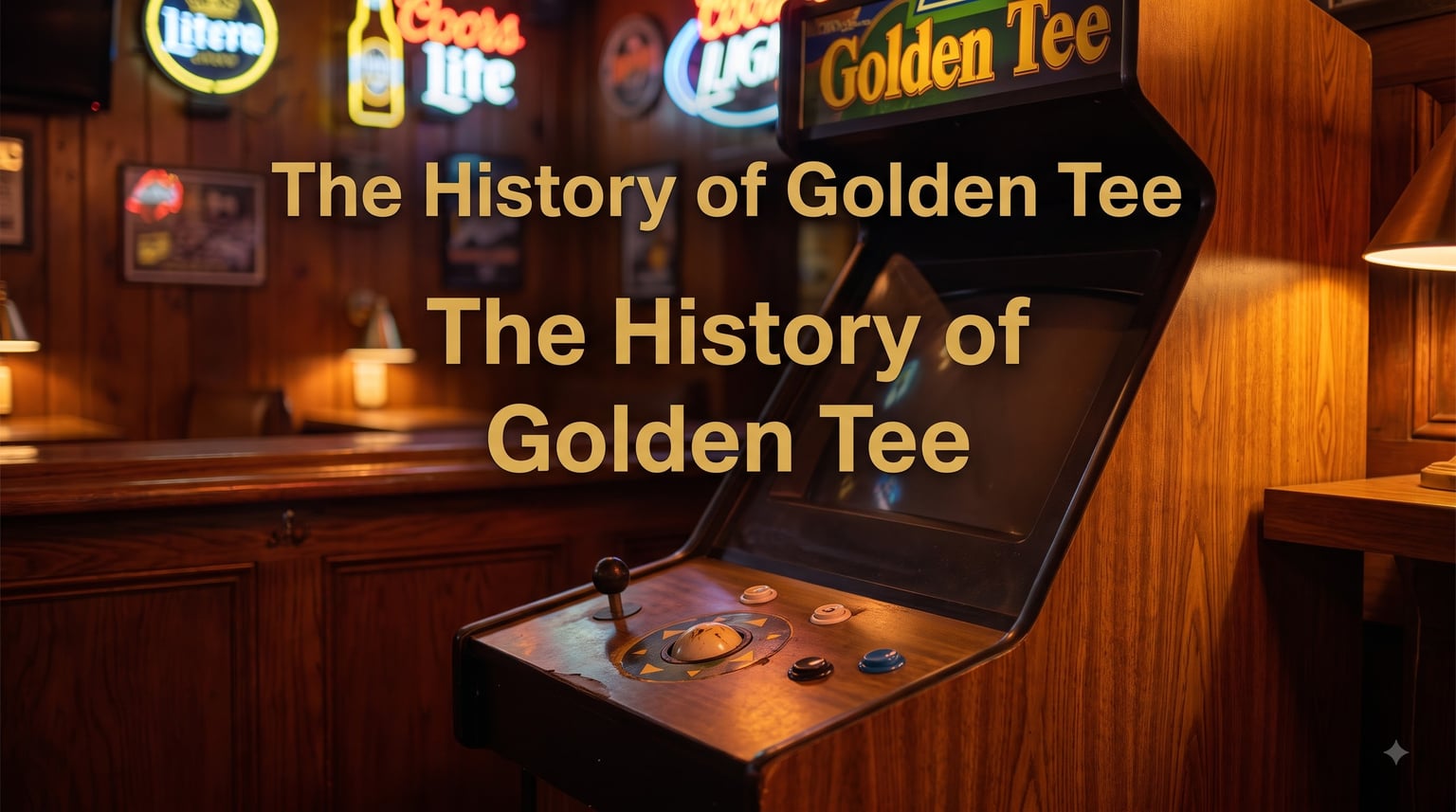
I have spent more late nights than I care to admit standing in front of a Golden Tee cabinet, chasing that perfect 30-foot slider that bends back toward the pin. When I dug into the history of Golden Tee for this guide, I found a story far bigger than a bar game. It is the story of a husband-and-wife team betting their last dollars on a wild idea, a trackball borrowed from a bowling game, and a community of devoted players who turned a coin-op box into a cultural icon.
Golden Tee Golf first appeared in 1989, created by Larry Hodgson and Jim Zielinski at Incredible Technologies in Arlington Heights, Illinois. The trackball-driven arcade golf game changed how players related to coin-operated games, and over the past 35+ years it has become one of the highest-grossing arcade titles in history. This guide walks through every major milestone, from the original failed golf simulator to the 2021 PGA TOUR partnership and the modern 4K cabinets shipping in 2026.
Table of Contents
- The History of Golden Tee: Origins and Founders
- The 1989 Creation Story: From Failed Simulator to Bar Hit
- Why Golden Tee Uses a Trackball Instead of a Joystick
- Golden Tee 3D Breakthrough and the 1995 Online Tournament
- Yearly Releases: The Complete Evolution Timeline (1989-2026)
- Cultural Impact: Bar Culture, Bangers, and TV Cameos
- The Competitive Scene: Tournaments and Prize Money
- The PGA TOUR Partnership and the Future of Golden Tee
- FAQs
- Conclusion: Why Golden Tee’s History Still Matters
The History of Golden Tee: Origins and Founders
The history of Golden Tee starts not in a game studio but in a living room with two people willing to risk everything. Incredible Technologies was founded in 1985 by Elaine Hodgson and her husband Richard Ditton in Arlington Heights, Illinois. They had no game industry pedigree, just a belief that personal computers could become entertainment machines. They originally named the company Free Radical Software, and the first products were utility software and simple games sold by mail order.
What makes their origin story stand out from other arcade legends is how close the company came to folding. After burning through their savings, Elaine and Richard made a final decision: invest their last $1,000 into one ambitious hardware project. That bet became the seed of the eventual arcade empire. They later renamed the company Incredible Technologies, a tongue-in-cheek nod to the fact that they were building their products on the brand-new Intel 80386 chip, which at the time felt nearly impossible to program.
The team that would design Golden Tee came together inside that small Illinois office. Larry Hodgson, a programmer, and Jim Zielinski, an artist, were early hires who shared a love of both golf and classic arcade games. Together, the three founders would spend the next several years chasing a single stubborn idea: making a golf game that felt as good to play as real golf felt to swing.
The 1989 Creation Story: From Failed Simulator to Bar Hit
The original Golden Tee concept was nothing like the game players know today. Hodgson and Zielinski first set out to build a large-scale golf simulator, the kind of multi-screen installation you might find at a trade show or a high-end golf club. They wanted to render full golf courses in 3D and let players swing a real club at a real ball. The technical scope was enormous and the timeline kept slipping. After two years of work, the team realized they were building something they could never afford to ship and never realistically place in bars.
That is when the pivot happened. One of the team’s developers had been working on a separate project involving a Capcom Bowling cabinet, which used a trackball instead of a joystick. The moment Hodgson grabbed the trackball and rolled it to simulate a putting stroke, he knew they had found the answer. A trackball translated the natural hand motion of a real golf swing directly into on-screen action. There was no analog stick or button to memorize, just the ball and your fingers.
Jim Zielinski built the original course artwork in Deluxe Paint on an Amiga computer, painting fairways, greens, and trees pixel by pixel. The game’s signature top-down 2D look came from those late-night Deluxe Paint sessions. The team wired a trackball into a standard arcade cabinet, plugged in a small monitor, and carried the prototype to a local bar to test it on real drinkers. The reaction was immediate. Players who had never touched a video golf game were lining up their second and third quarters within minutes.
That single bar play-test convinced the founders they had a hit. Incredible Technologies scrapped the golf simulator project entirely and rebuilt the game around the trackball control scheme. Golden Tee shipped as an arcade kit in 1989, and within months it was appearing in bars, taverns, and family entertainment centers across the United States.
Why Golden Tee Uses a Trackball Instead of a Joystick
The trackball is the single most important decision in the history of Golden Tee. Every other golf arcade game of that era used a three-button click system or a joystick, and almost all of them felt stiff and unrewarding. The trackball changed that because it made force, not timing, the central skill. The harder you rolled the ball, the harder your golfer swung. The faster you flicked your wrist on a putt, the softer the putt came off the club face. The trackball turned the cabinet into an extension of the player’s hand.
The design team credits Capcom Bowling with the inspiration, but they extended the idea into a philosophy they later called true touch control. Every other arcade golf game asked players to press the right button at the right moment. Golden Tee asked them to roll a ball the way they would swing a club. That physical translation is what made the game feel alive in 1989, and it is the reason the same control scheme still feels right in 2026.
There was also a practical reason. Bars wanted games that did not require a long learning curve. A joystick-based golf game frustrated first-time players and lost money. A trackball-based game rewarded anybody willing to grab the ball and try. The control scheme was a business decision as much as a design decision, and it is one of the clearest examples of hardware choice shaping an entire genre.
Golden Tee 3D Breakthrough and the 1995 Online Tournament
For its first six years, Golden Tee lived in a 2D world. The courses were beautiful Deluxe Paint creations, but they were still flat top-down views. In 1995, Incredible Technologies released Golden Tee 3D, and the series jumped from a clever top-down game into a true three-dimensional golf experience. Players could finally see hills, trees, and water hazards rendered with depth, and the game started to feel less like an arcade curiosity and more like a real sport.
The bigger breakthrough that year had nothing to do with graphics. The 1995 release was the first Golden Tee cabinet to ship with a built-in modem, and it was the first coin-op golf game to support real online tournaments. The team chose a Chicago bar as the test location and ran a live multi-cabinet tournament over dial-up phone lines. Players in different bars across the city could compete on the same course at the same time, and scores were posted on a national leaderboard.
The modem connection also enabled something that would define Golden Tee for the next three decades: the always-connected cabinet. Instead of treating tournaments as a side feature, the game assumed the cabinet was always online. New courses, new contests, and new software updates could be pushed out to thousands of machines without anyone touching them. That architecture is still the backbone of the modern Golden Tee network.
This was a radical idea in 1995. Most arcade games were sold as finished boxes and rarely updated. Golden Tee turned every cabinet into a node in a national network, which meant the game could keep evolving year after year. The dial-up modems gave way to broadband, then to always-on cellular connections, but the philosophy never changed.
Yearly Releases: The Complete Evolution Timeline (1989-2026)
One of the most unique things about Golden Tee is its yearly release cadence. While most arcade games stayed frozen in time once they hit a profit plateau, Golden Tee shipped a new version every single year starting in 1989. Each release brought new courses, new game modes, and new technical improvements. The following timeline covers every major era of the franchise.
2D Era (1989-1994)
The original Golden Tee shipped in 1989, followed by Golden Tee II in 1990. Both used Deluxe Paint-rendered 2D courses and the original trackball control scheme. These early releases established the bar arcade identity and proved there was an audience for video golf. By 1992 the game had become a regular sight in taverns and bowling alleys across the Midwest.
3D Era (1995-2004)
Golden Tee 3D launched in 1995 and changed everything. The 1996 release introduced Super Home Run Derby-style mini games. By 1998, Golden Tee ’99 added licensed commentary and began hinting at the franchise’s love of personality. Throughout this era the modem-based online tournament system matured into the foundation of the National Golden Tee Tour, with stops in multiple cities and growing prize purses.
Online Live Era (2005-2014)
The mid-2000s saw Golden Tee move to its always-on broadband architecture and introduced course designer features that let players build their own holes. Versions like Golden Tee LIVE in 2005 and Golden Tee 2006-2009 expanded the online ecosystem. The 2010 release introduced HD graphics, and the franchise kept layering new modes on top of the live network. Players could now track lifetime stats, compete in season-long contests, and earn collectible rewards.
Modern Era (2015-2026)
Starting with the 2015 release, Golden Tee moved to 4K resolution monitors and NFC-based player cards that stored lifetime profiles. The 2021 version added the landmark PGA TOUR partnership, officially branding the game as PGA TOUR Golden Tee LIVE. The 2025 and 2026 releases introduced TOUR Mode, a randomized course selector, and continued support for the online tournament ecosystem that now spans more than 100,000 connected cabinets worldwide.
| Year | Era | Major Innovation |
|---|---|---|
| 1989 | 2D | Original Golden Tee, trackball controls |
| 1995 | 3D | First 3D release, dial-up online tournaments |
| 2005 | Online | Always-on broadband architecture |
| 2010 | HD | HD graphics, expanded stat tracking |
| 2015 | Modern | 4K monitors, NFC player cards |
| 2021 | PGA TOUR | PGA TOUR Golden Tee LIVE partnership |
| 2026 | Modern | TOUR Mode, course randomizer, 4K live network |
Cultural Impact: Bar Culture, Bangers, and TV Cameos
Golden Tee is more than a game. It is a piece of bar furniture. In thousands of taverns across the United States, the cabinet sits in a corner next to the pool table and the jukebox, and it generates more revenue per square foot than almost anything else in the room. Operators know that a single Golden Tee machine in the right bar will pay for itself faster than any other piece of equipment on the floor.
Around that cabinet grew an entire subculture that players call bangers. A banger is a serious Golden Tee player, the kind of person who knows every break angle on every course and can drop a 30-footer with a flick of the wrist. Bangers travel to other bars to take on local legends. They swap profile cards and argue over which course design philosophy is best. Online communities on Reddit, Discord, and dedicated Golden Tee forums are full of bangers who have spent decades chasing the perfect round.
The cultural footprint extends well beyond the bars. Golden Tee has appeared on Saturday Night Live, Parks and Recreation, and Family Guy. There is even an apocryphal story that the game was once spotted aboard the USS John C. Stennis aircraft carrier, deployed as a morale boost for sailors on long tours. Whether that specific story is true or not, the fact that it circulates tells you everything you need to know about how deeply the game has embedded itself in American pop culture.
The Competitive Scene: Tournaments and Prize Money
The competitive scene around Golden Tee is one of the oldest and most established in coin-op gaming. The National Golden Tee Tour has been running for more than two decades, with six stops a year at bars and entertainment centers around the country. Top players qualify for the World Championship, where the top prize has reached $35,000 in recent years.
Notable champions include Ryan Bourgeois and Paul Tayloe, both of whom are multi-time World Championship winners and legendary figures in the banger community. Local tournaments at individual bars often run weekly or monthly, with prize pools funded by the entry fees. Bar operators love these events because a single Golden Tee tournament can drive $250,000 or more in annual food and beverage sales at a busy location.
Players qualify for the World Championship through the live network built into every modern cabinet. Insert your player card, play qualifying rounds at your local bar, and your scores are automatically uploaded to the national leaderboard. If you finish in the top tier at the end of the season, you earn a seat at the championship table. This is competitive gaming without a console, played on the same cabinets you see every night in your local pub.
The PGA TOUR Partnership and the Future of Golden Tee
In 2021, Incredible Technologies announced a landmark partnership with the PGA TOUR, officially rebranding the game as PGA TOUR Golden Tee LIVE. The deal was the first time a major professional sports league had attached its name to a coin-operated video game, and it signaled a serious vote of confidence in both the game and the bar arcade format.
The partnership brought real PGA TOUR branding to the game, along with new officially licensed courses and tournament modes tied to actual PGA TOUR events. Players can now compete in virtual recreations of famous TOUR stops and earn rewards inspired by real professional golf. The integration has helped Golden Tee reach a new audience of casual golf fans who never set foot in an arcade.
Looking forward, the 2026 release introduces TOUR Mode, which simulates a multi-round professional tournament, and a course randomizer that selects holes from across the entire library. The 2023 induction of Incredible Technologies into the Amusement Industry Hall of Fame marked an official recognition of the company’s role in arcade history. After 35+ years and counting, Golden Tee keeps finding new ways to stay fresh without losing the trackball soul that made it a hit in the first place.
FAQs
Where was Golden Tee invented?
Golden Tee was invented in Arlington Heights, Illinois, at the headquarters of Incredible Technologies, a small coin-op company founded by Elaine Hodgson and Richard Ditton. The original prototype was tested at a local Chicago-area bar before the first commercial release in 1989.
Who invented Golden Tee Golf?
Golden Tee Golf was invented by programmer Larry Hodgson and artist Jim Zielinski, who worked under the Incredible Technologies banner founded by Elaine Hodgson and Richard Ditton. Hodgson designed the trackball-based control system, and Zielinski painted the original 2D courses in Deluxe Paint.
Why is Golden Tee so popular?
Golden Tee is popular because the trackball control scheme lets players translate hand motion directly into swing power, making the game instantly intuitive and endlessly skillful. Its placement in tens of thousands of bars across the United States also makes it one of the most accessible competitive arcade games in history.
How many versions of Golden Tee are there?
There have been more than 35 yearly versions of Golden Tee since 1989, including 2D releases in the early 1990s, 3D releases starting in 1995, HD versions from 2010 onward, and modern 4K releases through 2026 featuring the PGA TOUR partnership.
What makes Golden Tee so addictive?
Golden Tee is addictive because the trackball rewards both casual players and dedicated bangers with the same controls, while yearly course releases and always-connected tournaments give players new challenges every season. The social bar environment also turns every game into a chance to compete for bragging rights.
Can you make money playing Golden Tee?
Yes, top Golden Tee players can make money through the National Golden Tee Tour and the annual World Championship, which has offered top prizes of $35,000 in recent years. Hundreds of smaller bar tournaments across the country also pay out cash, prizes, and bar tabs to local winners.
Who owns Golden Tee Golf today?
Golden Tee Golf is still owned and operated by Incredible Technologies, the same company founded by Elaine Hodgson and Richard Ditton in 1985. The studio continues to release yearly versions of the game and operates the live network that connects more than 100,000 cabinets worldwide.
Conclusion: Why Golden Tee’s History Still Matters
The history of Golden Tee is the history of an arcade game that refused to sit still. From the original 1989 trackball prototype tested in a single Chicago bar, to the 1995 online tournament revolution, to the 2021 PGA TOUR partnership, the franchise has kept finding new ways to grow without losing the simple joy of rolling a ball and watching a little golfer swing. The yearly release cadence, the always-connected cabinet network, and the deep banger community are all part of the same stubborn bet that Elaine Hodgson and Richard Ditton made with their last $1,000.
For players, that history matters because it explains why the game feels different from anything else in the arcade. The trackball is not a gimmick, the courses are not filler, and the tournament scene is not a marketing add-on. Every piece of Golden Tee in 2026 traces back to a small team in Arlington Heights that believed an arcade golf game could be the real thing. They were right, and 35+ years later, the cabinets are still pulling quarters.
If you have never played a serious round on a real Golden Tee cabinet, find the closest bar that still has one and drop a few quarters. Roll the trackball slowly. Aim for the back of the pin. When you finally drain that first 25-foot slider, you will understand why this game has survived for more than three decades and why its history still matters to anyone who loves arcades, golf, or both.