
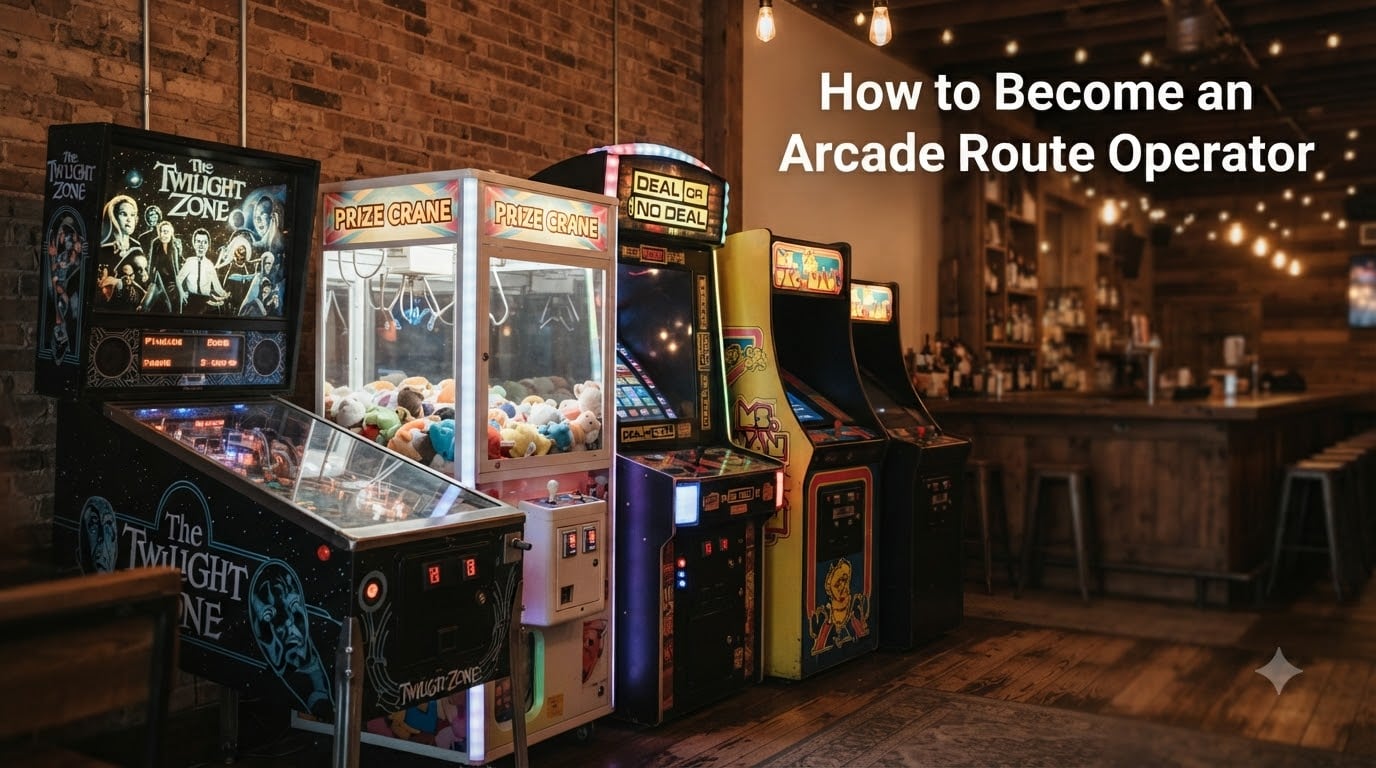
If you have ever walked into a bar, laundromat, or bowling alley and noticed a row of arcade games, claw machines, or a Golden Tee cabinet in the corner, you were looking at the work of an arcade route operator. Learning how to become an arcade route operator means building a coin-operated business where you own the machines, place them in third-party venues, and split the revenue with each location.
It is one of the few businesses where you can start small, often with just one or two machines, and scale gradually as your revenue grows. The barrier to entry is lower than opening a full arcade or family entertainment center, but the earning potential is real. Operators on forums like Reddit’s r/arcade report earning anywhere from $20 to $60 per week per machine in steady locations.
In this guide, I will walk you through every step of the process. I will cover licensing requirements, equipment costs, finding locations, negotiating revenue splits, day-to-day operations, and the honest challenges that nobody else talks about. Whether you want to supplement your existing income or build a full-time route with dozens of machines, this guide gives you the concrete numbers and actionable steps to get started.
By the end, you will have a clear roadmap for how to become an arcade route operator in 2026, including a startup checklist you can follow from day one.
Table of Contents
- What Is an Arcade Route Operator?
- How the Revenue-Share Model Works
- How to Become an Arcade Route Operator: Step-by-Step
- Licensing and Legal Requirements by State
- Equipment Types and Costs
- Best Venues for Machine Placement
- Day-to-Day Operations and Technology
- Common Challenges and How to Overcome Them
- How Much Can You Actually Earn?
- Frequently Asked Questions
- Conclusion: Is the Arcade Route Business Right for You?
What Is an Arcade Route Operator?
An arcade route operator is an independent business owner who purchases coin-operated or card-operated amusement machines, places them in venues they do not own, and shares the revenue with each location. The operator owns the equipment, handles installation, performs maintenance, collects money, and rotates games when performance drops. The venue provides the floor space, electricity, and foot traffic.
This model is sometimes called street operating, coin-op routing, or simply being a street operator. The term “route” refers to the fact that the operator drives a regular route between multiple locations to service and collect from machines. A single operator might manage machines across bars, restaurants, laundromats, truck stops, and movie theaters, all in one weekly or biweekly loop.
The key difference between a route operator and an arcade owner is location ownership. An arcade owner leases or buys a building and fills it with games, paying rent and utilities. A route operator places machines in other people’s businesses with zero real estate overhead. This makes route operating a lower-risk entry point into the coin-op amusement industry.
Route operators are part of a broader ecosystem that includes distributors who sell equipment, manufacturers who build games, and cashless system providers who supply card reader technology. You do not need to be an expert in all of these areas to start, but understanding how they fit together will help you make smarter purchasing and operational decisions.
How the Revenue-Share Model Works
The standard revenue split in the arcade route business is 50/50. The operator collects the gross revenue from each machine and gives the venue half. Some operators pay a flat monthly rent instead of a percentage, but the revenue-share model is far more common because it aligns incentives. If the machine earns more, both parties benefit.
Here is how the math works in practice. Say you place a claw machine in a family restaurant and it earns $80 in a week. You collect the money, count it, and pay the venue $40. Your gross is $40 for that machine that week. Now subtract your costs: electricity reimbursement (often included free by the venue), maintenance supplies, prize inventory for the claw machine, and fuel for your collection route. After expenses, you might net $25 to $30 per week from that single machine.
The actual earnings per machine vary widely based on three factors: location foot traffic, game type, and game condition. Here is what real operators report on forums and in community discussions:
- Video arcade games in bars: $30 to $80 per week gross
- Claw machines in restaurants and laundromats: $40 to $120 per week gross
- Redemption games in family entertainment centers: $50 to $200 per week gross
- Pinball machines in breweries and barcades: $25 to $60 per week gross
- Jukeboxes and digital jukeboxes in bars: $30 to $70 per week gross
These are gross figures before the 50/50 split. Your half would be roughly half of each number. The margin per machine is modest, which is why route operators scale by adding more locations rather than squeezing more out of one machine.
The split is also negotiable. Some venues with lower foot traffic might accept 60/40 in your favor. Premium locations with high traffic, like busy bowling alleys or popular bars, might demand 40/60 in their favor. The most important thing is that the arrangement is documented in writing and both parties understand the terms before installation.
How to Become an Arcade Route Operator: Step-by-Step
Learning how to become an arcade route operator is best approached as a sequence of clear, sequential steps. I have built this checklist based on what successful operators share in forums and what the top competitor guides recommend. Follow these in order.
Step 1: Research Your Local Market
Before you spend a single dollar on equipment, research the coin-op landscape in your area. Drive around and note which venues already have machines and which ones have open space. Pay attention to the types of games you see. If every bar in town already has a Golden Tee, that market may be saturated. If laundromats in your area have empty corners with no machines, that is an opportunity.
Talk to venue owners and managers casually. Ask whether they would be open to having arcade games on-site. You will quickly learn which venue types in your area are receptive. This informal market research costs nothing and saves you from buying equipment before you know where it will go.
Step 2: Register Your Business and Get Licensed
Operating coin-operated amusement machines is a regulated activity in most states. You need to register as a business first, typically as an LLC to protect your personal assets. Then you need to apply for the appropriate amusements license or coin-operated device permit in your state and locality.
Some states require a state-level operator license. Others regulate at the city or county level. Florida, Illinois, California, Texas, and New York all have distinct requirements, which I cover in detail in the licensing section below. Budget both time and money for this step, as processing can take several weeks.
Step 3: Secure Insurance
You need liability insurance before placing machines in any venue. If a machine malfunctions and someone gets injured, or if a claw machine tips over, you are the owner and you are liable. Most venues will require proof of insurance before they let you install anything.
A general liability policy for a small vending or amusement route typically runs $500 to $1,200 per year depending on your coverage limits and the number of machines. Some operators also carry inland marine insurance to cover the machines themselves against theft and damage.
Step 4: Buy Your First Machines
Start small. Most experienced operators recommend beginning with one to three machines. New arcade games cost $9,000 to $20,000 or more each, but you do not need to buy new. Used equipment from route operators who are retiring or upgrading is widely available at a fraction of the cost.
For your first machine, consider a proven earner. Claw machines, for example, are relatively affordable used, have low maintenance requirements, and generate consistent revenue in the right venues. Redemption games like keymaster or stacked prize games also perform well. Avoid obscure or unproven titles until you have cash flow from reliable machines.
Step 5: Find and Pitch Locations
Walk into venues with a simple pitch. You provide the machine, the maintenance, and the prize inventory at no cost to them. They provide the space and an electrical outlet. You split revenue 50/50, and they get a new attraction that keeps customers entertained and encourages longer visits.
The best locations for first-time operators are those with steady foot traffic and dwell time. Laundromats are a classic starting point because customers sit and wait for 30 to 90 minutes. Pizza restaurants, diners, and ice cream shops are also receptive because families with children tend to stay longer.
Step 6: Negotiate Revenue-Share Agreements
Always put your agreement in writing. A one-page contract should specify the revenue split, the collection schedule, who pays for electricity, how long the agreement lasts, and what happens if either party wants to terminate. Include a clause about machine removal and a notice period of 14 to 30 days.
Keep the terms simple. The standard 50/50 split works for most venues. If a venue is hesitant, offer a 60/40 split in their favor for the first 90 days to prove the machine earns money. Once they see consistent weekly revenue, you can renegotiate.
Step 7: Install, Service, and Scale
After installation, establish a collection and service schedule. Most operators visit each machine every one to two weeks to empty coin boxes, restock prizes, clean the cabinet, and check for mechanical issues. As you add machines and your revenue grows, reinvest in additional equipment and expand your route.
Scaling is gradual. Operators on forums consistently say that most route businesses grow organically, with new machines funded by revenue from existing ones. Some operators eventually expand to 20, 50, or even 100 machines, but that takes years of compounding reinvestment.
Licensing and Legal Requirements by State
This is the area where most existing guides fall short. Every state has different rules for coin-operated amusement machines, and the requirements can also vary by city and county. Here is a state-by-state breakdown of what to expect in the most searched states, based on the related search data for this topic.
Florida
Florida requires an amusement arcade license from the Department of Revenue for operators of coin-operated amusement machines. You must register for a sales tax permit because amusement machine revenue is subject to Florida sales tax. Some counties require an additional local business tax receipt. The state also has specific regulations regarding machines that award prizes, so be sure to understand the distinction between amusement machines and devices that simulate gambling.
Illinois
Illinois distinguishes between redemption machines and video gaming terminals. If you operate standard arcade games, redemption games, or claw machines, you need an amusement device operator license from your local municipality. Illinois also requires a state business registration and a sales tax account. If you plan to operate any device that pays out, be aware that video gaming terminals are regulated separately by the Illinois Gaming Board and require a completely different licensing process.
California
California regulates coin-operated amusement machines at the local level. Cities like Los Angeles and San Francisco require an amusement device permit for each machine placed. You also need a standard business license and a seller’s permit from the California Department of Tax and Fee Administration. Some California cities cap the number of machines allowed per venue, so check local ordinances before pitching locations.
Texas
Texas requires a coin-operated machine certificate from the State Comptroller’s office for each machine you operate. The cost is typically $60 per machine annually. You also need a sales tax permit. Texas has specific rules about machines that award prizes and distinguishes between amusement redemption machines and what it classifies as gambling devices, so know the difference.
New York
New York requires a general business license and may require an amusement device permit depending on your city. New York City has specific rules for amusement devices and requires permits from the Department of Consumer Affairs. You also need to register for state sales tax collection.
General Requirements Across All States
Regardless of where you operate, plan on the following at minimum: a business entity registration (LLC is most common), a federal Employer Identification Number, a state sales tax permit, a local business license, and a coin-operated amusement device permit or operator license. Some states require fingerprinting and background checks for operators. Budget $200 to $1,000 for initial licensing depending on your state and the number of machines.
Always verify current requirements directly with your state’s Department of Revenue or equivalent agency. Regulations change, and this guide is a starting point, not legal advice.
Equipment Types and Costs
Choosing the right equipment is critical to your success. Different game types perform differently depending on venue, and the cost of entry varies widely. Here is a breakdown of the main categories.
Video Arcade Games
Classic video arcade games like Golden Tee, Big Buck Hunter, and racing games are reliable earners in bars and sports venues. New units cost $7,000 to $15,000. Used units in working condition can be found for $1,500 to $5,000. These games appeal to adults and tend to perform best in venues with a social, competitive atmosphere.
Redemption Games
Redemption games like keymaster, stacked ticket games, and coin pushers award tickets or small prizes. They are top performers in family restaurants, movie theaters, and family entertainment centers. New redemption games cost $3,000 to $8,000. Used units run $1,000 to $4,000. These games have higher ongoing costs because you must maintain prize inventory.
Claw Machines
Claw machines are one of the most popular starting points for new route operators. They are affordable, easy to maintain, and visually appealing. A new claw machine costs $2,000 to $5,000. Used units can be found for $500 to $2,000. Prize costs vary based on what you stock, from plush toys to higher-end electronics.
Pinball Machines
Pinball has a dedicated following and performs well in breweries, barcades, and craft beer bars. New Stern pinball machines cost $6,000 to $9,000. Used machines range from $2,500 to $6,000 depending on title and condition. Pinball requires more maintenance than other game types, so factor in service time.
Jukeboxes and Music Systems
Digital jukeboxes like TouchTunes are a common sight in bars and restaurants. These are typically operated through a licensing agreement with the jukebox provider rather than purchased outright. If you buy a used physical jukebox for a route, expect to pay $1,000 to $4,000.
Bulk Vending and Skill Cranes
Some operators supplement their arcade routes with bulk candy machines or small skill cranes in high-traffic retail locations. These are lower-cost entry points at $200 to $800 per unit but also generate lower per-machine revenue.
Best Venues for Machine Placement
The location makes or breaks a machine. A great game in a dead location earns nothing. Here are the venue types that consistently perform well for route operators, ranked roughly by earning potential.
Bars and Pubs
Bars are a natural fit for video arcade games, pinball, and digital jukeboxes. Customers stay for extended periods, enjoy social competition, and are more likely to spend on entertainment after a few drinks. Pool tables, dartboards, and arcade games complement each other. Aim for bars with steady weekday traffic, not just weekend crowds.
Bowling Alleys
Bowling alleys are prime locations because they capture families, league players, and party groups. Arcade games in bowling alleys see consistent year-round traffic. Revenue splits may tilt in the venue’s favor because bowling alleys know the value of their space.
Family Entertainment Centers
FECs are the highest-revenue venues for redemption games. They already attract families and children looking to play. If you can place games in an FEC, expect higher per-machine earnings but also higher revenue-share demands from the venue.
Laundromats
Laundromats are a classic route operator venue. Customers sit and wait for 30 to 90 minutes, and a claw machine or small redemption game gives them something to do. Earnings per machine are modest but consistent. Laundromats are an excellent starting point for new operators.
Truck Stops and Travel Plazas
Truck stops and travel centers capture travelers who stop for food, fuel, and rest. Arcade games and claw machines near the food court or waiting area can generate solid revenue. These locations are often underserved by operators, making them easier to secure.
Movie Theaters
Movie theaters have built-in dwell time. Customers arrive early, wait in lines, and linger after shows. Redemption games and claw machines in theater lobbies can be strong earners. The challenge is that theaters often prefer to manage their own arcades, so your pitch needs to emphasize the value of outsourcing.
Hotel Lobbies and Resorts
Hotels with family traffic can support arcade games in common areas. The audience is transient, so game variety matters more than loyalty. Business hotels are generally poor fits unless they have a bar or restaurant on-site.
Day-to-Day Operations and Technology
Running a route is not passive income, at least not at first. Your weekly routine involves collecting money, maintaining machines, restocking prizes, and managing relationships with venue owners. As your route grows, technology becomes essential for keeping everything organized.
Collection Schedule
Most operators collect every 7 to 14 days. Higher-earning locations may need weekly collection. When you collect, you count the money on-site or bag it for counting at home, record the gross amount, calculate the venue’s share, and pay them. Many operators pay venues by check or cash at the time of collection to maintain trust.
Maintenance and Service Calls
Machines break. Bill acceptors jam, coin mechanisms fail, joysticks stop responding, and screens go dark. You need to respond to service calls within 24 to 48 hours. Venues lose patience quickly if a machine sits broken for a week because a broken machine earns nothing for either party.
Learn basic repair skills. Most common issues, like jammed coin mechs or disconnected wiring, can be fixed in 15 minutes with a screwdriver and a multimeter. For complex repairs, build a relationship with a local arcade technician or distributor who can service boards and monitors.
Cashless Systems and Telemetry
Modern route operators increasingly use cashless payment systems and card reader technology. Systems from providers like Intercard, Embed, and others let customers pay with cards or mobile wallets instead of coins. Operators on forums report that switching to cashless systems increased revenue by 130% to 400% in documented cases, partly because customers spend more when they are not limited by the coins in their pocket.
Telemetry takes this further. With remote monitoring, you can see real-time revenue data from each machine, track collection schedules, and identify problems before a venue calls you. You know exactly when a machine needs a service visit without driving there to check. For operators managing 10 or more machines, telemetry pays for itself quickly.
Game Rotation
Even a proven earner gets stale. Most operators rotate games every 6 to 12 months in a given location. A game that was earning $60 per week may drop to $30 after regulars lose interest. Moving it to a new venue and bringing in a fresh title resets the earning curve. Plan for rotation when you choose equipment that is easy to transport.
Common Challenges and How to Overcome Them
The arcade route business is not without friction. Operators on forums like Reddit and arcade-museum.com are refreshingly honest about what makes this business hard. Here are the most common challenges and how experienced operators deal with them.
Low Margins Per Machine
The reality is that $20 to $60 net per week per machine is modest. You are not going to replace a full-time income with five machines. The solution is scale. A route of 30 machines earning an average of $35 net per week each generates about $4,200 per month. That requires significant upfront investment and time, but it is achievable through gradual reinvestment.
High Equipment Costs
New arcade games are expensive. A single new redemption game can cost $8,000. Overcoming this means buying used equipment, starting small, and reinvesting profits. Many operators buy used machines from retiring operators at significant discounts. You can also finance equipment through distributors, though this adds monthly payments that eat into early margins.
Time-Intensive Service
Every collection visit, every service call, and every installation takes time. A route of 20 machines might require 15 to 20 hours per week of hands-on work. As you grow, consider hiring a part-time technician or route assistant to handle routine collections and minor repairs while you focus on finding new locations and managing relationships.
Venue Competition
Some venues decide to buy their own machines once they see how much revenue arcade games generate. To prevent this, maintain strong relationships with venue owners, provide excellent service, and keep your agreements fair. A venue is less likely to replace you if you are reliable, responsive, and the machines are consistently earning for both parties.
Vandalism and Theft
Machines in public venues are vulnerable. Bill acceptors get jammed with foreign objects, cabinets get scratched, and coin boxes can be targeted. Insurance covers major losses, but prevention is better. Place machines in well-lit, visible areas. Use security locks on all access panels. Build strong relationships with venue staff who can keep an eye on your equipment.
How Much Can You Actually Earn?
This is the question everyone asks, and most guides dodge it with vague answers. Here are the real numbers based on what operators share in forums and community discussions.
Per machine, you can expect $20 to $60 net per week after the 50/50 split and expenses. This range depends heavily on venue type and game quality. A claw machine in a busy laundromat might net $30 per week. A redemption game in a high-traffic family restaurant could net $50 to $80 per week. A pinball machine in a quiet bar might net only $15 per week.
To build a realistic income projection, consider this example. If you start with 5 machines averaging $35 net per week each, that is $175 per week or about $9,100 per year. After equipment costs are recovered, this is mostly profit, but it is supplemental income, not a full-time salary.
To reach a full-time income of $50,000 per year, you would need approximately 28 machines at that same $35 weekly average. That is a substantial route requiring roughly $50,000 to $100,000 in equipment investment and 20-plus hours per week of hands-on work. It is achievable, but it takes years of gradual growth.
The encouraging news is that the business scales. Once a machine is placed and earning, it generates recurring revenue with relatively predictable maintenance costs. Adding the 20th machine is easier than adding the first because you have systems, relationships, and cash flow. Many operators start with one machine and build from there, reinvesting all profits for the first few years.
Card and cashless systems have changed the profitability picture. Operators report 130% to 400% revenue increases after adding cashless payment options. Customers simply spend more when they can tap a card or phone instead of digging for quarters. If you are starting in 2026, consider investing in cashless-ready equipment from the beginning.
Frequently Asked Questions
What license do you need for an arcade?
You typically need a coin-operated amusement device operator license or permit from your state or local government, a general business license, and a state sales tax permit. Requirements vary by state. Florida requires an amusement arcade license from the Department of Revenue. Texas requires a coin-operated machine certificate at $60 per machine annually. Illinois requires a local amusement device operator license. Always check with your state’s Department of Revenue and your city’s business licensing office for current requirements.
How much money do arcade owners make?
Arcade route operators typically earn $20 to $60 net per week per machine after a 50/50 revenue split with the venue and expenses. A route of 20 machines averaging $35 net per week each generates about $2,800 per month or $36,000 per year. Full-time operators managing 30 or more machines can earn $50,000 or more annually, but reaching that level requires years of gradual reinvestment and growth.
How much is an arcade license?
Arcade and coin-operated amusement licenses range from $50 to $500 depending on your state and locality. Texas charges $60 per machine annually. Florida’s amusement arcade license varies by machine count. Local business licenses typically cost $50 to $200. Plan to budget $200 to $1,000 total for initial licensing fees including state permits, local business licenses, and per-machine certificates.
How much money do you need to start an arcade business?
To start as a route operator, you need approximately $3,000 to $10,000 for your first one to three machines (buying used), plus $200 to $1,000 for licensing, $500 to $1,200 for annual liability insurance, and a few hundred dollars for initial prize inventory and transport. Starting with a single used claw machine in a laundromat can cost as little as $1,500 to $3,000 total including licensing and insurance.
Is the arcade route business profitable?
Yes, but margins per machine are modest. The business becomes profitable through scale and reinvestment. Operators report $20 to $60 net per week per machine. With 20 to 30 machines, a route can generate $40,000 to $60,000 annually. Most operators start small and scale gradually using profits from existing machines to fund new equipment. Cashless payment systems have been shown to increase revenue 130% to 400% for some operators.
What games work best for arcade routes?
The most reliable earners for route operators are claw machines, redemption games like keymaster and coin pushers, proven video titles like Golden Tee and Big Buck Hunter, and pinball machines in craft beer venues. Claw machines are ideal for beginners due to low cost and easy maintenance. Redemption games earn the most in family venues. The key is matching the right game type to the right venue and rotating games every 6 to 12 months to maintain interest.
Conclusion: Is the Arcade Route Business Right for You?
Learning how to become an arcade route operator comes down to understanding the fundamentals: you buy machines, place them in high-traffic venues, split revenue with location owners, and service your equipment regularly. The business model is proven, the startup costs are manageable, and the path to scaling is clear.
What separates successful operators from those who struggle is patience and consistency. The margins per machine are real but modest, which means this is a business of accumulation. You start with one machine, learn the ropes, build relationships with venue owners, and reinvest your profits into additional equipment. Over two to five years, a disciplined operator can build a route of 20 to 40 machines generating a solid full-time income.
The biggest advantages of this business are low overhead, no need for your own real estate, and recurring revenue. The biggest challenges are equipment costs, maintenance time, and the patience required to scale. If you enjoy hands-on work, like dealing with people, and are comfortable with gradual growth, the arcade route business can be a rewarding and profitable venture.
Your next step is simple. Research the licensing requirements in your state, identify three to five candidate venues in your area, and price out your first used machine. Start with one placement, learn the operational rhythm, and let the revenue guide your expansion. The coin-op route business has been around for decades, and there is room for new operators who are willing to do the work.