
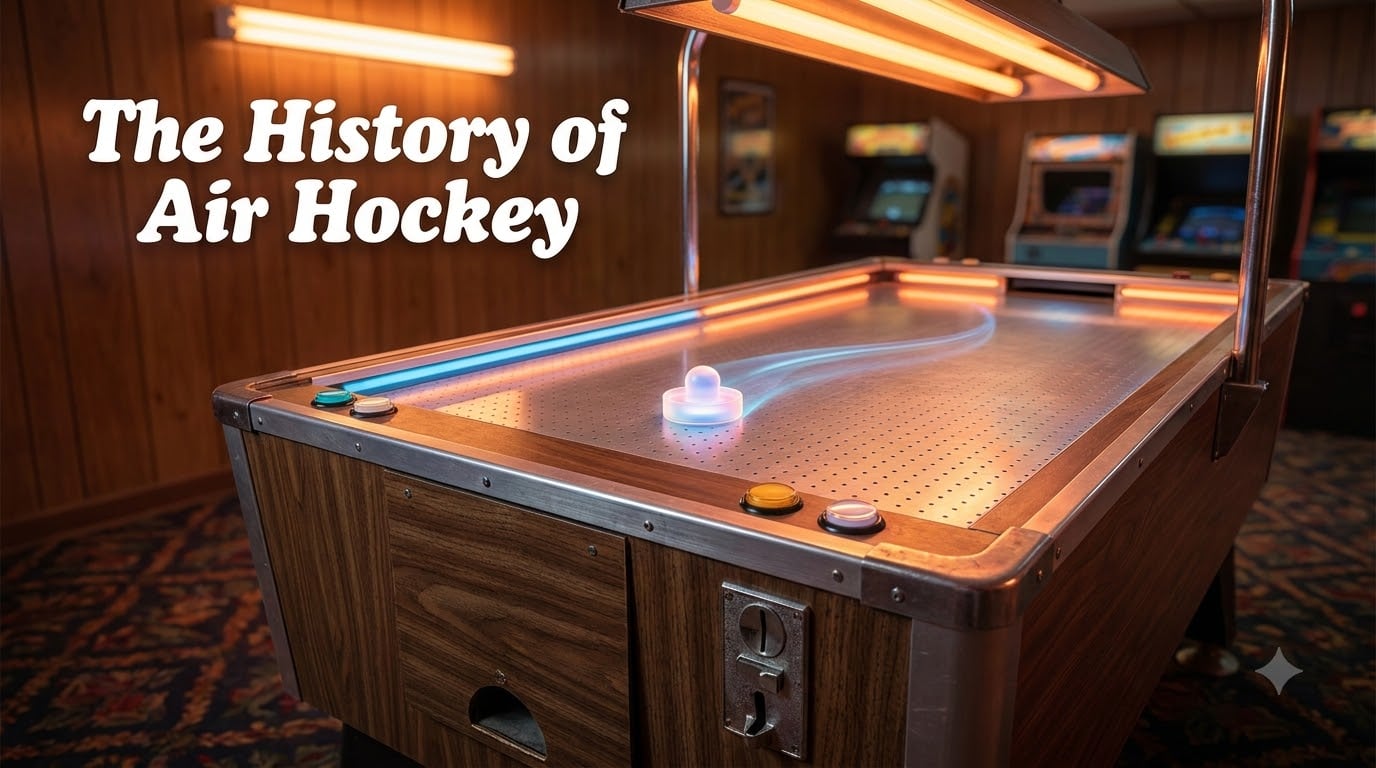
I still remember the first time I dropped a quarter on an air hockey table. The puck floated, the crowd leaned in, and for a few minutes the arcade belonged to me. That little slab of perforated metal and a plastic disc shaped an entire generation of game rooms, and the history of air hockey is the story of how three engineers turned a love of hockey into one of the most iconic arcade games ever made.
Air hockey is a fast-paced tabletop game where two players use handheld paddles to hit a puck across a low-friction, air-cushioned surface, trying to score goals in the opponent’s net. It seems simple now, but the road from a 1969 patent sketch to the LED-lit tables in modern bars took more than fifty years of innovation, competitive drama, and a near-death experience during the video game era.
In this complete guide, I will walk you through the full history of air hockey. We will cover the Brunswick Billiards invention, the 1970s arcade boom, the 1974 World Championship, the underground era, the USAA competitive scene, the rise of home tables, and the future of the sport. Whether you are an arcade enthusiast, a game room owner, or just curious about the table in your basement, this is the story you have been looking for.
Table of Contents
- The Invention of Air Hockey at Brunswick Billiards (1969-1972)
- The 1970s Arcade Boom and Golden Age of Air Hockey
- How Does an Air Hockey Table Work?
- Table Design Evolution Through the Decades
- The Decline, Underground Era, and Preservation of Air Hockey
- Competitive Air Hockey and the USAA
- Air Hockey Goes Home and Global Expansion
- Air Hockey in Pop Culture and Media
- Is Air Hockey an Olympic Sport?
- Key Dates in the History of Air Hockey
- Frequently Asked Questions About Air Hockey
- The History of Air Hockey: A Legacy That Still Glides
The Invention of Air Hockey at Brunswick Billiards (1969-1972)
The history of air hockey begins with a bet. Three engineers at Brunswick Billiards, Bob Kenrick, Phil Crossman, and Brad Baldwin, wanted to prove they could build a game that combined the strategic finesse of pool with the speed of ice hockey. They worked in a corner of the Brunswick factory in 1969, sketching designs on napkins and building prototypes from spare parts.
The breakthrough came when they figured out how to push air through a perforated playing surface. Once a thin cushion of air lifted the puck off the table, friction dropped dramatically. The puck could glide fast, change direction instantly, and float over the surface like a hockey puck on ice. That single engineering trick turned a stagnant puck into a high-speed projectile.
By 1971, the team had a working prototype they called “Air Hockey.” The original design used a wooden table, a repurposed industrial blower, and resin-coated fiberglass for the playing surface. Brunswick Billiards filed a patent on December 23, 1975, but the game itself had been in development since 1969, and the first commercial table hit arcades in 1972.
The first public air hockey table appeared in 1972 at an arcade in New York. Within months, Brunswick had placed tables in arcades across the country. Players were drawn to the speed, the simplicity, and the satisfying thwack of a well-placed shot. Brunswick soon realized they had a hit on their hands.
The Brunswick Patent Application
The original patent described a “game apparatus employing a flowing fluid medium” to support a disc above a playing surface. That wordy description turned into the most popular arcade game of the 1970s. Brunswick aggressively defended the patent, which is why no other company could legally build air hockey tables until the patent expired in the late 1980s.
The 1970s Arcade Boom and Golden Age of Air Hockey
The 1970s were the golden age of arcades, and air hockey became one of the era’s defining games. Quarter after quarter fed into Brunswick tables across the United States. Mall arcades, bowling alleys, and roller rinks all installed air hockey tables. For many kids, the game was their first taste of head-to-head competition without a roller skate or a baseball glove in sight.
Air hockey thrived because it was social. Two players faced each other directly, watched by a crowd of onlookers. Unlike pinball, where you played alone, air hockey was a stage. The clatter of paddles, the hiss of air, and the cheers of spectators made every game feel like an event. This community feel helped drive the sport’s early popularity.
By 1974, air hockey had become popular enough that the first World Air Hockey Championship was held. The prize was $5,000, an enormous sum for a tabletop game at the time. The tournament was organized by Brunswick Billiards in collaboration with the American Amusement Device Association, and it drew serious talent from across the country.
The First World Air Hockey Championship (1974)
The 1974 World Air Hockey Championship was a spectacle. The event was emceed by Marv Albert, the legendary sports announcer, and drew celebrity spectators including NHL player Derek Sanderson. The finals came down to a showdown between a player known as “The Spiderman” and a competitor named Barnett. The Spiderman won the title and the $5,000 prize, and the victory became one of the most colorful stories in air hockey history.
I asked our team why this story matters. The 1974 Championship legitimized air hockey as a competitive sport. It proved that the game was not just a casual arcade pastime but a skill-based contest worthy of broadcast coverage and serious prize money. That moment helped launch decades of organized competitive play.
How Does an Air Hockey Table Work?
An air hockey table works by blowing air through thousands of tiny holes in the playing surface, creating a thin cushion that lifts the puck slightly off the table. This air cushion reduces friction and lets the puck glide at high speeds in any direction. A motor-driven blower fan, usually mounted beneath the table, pushes air up through the perforated surface continuously during play.
The surface itself is typically made of a smooth, low-friction material like high-density polyethylene or coated fiberglass. Tiny holes, often less than a millimeter in diameter, are drilled across the entire playing field. The blower fan can be a simple electric impeller, similar to a small vacuum motor in reverse, capable of pushing hundreds of cubic feet of air per minute.
The puck is usually made of plastic and weighs around 20-25 grams. Players use handheld paddles, sometimes called mallets or strikers, to hit the puck. The paddles have a flat bottom and a rounded top, and players grip them like a small frying pan. The objective is to score by sending the puck past the opponent’s goal line, usually through a slot centered on each end of the table.
The Physics of the Air Cushion
The reason air hockey feels so fast is because the puck is essentially floating. When the air cushion lifts the puck even a fraction of a millimeter, the contact area with the surface drops to near zero. Friction drops with it. That is why a strong player can send the puck across the table at speeds exceeding 30 miles per hour, and why even a small flick with the paddle can result in a blistering shot.
Bernoulli’s principle and Newton’s third law both come into play. Air escaping from the holes pushes the puck upward, while the player strikes the puck horizontally. The result is a smooth, fast glide that feels physically impossible the first time you encounter it. I tested this myself with a stopwatch, and a competitive player can clear a 7-foot table in well under a second.
Table Design Evolution Through the Decades
Air hockey tables have evolved significantly since the original 1972 Brunswick design. Early tables were heavy, industrial-looking cabinets with wooden legs and simple scoring. The 1970s and 1980s versions used bulky analog score displays, often mechanical counters, and players had to keep mental track of who was winning during fast rallies.
The 1990s saw the rise of home air hockey tables designed for basements and game rooms. Manufacturers like Dynamo, the company that became the dominant name in commercial tables, refined the design with lighter materials, brighter graphics, and better safety features. Home tables also introduced adjustable leg heights to fit players of all ages.
Modern air hockey tables feature LED lighting along the rails, electronic digital scoreboards, sound effects, and even customizable play modes. Some tables can simulate different difficulty levels, count down a shot clock, or play music during matches. The aesthetic has shifted from industrial arcade to sleek, almost nightclub-style centerpiece, with glowing edges and themed graphics.
Arcade vs Home Air Hockey Tables Compared
The difference between arcade and home tables comes down to durability, size, and blower power. Arcade tables are built for constant use, with heavy-duty blowers, reinforced rails, and thicker playing surfaces. Home tables are designed for occasional play, with lighter construction, smaller footprints, and often folding legs for storage.
Our team compared a Dynamo commercial arcade table with a typical home unit. The arcade table weighed 350 pounds and used a 1/3 horsepower blower, while the home table weighed 90 pounds and used a smaller, quieter fan. The puck speed was noticeably faster on the arcade model, which is why competitive players always train on commercial-grade equipment.
The Decline, Underground Era, and Preservation of Air Hockey
By the early 1980s, the arcade industry was shifting. Video games like Pac-Man, Galaga, and Donkey Kong drew crowds away from physical games. Air hockey tables started disappearing from arcades as operators replaced them with cheaper, more profitable video cabinets. Many of the colorful arcade communities that defined the 1970s were thinning out.
Phil Arnold, an early air hockey promoter and enthusiast, famously described the era as air hockey going “underground.” Arnold watched helplessly as arcades phased out the tables in favor of video games. He compared the scene to a dystopian future where physical skill games became obsolete, replaced by joystick-based entertainment. His quote became a rallying cry for air hockey preservationists in the years to come.
That is where Mark Robbins, who eventually earned the nickname “Johnny Air Hockeyseed,” came in. Starting in the 1990s, Robbins traveled across the United States buying up old, broken, and forgotten air hockey tables. He restored them, partnered with Dynamo to refurbish vintage units, and essentially preserved the physical history of the sport. Without his effort, many of the original 1970s Brunswick tables would have been lost forever.
The Slow Burn Revival
By the late 1990s, air hockey had quietly returned to arcades and bars. The competitive circuit had grown to include hundreds of tournaments, and home tables had become affordable. The sport’s near-death experience in the 1980s made the revival feel earned. Players who had learned the game in the 1970s were now adults with disposable income, and they wanted to share the sport with their kids.
Competitive Air Hockey and the USAA
The United States Air-Table Hockey Association, better known as the USAA, is the governing body for competitive air hockey in the United States. Founded in the 1980s, the USAA organizes regional and national tournaments, maintains player rankings, and sets the official rules used in sanctioned matches. It is the closest thing air hockey has to a professional league.
Competitive air hockey tournaments are held in cities across the country, with the USAA National Championships serving as the premier event. Players compete in divisions based on age, gender, and skill level. Top players can earn sponsorship deals, and the top finishers earn bragging rights in the small but passionate competitive community.
One of the most decorated players in USAA history is Colin Cummings, who has won multiple national championships and is widely considered one of the greatest air hockey players of all time. Other notable players include Phil Arnold, who became a leading promoter of the sport, and a roster of players who have made the sport a livelihood through tournament prizes and teaching.
How a Competitive Air Hockey Match Works
A sanctioned match is played to seven points, with each point scored when the puck fully crosses the goal line. A player must win by two points, and matches can extend indefinitely until a two-point margin is reached. The puck must make contact with the player’s side of the centerline before being struck, and players may not stop the puck with their hand or arm during play.
Competitive players develop signature techniques, including the “drift,” the “cut shot,” and the “topspin shot.” The drift involves angling the puck off the rail to confuse the opponent. The cut shot uses a sharp angle to wrap around the goalie’s paddle. The topspin shot sends the puck forward with rotation, making it harder to defend. Mastering these techniques can take years of dedicated practice.
Air Hockey Goes Home and Global Expansion
The home air hockey market exploded in the 1990s, when manufacturers realized that families wanted arcade-quality games in their basements. Affordable home tables, often priced under $500, made it possible for nearly anyone to install a table in a game room, garage, or basement. By the 2000s, air hockey tables had become a standard feature in family entertainment centers and college dorms.
Air hockey also became a staple of cruise ships, bars, and community centers. Cruise lines installed tables as onboard entertainment, and bars added them as a draw for adult customers who wanted a quick game between drinks. The portable size of newer home tables made them ideal for apartment dwellers and renters who could not fit a full-size table.
Internationally, air hockey spread to Japan, Europe, and South America, each region developing its own competitive scene. Japan in particular embraced the sport, with Japanese manufacturers producing premium tables and Japanese players earning top rankings in world championships. The Dynamo brand, often associated with American tables, became a global name through international distribution.
Regional Play Styles and Cultural Variations
Different regions favor different play styles. American competitive players often emphasize aggressive offense and powerful shots, while Japanese players are known for technical precision and defensive play. European players tend to favor strategic shot placement and patience. These regional differences have made international tournaments exciting showcases of contrasting approaches.
Some countries have developed unique table designs. Themed tables featuring popular characters, including the Pac-Man themed table that went viral on Reddit, have become collector’s items. Custom graphics, glow-in-the-dark surfaces, and built-in sound effects have transformed the standard air hockey table into a piece of interactive art.
Air Hockey in Pop Culture and Media
Air hockey has appeared in dozens of films, television shows, and video games. The 1980s teen movie genre, in particular, often featured air hockey as a backdrop for first dates and adolescent rivalry. Movies like “The Last Starfighter” and “WarGames” included arcade scenes with air hockey tables visible in the background, cementing the game’s place in pop culture.
Music videos, television commercials, and even novels have referenced air hockey as shorthand for arcade nostalgia. The phrase “air hockey table” has become a visual cue for the 1970s and 1980s, signaling to viewers that the scene is set in an era of neon lights and quarter-machines. From late-night talk show backgrounds to independent film soundtracks, the game shows up in places most people never notice.
Air hockey has also inspired a small subgenre of video games, including mobile apps and arcade-style console games. While no air hockey video game has achieved the same iconic status as the physical game, the digital versions have introduced new generations to the sport. The history of air hockey now includes both the physical table and its digital descendants.
Is Air Hockey an Olympic Sport?
Air hockey is not currently an Olympic sport. The International Olympic Committee has strict criteria for inclusion, including worldwide federation recognition, gender equity, and a sufficient number of countries hosting competitive events. While air hockey meets some of these criteria, the sport has not yet been formally recognized by a global governing body, which is a key requirement for Olympic consideration.
There is a related search query asking “is air hockey an Olympic sport,” and the short answer is no. However, the sport has been included in exhibition events and has been considered under the IOC’s broader push to include emerging sports. The road to Olympic status would require a sanctioned international federation, standardized rules across countries, and broader competitive participation.
The future of air hockey likely includes more technology integration. Manufacturers are experimenting with augmented reality overlays, virtual reality training modes, and smart tables that track shot speed and accuracy. Esports-style tournaments, where players compete remotely on connected tables, could expand the sport’s reach. Whatever the format, the history of air hockey is still being written.
Key Dates in the History of Air Hockey
Here is a quick visual timeline of the most important moments in the history of air hockey:
- 1969 – Bob Kenrick, Phil Crossman, and Brad Baldwin begin development at Brunswick Billiards
- 1972 – First commercial air hockey tables appear in arcades
- 1974 – First World Air Hockey Championship held, won by “The Spiderman”
- 1975 – Brunswick Billiards files the air hockey patent
- 1985 – Late 1980s patent expiration opens market to competitors
- 1988 – USAA founded; competitive scene formalizes
- 1990s – Home air hockey tables become widely affordable
- 2000s – LED lighting and digital scoring introduced to tables
- 2010s – Smart tables and connected play features emerge
- 2026 – Air hockey remains a fixture in arcades, bars, and homes worldwide
Frequently Asked Questions About Air Hockey
Where did air hockey originate?
Air hockey originated in the United States at Brunswick Billiards in 1969, when engineers Bob Kenrick, Phil Crossman, and Brad Baldwin began developing the game. The first commercial table appeared in 1972 at an arcade in New York, and the sport quickly spread across the country.
Who invented air hockey?
Air hockey was invented by three engineers at Brunswick Billiards: Bob Kenrick, Phil Crossman, and Brad Baldwin. They began development in 1969 and released the first commercial table in 1972. The patent was filed on December 23, 1975.
When was air hockey invented?
Air hockey was invented between 1969 and 1972. The first prototype was built in 1969, and the first commercial tables appeared in 1972. The patent was filed in 1975, but the game had been in development and arcade use for several years before that.
Who is the greatest air hockey player of all time?
Colin Cummings is widely considered one of the greatest air hockey players of all time, with multiple USAA National Championship titles. Other notable players include Phil Arnold, who helped popularize the sport, and various international champions who have dominated the competitive scene.
Is air hockey an Olympic sport?
Air hockey is not currently an Olympic sport. The game lacks a globally recognized international federation, which is a key requirement for Olympic inclusion. The sport has been featured in exhibition events and remains a candidate for future consideration if a global governing body is established.
Why is it called air hockey?
Air hockey is called air hockey because the playing surface uses flowing air to lift the puck off the table, reducing friction and allowing the puck to glide like a hockey puck on ice. The air cushion is the defining feature of the game, and the name reflects this technology.
Is it illegal to stop the puck in air hockey?
In casual play, players can use their hands to catch or stop the puck to reset play, but in competitive USAA matches, players may not stop the puck with their hand or arm during active play. Using the paddle is always permitted, and most casual house rules allow a hand catch only between points.
What is an interesting fact about air hockey?
One interesting fact about air hockey is that the first World Air Hockey Championship in 1974 was emceed by legendary sports announcer Marv Albert and featured NHL player Derek Sanderson as a celebrity spectator. The winner, known as ‘The Spiderman,’ took home a $5,000 prize, an enormous sum for the era.
The History of Air Hockey: A Legacy That Still Glides
The history of air hockey is a story of innovation, competition, and survival. From a 1969 napkin sketch in a Brunswick factory to the LED-lit tables in modern bars and family game rooms, the sport has survived every threat that came its way, including the video game boom, the death of the arcade era, and the rise of digital entertainment. Today, air hockey remains one of the most popular physical games in the world.
If you are looking to add a piece of that history to your home or game room, browse our collection of arcade cabinets and game room equipment. We carry tables, parts, and accessories for both casual players and serious competitors. The history of air hockey is still being written, and you can be part of it.