
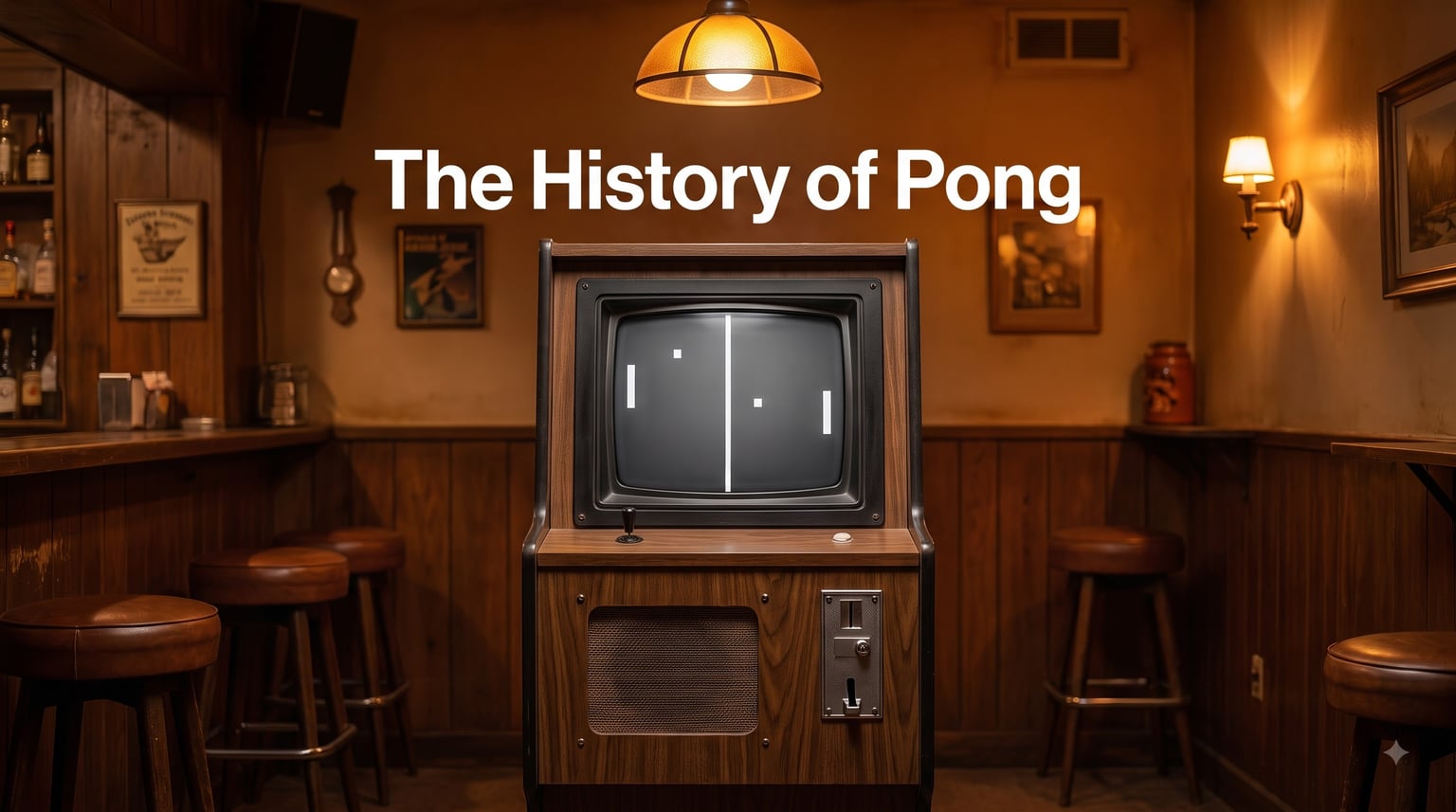
Imagine walking into a bar in Sunnyvale, California, in late 1972 and finding a mysterious wooden cabinet with a black-and-white screen inside. Two players stand in front of it, slapping a blip of light back and forth with electronic paddles. The coin slot is jammed, packed tight with so many quarters that the machine stopped working. That cabinet was running Pong, and that jammed coin slot told Nolan Bushnell something simple but powerful: people loved this game.
Pong is a 1972 sports video game developed and published by Atari that simulates table tennis, and it is widely recognized as the first commercially successful video game in history. Released on November 29, 1972, it was created by Allan Alcorn as a training exercise assigned by Atari founders Nolan Bushnell and Ted Dabney. What started as a simple warmup project became the spark that ignited the entire video game industry.
Here is something most people get wrong, though. Pong was not the first video game ever made. It was not even the first arcade video game. But it was the first one that ordinary people actually wanted to play, and that distinction changed everything. The history of Pong is really the history of how a blinking dot of light on a screen became a multi-billion-dollar entertainment industry.
Table of Contents
- Before Pong: The Seeds of Video Gaming (1958-1971)
- The Birth of Atari (June 1972)
- How Pong Was Created: Al Alcorn’s Training Exercise
- The Andy Capp’s Tavern Test (November 1972)
- Pong Goes Commercial: Mass Production and Arcade Dominance
- From Arcade to Living Room: The Sears Partnership (1975)
- The Magnavox Lawsuit: Legal Battles Over Pong
- Pong’s Legacy: How It Changed Gaming Forever
- FAQs
- Conclusion
Before Pong: The Seeds of Video Gaming (1958-1971)
To understand the history of Pong, we need to go back over a decade before Atari existed. The idea of playing a game on a screen did not start with Nolan Bushnell. It started in research labs and university basements with engineers who were simply curious about what cathode-ray tubes could do.
In 1958, physicist William Higinbotham created “Tennis for Two” at the Brookhaven National Laboratory. It was an analog tennis game displayed on an oscilloscope screen, built to entertain visitors during a public exhibition. Higinbotham never patented it, and the game was dismantled after the event. But it proved that interactive electronic games were possible.
Then in 1962, a group of students at MIT developed “Spacewar!” on a PDP-1 mainframe computer. Two players controlled spaceships and tried to shoot each other while dealing with a central star’s gravity. Spacewar! spread across university computer labs throughout the 1960s and became the first video game that could be played on more than one machine.
The most important precursor to Pong, though, was the work of Ralph Baer. Starting in 1966, Baer began developing a home video game system at the defense contracting firm Sanders Associates. His prototype, eventually nicknamed the “Brown Box,” could play several simple games including a table tennis game. Baer patented his invention in 1971, and it would soon be licensed to Magnavox and released as the Magnavox Odyssey in 1972. This patent would come back to haunt Atari.
Meanwhile, in California, Nolan Bushnell and Ted Dabney were working at AMPEX, a company that built video recording equipment. Bushnell had seen Spacewar! at the University of Utah, where he studied engineering. He became obsessed with the idea of turning video games into a commercial business.
In 1971, Bushnell and Dabney built their first arcade game, called Computer Space. It was a simplified version of Spacewar! packaged into a single arcade cabinet. Nutting Associates manufactured and distributed it. The game had colorful fiberglass casing and looked like a prop from a science fiction film. But it was too complicated for most players. The controls were confusing, the gameplay was hard to learn, and there were no instructions. Computer Space flopped commercially.
The failure of Computer Space taught Bushnell a critical lesson: arcade games needed to be simple enough that anyone could understand them in seconds. That lesson would directly shape the creation of Pong.
The Birth of Atari (June 1972)
After Computer Space underperformed, Bushnell and Ted Dabney decided to start their own company where they could control both the design and the distribution of their games. In June 1972, they founded a small company originally called Syzygy. When they discovered the name was already taken by a candle company, they chose “Atari” instead, a term from the Japanese board game Go that means a state of being threatened or in danger.
The two men had met at AMPEX, where both worked as engineers on video recording technology. Dabney had developed a technique for generating video signals without a computer, using only analog circuitry. This was a breakthrough that meant arcade games could be built without expensive mainframe processors. Instead of a computer running code, the game logic lived in the wiring of custom electronic components.
Atari started with barely any money. Bushnell reportedly invested about $250 of his own funds, and Dabney contributed a similar amount. They operated out of a small office in Santa Clara, California, and their first order of business was to hire an engineer who could build games using Dabney’s video technology.
That engineer turned out to be Allan Alcorn, another AMPEX veteran. Alcorn was 24 years old when Bushnell brought him on board as Atari’s first design engineer. He had no idea he was about to create the most important video game of the 20th century.
How Pong Was Created: Al Alcorn’s Training Exercise
The story of Pong’s creation sounds almost too simple to be true. Bushnell assigned Al Alcorn a project to build a basic table tennis game. He told Alcorn it was for a contract with General Electric, but that contract did not actually exist. Bushnell simply wanted to give his new engineer a manageable task to practice with the analog video technology Dabney had developed.
Alcorn took the assignment seriously. He built the game using about 66 discrete logic chips on a single circuit board, connected to a standard black-and-white television set. There was no computer processor, no software code, and no programming language. The entire game existed as electronic signals flowing through physical circuits.
What Alcorn created was remarkably sophisticated for a “training exercise.” The game featured two paddles, one on each side of the screen, and a ball that bounced between them. The physics were intuitive: if the ball hit the center of a paddle, it went straight back. If it hit the edge, it bounced at an angle. This meant players could aim their shots by positioning the paddle strategically.
The score was displayed numerically at the top of the screen, and the first player to reach a set number of points won the match. But Alcorn added something that nobody asked for: sound effects. When the ball hit a paddle, it made a sharp “bleep” tone. The pitch changed depending on which paddle was hit, giving each player audio feedback.
The sound was actually an accident of the hardware design. Alcorn discovered that the circuitry naturally generated a signal whenever the ball made contact, and he routed it through a speaker to create the iconic tone. Bushnell loved it. That simple bleep became one of the most recognizable sounds in video game history.
Alcorn also added a clever detail to the gameplay. If a player missed the ball, it would fly off the edge of the screen and the other player would score. But Alcorn programmed the ball to slowly accelerate as rallies lasted longer, making the game progressively harder. This created a natural difficulty curve that kept players engaged without them realizing it.
When Bushnell saw the finished game, he realized immediately that it was too good to waste as a training exercise. This was not a throwaway practice project. This was a product.
The Andy Capp’s Tavern Test (November 1972)
Before committing to mass production, Bushnell and Alcorn wanted to test whether real people would actually pay to play Pong. They built a prototype cabinet using a modified Hitachi black-and-white television mounted inside a wooden housing. The cabinet was painted yellow and had a coin mechanism from a laundromat bolted to the front. A milk carton was used to catch the coins inside.
In November 1972, they placed the prototype in Andy Capp’s Tavern, a popular bar in Sunnyvale, California. The location was deliberate. Bars had the right demographic for arcade games: adults with disposable income, competitive social energy, and time to kill. Bushnell told the tavern owner to let people play for free at first, then see what happened.
What happened stunned everyone. Within days, the game became the most popular attraction in the bar. People lined up to play. They stood in front of the cabinet for hours, feeding it quarters. The gameplay was so intuitive that even people who had never touched an electronic game could understand it instantly: move the paddle, hit the ball, don’t miss.
Then came the moment that became Atari legend. About two weeks after the prototype was installed, the tavern owner called Bushnell with a problem. The machine had stopped working. Bushnell sent Alcorn to fix it, expecting a technical malfunction. When Alcorn opened the cabinet, he found the cause: the coin mechanism was jammed completely shut, packed with so many quarters that it could not accept any more coins. The milk carton inside was overflowing.
That jammed coin slot was all the proof Bushnell needed. People were not just playing Pong. They were paying for it, enthusiastically, again and again. The game was reportedly earning about $40 per week at that single location, which was roughly what some arcade machines earned in a month. Bushnell greenlit full production immediately.
Pong Goes Commercial: Mass Production and Arcade Dominance
On November 29, 1972, Atari officially released Pong as a commercial arcade product. The first production units were built in a converted roller skating rink that Atari used as a manufacturing facility. Each cabinet cost roughly $500 to produce and was sold to distributors and operators for about $1,200.
The initial production run was small. Atari built about a dozen units to test the market, placing them in bars, restaurants, and amusement centers around Northern California. The response was immediate and overwhelming. Within weeks, operators were calling Atari to order more machines. The demand far exceeded anything Bushnell had projected.
Atari ramped up production as fast as it could. By early 1973, the company was shipping Pong cabinets across the United States. The game’s appeal crossed every demographic line. Adults played it in bars after work. Teenagers played it in arcades on weekends. College students organized informal tournaments in student union buildings. Pong became a genuine cultural phenomenon.
The reasons for Pong’s commercial success were straightforward:
The controls were a single knob per player. No instructions needed.
Games lasted just a few minutes, keeping the turnover rate high and the earnings strong for operators.
Two-player competitive play created social engagement that single-player games could not match.
The sound effects provided satisfying audio feedback that drew crowds in noisy environments.
The scoring system was visible and easy to follow, making matches exciting to watch as well as play.
Pong’s success also attracted imitators. Within months of its release, competitors began producing clone machines with identical or nearly identical gameplay. Companies like Bally, Chicago Coin, and Alliance Manufacturing flooded the market with Pong knockoffs. Some estimates suggest that by 1974, there were dozens of Pong-style games from different manufacturers competing for floor space in arcades and bars.
For Atari, the clone problem was frustrating but also validating. The sheer number of copycat products confirmed that Bushnell and his team had identified an entirely new category of entertainment. The coin-operated arcade video game was no longer an experiment. It was an industry.
From Arcade to Living Room: The Sears Partnership (1975)
Pong had conquered bars and arcades, but Bushnell had a bigger ambition. He wanted to bring video games into people’s homes. The challenge was enormous. An arcade cabinet could sell for over a thousand dollars because it earned revenue continuously. A home version needed to be affordable enough for a family to buy once and play indefinitely.
Harold Lee, an engineer at Atari, proposed building a home version of Pong that used a single custom integrated circuit instead of the dozens of discrete chips in the arcade original. This was a significant technical achievement. The custom chip consolidated all the game logic, video signal generation, and scoring into one component, dramatically reducing the manufacturing cost.
The home Pong console connected directly to a television set. It came with two built-in paddles, an AC adapter, and instructions. The gameplay was the same as the arcade version: two paddles, one ball, a bouncing bleep, and a running score.
Atari initially struggled to find a retailer willing to carry the product. Most electronics stores did not understand what a home video game was or why anyone would buy one. The breakthrough came when Atari pitched the product to Sears, the largest retailer in the United States at the time.
Tom Quinn, a sporting goods buyer at Sears, saw the potential immediately. He agreed to carry the home Pong console under the Sears Tele-Games brand name, sold as the “Sears Tele-Games Pong.” The console was priced to be an affordable family Christmas gift, and Sears used its massive catalog and retail network to promote it.
The home Pong console launched through Sears for the 1975 holiday season, and it was a smash hit. Sears sold every unit Atari could manufacture, and demand exceeded supply throughout the Christmas shopping period. The success of the Sears Tele-Games Pong proved that home video games were a viable market, and it set the stage for Atari to develop the Atari 2600, the console that would define home gaming in the late 1970s and early 1980s.
The Magnavox Lawsuit: Legal Battles Over Pong
Pong’s success did not just attract commercial imitators. It also attracted legal attention from Magnavox, the company that had released the Magnavox Odyssey home console in 1972 based on Ralph Baer’s patented technology. Magnavox held patents covering the concept of playing interactive games on a television screen, and Baer’s table tennis game had been demonstrated publicly at a Magnavox trade show in 1972, months before Pong’s release.
In 1974, Magnavox filed a patent infringement lawsuit against Atari. The legal argument was straightforward: Ralph Baer had invented the concept of a video tennis game played on a television, had patented it, and had demonstrated it publicly before Pong existed. Nolan Bushnell had reportedly attended the Magnavox demonstration in 1972, which strengthened Magnavox’s claim that Atari’s design was derived from Baer’s work.
Atari faced a difficult legal position. The company was still young and did not have the resources for a prolonged court battle against a major corporation like Magnavox. Rather than fight the case to the end, Bushnell chose to settle.
In 1976, Atari agreed to pay Magnavox a settlement, reportedly around $700,000, to license the technology and avoid further litigation. As part of the settlement, Magnavox retained the right to pursue other companies that had copied Pong-style games, and Atari’s settlement became a precedent that Magnavox used to go after other manufacturers.
The Magnavox lawsuit had a lasting impact on the video game industry. It established that video game concepts could be protected by patents, and Magnavox went on to collect licensing fees and settlements from dozens of companies throughout the 1970s and 1980s. Ralph Baer, who had been working on his inventions since the 1960s, is now recognized alongside Bushnell as one of the founding fathers of video games.
Pong’s Legacy: How It Changed Gaming Forever
Pong’s impact extends far beyond its own success as an arcade and home game. It effectively created the blueprint for the entire video game industry, from how games are designed and tested to how they are sold and distributed.
The arcade model that Pong pioneered, where players pay per game using coins, dominated the video game business for nearly two decades. Arcades became cultural gathering spaces throughout the 1970s and 1980s, and the coin-operated revenue model funded the development of increasingly sophisticated games, from Space Invaders to Pac-Man to Street Fighter.
On the home front, the Sears Tele-Games Pong console proved that families would buy dedicated gaming hardware. This led directly to the development of the Atari 2600 (originally called the Atari Video Computer System), released in 1977. The 2600 used interchangeable cartridges, allowing players to buy multiple games for a single console. It sold over 30 million units during its lifetime and established the home console as a permanent fixture in living rooms worldwide.
Pong itself has never really gone away. Atari and other companies have released countless variations of the game over the decades, including updated versions with improved graphics, new game modes, and multiplayer features. In 2026, you can play Pong on smartphones, web browsers, and even dedicated retro gaming consoles.
The game has also popped up in unexpected places. In one fascinating experiment, a team of neuroscientists grew human brain cells in a dish and connected them to a computer running a simplified version of Pong. The cells learned to “play” the game by sending and receiving electrical signals, adapting their responses over time. The experiment, known as “DishBrain,” demonstrated that living neurons can interact with virtual environments, and it all started with the same simple concept of a ball bouncing between two paddles.
Culturally, Pong has become a shorthand for the origins of video games. It appears in films, television shows, and advertising as a visual reference for the birth of digital entertainment. The sound of its electronic bleep is instantly recognizable to anyone who grew up in the 1970s or 1980s. For many people, Pong was their first experience with a machine that responded to their actions in real time, and that memory has become a shared cultural touchstone.
FAQs
Is Pong the oldest game?
No, Pong is not the oldest video game. Tennis for Two (1958) and Spacewar! (1962) both came years before it. Pong is the oldest commercially successful video game, released by Atari on November 29, 1972. The distinction matters because earlier games were either academic experiments or commercial failures.
Who sued Atari for Pong?
Magnavox sued Atari for patent infringement in 1974, based on Ralph Baer’s patents for playing interactive games on a television. Baer had demonstrated a table tennis game at a trade show before Pong was released. Atari settled in 1976 for approximately $700,000 and agreed to license the technology.
Why is Pong so famous?
Pong is famous because it was the first video game that proved video games could be a commercially viable business. Its simple two-player gameplay was instantly understandable, and its release in arcades and later as a home console through Sears created the modern video game industry. The iconic coin jam at Andy Capp’s Tavern became legendary proof of its popularity.
How many versions of Pong exist?
There is no exact count, but dozens of official and unofficial versions of Pong have been produced since 1972. Atari released multiple arcade sequels and home console editions, and countless clones were made by competitors. Modern versions exist on smartphones, web browsers, and retro consoles, keeping the original gameplay alive today.
Conclusion
The history of Pong is really the story of how a simple idea, two paddles bouncing a dot of light back and forth, became the foundation of an entire entertainment industry. Allan Alcorn built it as a practice project. Nolan Bushnell and Ted Dabney turned it into a business. And millions of players around the world made it a phenomenon.
What makes Pong remarkable is not its technology, which was modest even by the standards of 1972. It is the fact that the game got the fundamentals right. The controls were easy to learn. The competition was exciting. The feedback was satisfying. Those principles still define great game design today, more than five decades later.
Pong was not the first video game, and it is important to remember the contributions of pioneers like Ralph Baer, William Higinbotham, and the MIT students who built Spacewar!. But Pong was the game that made the world pay attention. It proved that video games were not a novelty or a laboratory curiosity. They were a new form of entertainment with real commercial potential, and that potential has grown into a global industry worth hundreds of billions of dollars.
Every time you play a game on your phone, your console, or your computer, you are participating in a tradition that started with a wooden cabinet in a California bar, a jammed coin slot, and a simple electronic bleep. That is the legacy of Pong.