
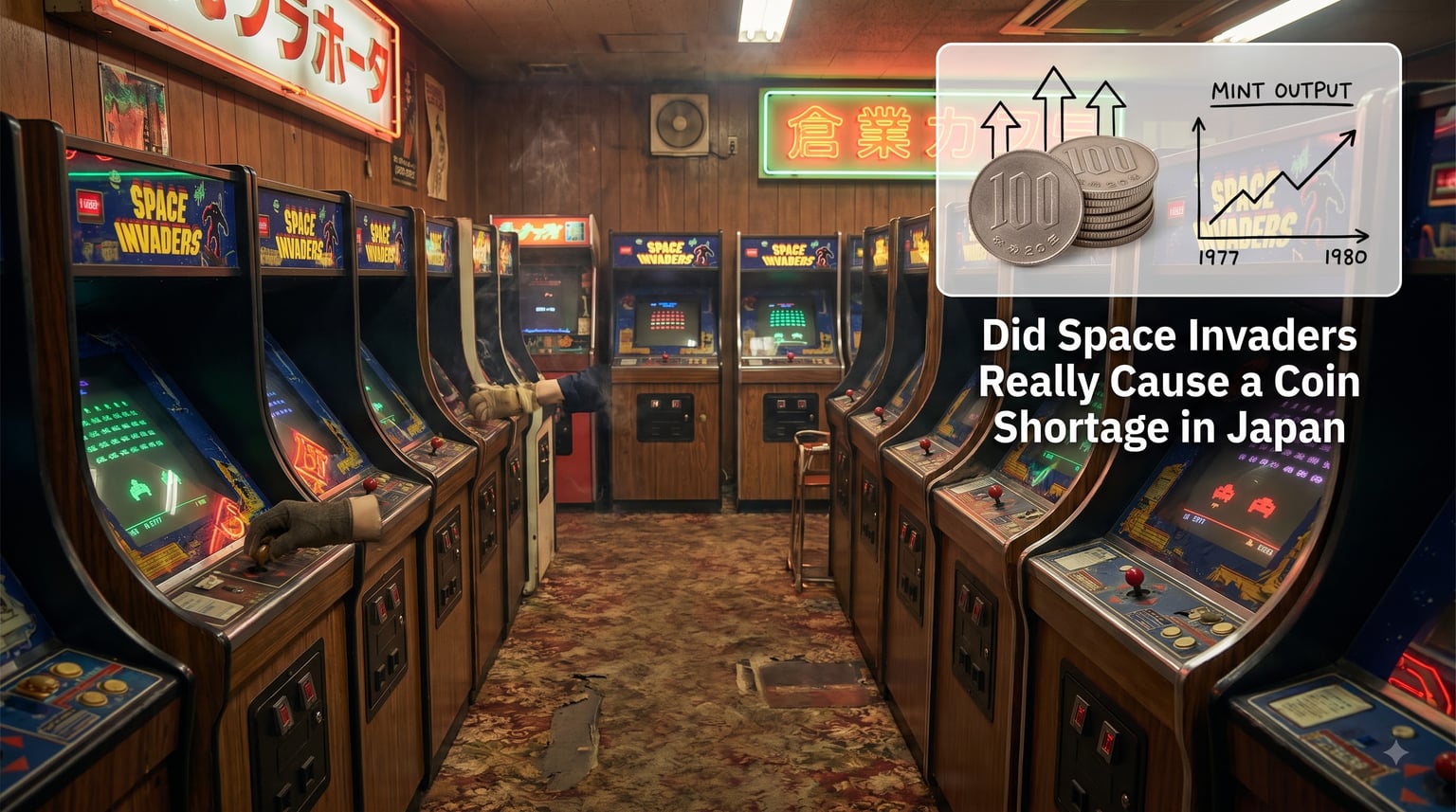
No, Space Invaders did not cause a nationwide coin shortage in Japan. The claim that the 1978 arcade hit drained Japan’s supply of 100-yen coins is one of the most repeated stories in gaming history, and one of the most thoroughly debunked. Japanese Mint production records show 100-yen coin mintage actually rose sharply in 1979 and 1980, the years right after Space Invaders took off.
I dug into the primary sources, the numismatic data, and the academic research to put this legend to rest. In this guide, I will walk you through what people actually believe happened in 2026, what the production numbers really show, and how a clever piece of marketing turned a minor circulation hiccup into one of gaming’s most famous urban legends.
Table of Contents
- What Is the Space Invaders Coin Shortage Claim?
- How Popular Was Space Invaders in 1978 Japan?
- What Does the Evidence Show About the Coin Shortage?
- Where Did the Coin Shortage Myth Originate?
- Did the Japanese Government Actually Investigate?
- How Did Taito and the Media Keep the Story Alive?
- FAQs
- The Verdict on the Space Invaders Coin Shortage Myth
What Is the Space Invaders Coin Shortage Claim?
The Space Invaders coin shortage Japan myth goes like this: in 1978, Taito’s Space Invaders became so insanely popular that players fed billions of 100-yen coins into arcade machines, locking the currency away inside the games. Stories vary, but the most common version claims that the Bank of Japan had to investigate and ramp up coin production to fix the imbalance.
The story has been repeated in books, documentaries, and even on Wikipedia for decades. It often pairs with another claim that the game caused a wave of juvenile delinquency. Both stories serve a similar narrative purpose: they make Space Invaders sound like a cultural earthquake that physically reshaped Japan.
There is just one problem with the story. The coins were never missing. They were sitting in cash boxes at arcades, waiting to be collected. The real cause of any 1978 100-yen coin circulation dip was a deliberate decision by the Japanese Mint to underproduce the denomination in 1977, not a single video game eating the country’s money supply.
How Popular Was Space Invaders in 1978 Japan?
To be fair to the myth, Space Invaders was an absolute monster hit. Designer Tomohiro Nishikado released it in June 1978 through Taito, and within a year it was installed in over 100,000 arcade locations across Japan. By some estimates, one in every four yen spent in Japan’s leisure economy in 1979 went through a Space Invaders cabinet.
That kind of reach made it one of the most successful coin-operated machines of its era. In 2008, Guinness World Records recognized Space Invaders as the top-rated arcade game of all time. It was the first game to break a billion dollars in gross revenue when you adjust for inflation.
Gameplay was also a huge part of the legend. Each player drop cost 100 yen, and average play sessions stretched past an hour as gamers chased high scores. The simple shooting mechanic, the rising heartbeat audio, and the steady march of descending aliens created a feedback loop that arcade operators loved.
So when people tell the Space Invaders coin shortage Japan story, they are not wrong about the game’s popularity. They are wrong about the financial side. The cabinets were making money hand over fist, but that money was still inside the Japanese economy. It just had not yet cycled back to the banks.
What Does the Evidence Show About the Coin Shortage?
The smoking gun is in the Japanese Mint production data. Researcher Charles Paradis contacted the Japanese Mint’s PR office and the Bank of Japan directly while writing his academic paper “Insert Coin to Play: Space Invaders and the 100 Yen Myth.” What he found directly contradicts the popular narrative.
Here is the production picture for 100-yen coins across the years surrounding Space Invaders’ release:
100-Yen Coin Production in Japan (1977-1980)
1977: Baseline year before Space Invaders. Production was held at deliberately low levels by the Japanese Mint.
1978: Space Invaders launches in June. Production remained low for most of the year.
1979: Production jumped by 76.4 percent compared to 1978.
1980: Production rose another 64.9 percent compared to 1979.
If Space Invaders had really drained Japan’s coins, you would expect to see a drop in 1978 followed by a panicked, massive ramp-up. What actually happened was a planned, predictable increase driven by the Mint’s own calendar, not by arcade hoarding.
The brief circulation dip in late 1978 was real, but it was caused by the Mint underproducing the coin in 1977 and the first half of 1978. The 100-yen coin was a relatively new denomination, and the Mint was still calibrating how many to strike each year. By 1979, the Mint expanded production to meet ordinary demand, and by 1980 the supply had more than doubled. The shortage was not a Space Invaders problem. It was a forecasting problem.
Where Did the Coin Shortage Myth Originate?
Tracing the Space Invaders coin shortage Japan story is a little like playing telephone across forty years of gaming journalism. The earliest verifiable source appears in a 1980 magazine article that loosely connected Space Invaders popularity with a brief coin circulation dip. That article did not claim the game caused the shortage. It only noted both events happened at the same time.
From there, the story bounced between coin-collector publications and arcade industry trade magazines throughout the 1980s. Each retelling sharpened the language, replacing cautious wording with confident claims. By the 1990s, the story had fully transformed. It was no longer “the game coincided with a coin dip.” It was “the game caused a national crisis that required a government investigation.”
Wikipedia has carried a version of this claim for years, and it is the most-cited source pushing the myth forward. The maisonroshi.com article and a popular documentary called “100 Yen” also repeat the framing without verifying it against Japanese Mint data.
This pattern is a classic example of how an urban legend spreads. A small truth (coins were briefly tight in 1978) gets attached to a big story (Space Invaders was huge). Over time, the small truth becomes the cause, and the big story becomes the effect. Repeat the cycle enough decades and the myth calcifies into accepted fact.
Did the Japanese Government Actually Investigate?
The “government investigation” claim is the most theatrical part of the legend. The popular version states that authorities traced the missing coins directly to arcade cabinets and ordered Taito to empty the cash boxes. It sounds dramatic. It also never happened.
No Japanese government agency ever launched a formal investigation into Space Invaders arcades over coin circulation. The Bank of Japan tracks currency supply closely, but its records show the 1978 dip was consistent with routine Mint scheduling decisions, not a sudden withdrawal from circulation.
Taito itself has never confirmed any government contact about coin shortages. The company’s internal history, including statements from founder Michael Kogan and various executive interviews, focuses on production scale and licensing deals, not currency crises.
This part of the myth appears to be pure invention, likely added by a writer in the 1990s who wanted to make the story feel more urgent. Government investigations make for great headlines, so the claim stuck around even after it was never supported by primary records.
How Did Taito and the Media Keep the Story Alive?
Once the Space Invaders coin shortage Japan myth became established, both Taito and the gaming press had reasons not to challenge it. For Taito, the story made the company sound like a titan that had reshaped Japan’s economy. For arcade historians and gaming journalists, the tale gave Space Invaders a unique place in cultural history, separate from other big hits.
Paradis’s research suggests that Taito’s marketing department leaned into the legend during the 1980s and 1990s. Brochures, anniversary retrospectives, and licensed merchandise often referenced the coin shortage story as a point of pride. Whether Taito’s founders believed the myth or simply found it useful, the company never publicly corrected it.
The media played an equally large role. Coin collecting magazines, gaming historians, and even mainstream outlets repeated the story without checking production numbers. By the time academic researchers like Paradis reached out to the Japanese Mint and Bank of Japan in the early 2010s, the myth had already gone global through Wikipedia, documentaries, and countless blog posts.
This is a useful lesson for any myth. Once a story serves someone’s interests, correcting it becomes commercially inconvenient. The Space Invaders coin shortage tale survived because nobody with a stake in the game’s reputation had a reason to debunk it. Only outside researchers with no commercial ties finally laid out the production data.
FAQs
Did Space Invaders really cause a coin shortage in Japan?
No. Japanese Mint production data shows that the 100-yen coin shortage in 1978 was caused by low mintage in 1977 and the first half of 1978, not by Space Invaders arcades hoarding currency. Production rose sharply in 1979 and 1980.
How many 100-yen coins did Japan produce between 1977 and 1980?
Production was deliberately held low in 1977 and the first half of 1978. In 1979 the Japanese Mint increased 100-yen coin output by 76.4 percent compared to 1978, and in 1980 production rose another 64.9 percent compared to 1979.
What caused the 1978 100-yen coin shortage in Japan?
The shortage was caused by the Japanese Mint underproducing the 100-yen denomination in 1977 and the early months of 1978. The Mint was still calibrating production levels for the relatively new coin. Any circulation dip coincided with Space Invaders’ release but was not caused by it.
Did the Japanese government investigate Space Invaders arcades?
No government agency ever launched a formal investigation into Space Invaders arcades over coin shortages. The Bank of Japan’s records show the 1978 circulation dip was consistent with routine Mint scheduling, and Taito has never confirmed any government contact about the issue.
How many Space Invaders machines were in Japan in 1978?
By the end of 1978, Space Invaders had been installed in over 100,000 arcade locations across Japan. The game became one of the highest-grossing coin-operated machines of its era and was later recognized by Guinness World Records as the top-rated arcade game of all time.
The Verdict on the Space Invaders Coin Shortage Myth
The story of Space Invaders causing a coin shortage in Japan is a fact-check case study in how legends take hold. A brief, real circulation dip in 1978 got paired with a true cultural phenomenon, and the combined narrative grew more dramatic with every retelling. Taito’s marketers and gaming journalists had no reason to correct it, so the myth spread for over four decades.
The real story is more interesting than the legend. Space Invaders was a genuine cultural earthquake, but its impact showed up in arcade revenue, youth culture, and the global rise of video games, not in the Bank of Japan’s ledger. When you look at the production numbers from the Japanese Mint, the conclusion is clear. There was no Space Invaders coin shortage in Japan. There was just an underproduced coin that the Mint fixed on its own schedule, exactly as planned.
So the next time someone tells you Space Invaders ate Japan’s pocket change, you can answer with confidence. It is a great story. It is also not true.