
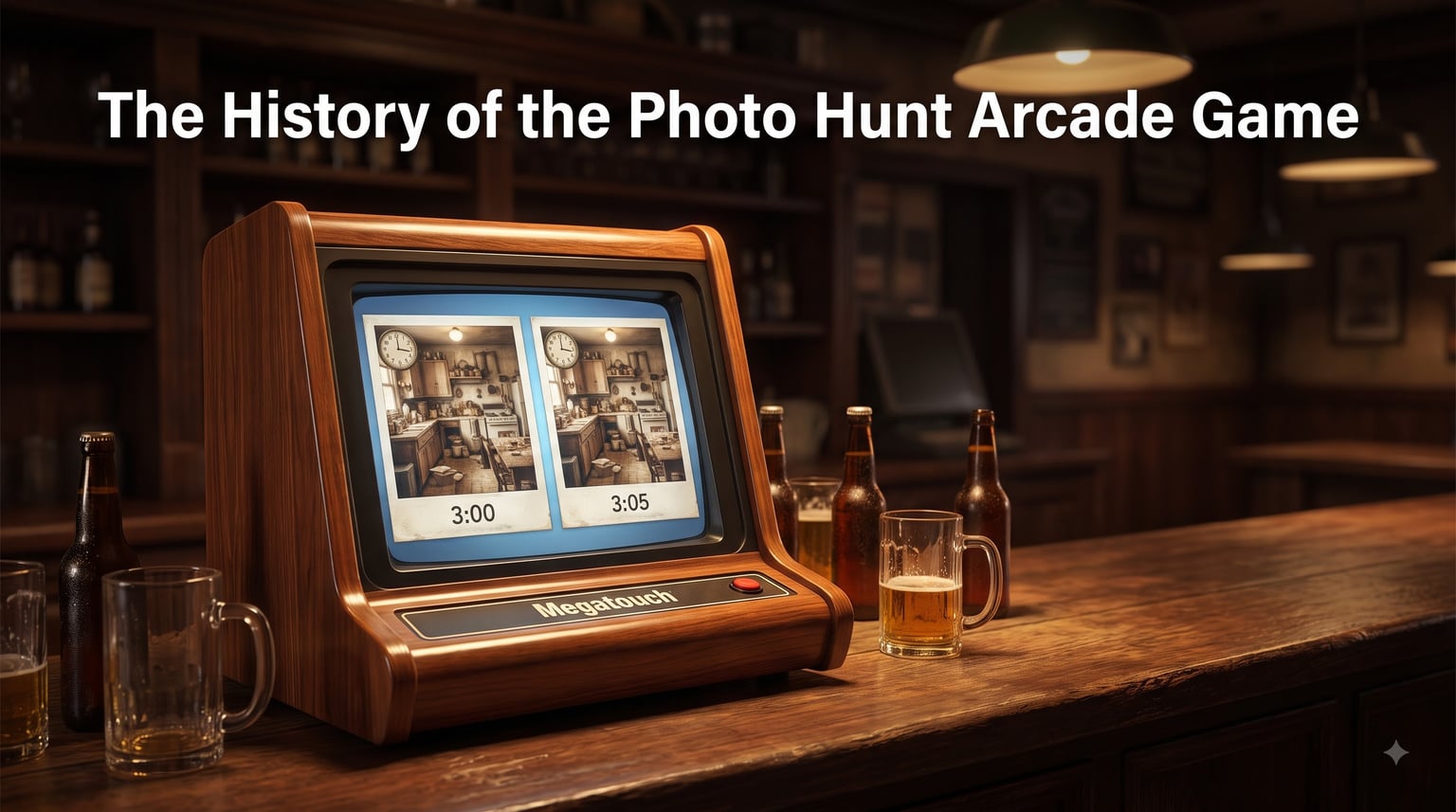
Photo Hunt is a spot-the-difference puzzle arcade game developed by Merit Industries for its Megatouch touchscreen countertop machines, first released in 1997. Players tap five subtle differences between two side-by-side photos before a timer runs out, then advance to harder rounds. Over the next 17 years, the game became a defining fixture of American bar and tavern culture, with more than 50,000 networked Megatouch systems installed globally at its peak.
I grew up in a town where the local pub had a Megatouch tucked between the dartboard and the jukebox. On any given Friday night, you would find three or four people crowded around the screen, arguing about whether a missing leaf on a house counted as a difference. That little ritual is exactly what we are going to unpack in this history.
Table of Contents
- What Is Photo Hunt?
- How to Play Photo Hunt?
- The Origins: Merit Industries and the Birth of Photo Hunt
- Megatouch Hardware Generations
- Erotic Photo Hunt: The Adult Variant
- The Decline: AMI Merger and the 2014 Closure
- Photo Hunt Beyond the Arcade: iPhone, iPad, and Nintendo Switch
- Cultural Legacy and Bar Nostalgia
- Frequently Asked Questions
- Final Thoughts on the History of the Photo Hunt Arcade Game
What Is Photo Hunt?
Photo Hunt is a touchscreen spot-the-difference arcade game where two nearly identical photographs appear side by side and players race to tap five subtle changes before a countdown timer expires. It was built by Merit Industries specifically for the Megatouch line of countertop arcade cabinets, which sat on bars, restaurant counters, and taverns across the United States. Its simplicity, short round length, and co-op-friendly design made it one of the most-played casual arcade games of the late 1990s and 2000s.
Unlike competitive fighters or racing cabinets that demanded quarters from a single player, Photo Hunt invited groups to gather, debate, and high-five. That social mechanic is the reason it survived in dive bars, family restaurants, and airport lounges long after more ambitious arcade genres collapsed.
How to Play Photo Hunt?
The rules of Photo Hunt are simple enough that anyone can learn them in a single round, which is part of why it spread so widely in social settings.
Two photos appear side by side on the touchscreen. Five small differences are hidden between them.
You tap the difference on the screen. Correct taps flash a green circle to confirm.
Wrong taps trigger a red penalty and drain a chunk of time from the countdown.
If you get stuck, you can use a hint to highlight one remaining difference. Hints are limited per round.
Find all five differences before the timer hits zero and you advance to a harder photo pair with a shorter clock.
Higher levels stack penalties, shrink the timer, and use more visually similar photo pairs. Skilled players learned to scan methodically – top to bottom, left to right – rather than chasing the obvious differences first. Most rounds last between 20 seconds and 90 seconds, which is exactly why it slotted into the rhythm of a bar night.
The Origins: Merit Industries and the Birth of Photo Hunt
Photo Hunt was created by Merit Industries, a Pennsylvania-based maker of coin-operated electronic games founded in 1976 by Pete Feuer. The company started in Bensalem, Pennsylvania, and later moved operations to nearby Bristol, Pennsylvania, where it would remain for most of its life. Merit’s early products were trivia and fortune-telling machines, and the company reportedly produced only 82 units in its first year.
By the mid-1990s, Merit had committed to a touchscreen countertop platform called Megatouch. The first Megatouch cabinet, the Megatouch IV, shipped in 1995 and ran on a Windows-based PC architecture inside. When software updates rolled out across the Megatouch XL line in 1997, Photo Hunt appeared as part of the standard game rotation.
The design was inspired by the spot-the-difference puzzles that had appeared in print magazines for decades. Merit adapted the format for a touchscreen, added a competitive timer, and packaged it for a place where people were already killing time with a drink in their hand. The fit was perfect. Players already knew how to play; they just needed a screen to tap.
Megatouch Hardware Generations
Photo Hunt’s life is inseparable from the Megatouch hardware it ran on. Across nearly two decades, Merit shipped the game through six distinct cabinet generations, each with its own screen, processor, and visual style.
Megatouch IV (1995) – The original 14-inch CRT touchscreen platform that launched the line.
Megatouch XL (1997) – The first generation to ship Photo Hunt as part of the standard game library.
Megatouch Maxx (1999) – Larger cabinet footprint, upgraded 17-inch screen, became the long-running workhorse of bars.
Megatouch Force EVO (2003) – Slimmer cabinet design, brighter LCD, faster boot times.
Megatouch Aurora (2009) – Modernized industrial design with a 19-inch widescreen LCD.
Megatouch ION (2010-2014) – The final generation, with online leaderboards and downloadable photo packs. Photo Hunt Classic shipped as a final software update in 2014.
Every new generation kept Photo Hunt in the lineup. That continuity is unusual for arcade games, where sequels usually replace the original. Operators liked it because the game was a reliable earner, and players liked it because the rules never changed under their fingers.
Erotic Photo Hunt: The Adult Variant
Alongside the standard version, Merit released an adult variant called Erotic Photo Hunt. The imagery was sourced from Penthouse magazine and edited by Jim Hartman, who manually retouched the photos to embed the five differences. Operators could enable or disable the adult game on their machines, and many bars scheduled it to unlock only after a certain hour of the evening.
It was a big draw in certain bars and remains a piece of late-90s and 2000s bar culture that gets discussed in forums whenever Photo Hunt nostalgia comes up. Documented in a 2016 Eater article and a later Technical.ly profile of Hartman, the variant shows how far Merit was willing to push to keep the Megatouch platform profitable in adult-leaning venues.
The Decline: AMI Merger and the 2014 Closure
Merit Industries merged with AMI Entertainment Network in 2009, and the combined company shifted its primary focus from standalone arcade machines to digital jukeboxes and networked entertainment systems. That strategic pivot left the Megatouch platform with less internal investment, even as the broader arcade market was shrinking under pressure from home consoles and smartphones.
The final 2014 software release for the Megatouch ION hardware included a Photo Hunt Classic add-on, which was effectively a farewell update. By the end of 2014, Merit Entertainment had closed its doors. Manufacturing stopped, parts dried up, and the existing cabinets began aging without support. Many machines survived in bars for years afterward, but no new units were ever produced.
Smartphones deserve a share of the blame too. Once a casual player could carry a spot-the-difference app in their pocket, the value of feeding quarters into a bar-top cabinet dropped sharply. The communal social ritual of a Megatouch night was harder to replicate alone on a phone, but the convenience of mobile play was undeniable.
Photo Hunt Beyond the Arcade: iPhone, iPad, and Nintendo Switch
Merit did try to bring Photo Hunt into the mobile era. An iPhone and iPod touch version launched in 2009, and an iPad HD version followed in 2011. Both apps were eventually pulled from the App Store as the company wound down, and original installs stopped working cleanly on newer iOS versions.
The most surprising modern chapter is the 2024 Nintendo Switch port titled “Aha! Let’s Photo Hunt!” released independently of Merit. It adapted the original spot-the-difference formula for a home console audience, complete with photo packs and hint systems. A browser-based clone also exists on CrazyGames for anyone who wants a quick nostalgia hit without buying the Switch version.
Cultural Legacy and Bar Nostalgia
Photo Hunt’s real legacy is the social ritual it created. On any given night from the late 1990s through the early 2010s, you could walk into a bar in nearly any American city and find a small crowd huddled around a Megatouch, shouting out suspected differences and cheering each correct tap. It was cooperative, competitive, and visible, which made it a magnet for new players who had not planned to play at all.
That kind of communal, in-person arcade experience has not been replaced. Online games are everywhere, but a phone screen is private. Gen X and Millennial players carry strong memories of Photo Hunt nights, and those memories surface regularly on Reddit’s r/nostalgia subreddit and in YouTube retrospectives of the Megatouch era. Bartenders and bar owners still report being asked about Photo Hunt by nostalgic regulars, even today.
What was lost when Merit closed was not just a game. It was a particular kind of shared, accidental entertainment that required a physical space and a physical screen. The 2024 Switch port is a welcome revival, but it cannot fully recreate the spontaneous huddle at the end of the bar. That moment is what made the history of the Photo Hunt arcade game worth remembering.
Frequently Asked Questions
What is a photo hunt game?
A photo hunt game is a spot-the-difference puzzle where two nearly identical photographs appear side by side and players tap the five hidden differences before a timer expires. The Photo Hunt arcade game specifically refers to the 1997 touchscreen version by Merit Industries, played on Megatouch cabinets in bars and taverns.
When was the Photo Hunt arcade game released?
Photo Hunt was first released in 1997 as part of a Megatouch XL software update on Merit Industries’ countertop touchscreen cabinets. It stayed in continuous rotation through the final Megatouch ION generation in 2014.
Why did Megatouch go out of business?
Merit Industries merged with AMI Entertainment Network in 2009 and shifted its focus to digital jukeboxes and networked entertainment. Combined with the rise of smartphones and the broader decline of arcade gaming, the company closed its doors at the end of 2014, ending Megatouch manufacturing and support.
Is Photo Hunt still available in 2026?
You can play Photo Hunt on the Nintendo Switch through the 2024 port Aha! Let’s Photo Hunt!, or on free browser clones such as the CrazyGames version. The original iPhone and iPad apps from Merit are no longer available in app stores, and original Megatouch cabinets are aging and unsupported.
What is the difference between standard and Erotic Photo Hunt?
Erotic Photo Hunt uses adult imagery sourced from Penthouse magazine and manually edited by Photoshop artist Jim Hartman. Bar operators controlled access by enabling or disabling the adult game on each machine, and many scheduled it to unlock only during late evening hours.
Who created Photo Hunt and Megatouch?
Both Photo Hunt and the Megatouch platform were created by Merit Industries, a coin-operated game company founded in 1976 by Pete Feuer in Bensalem, Pennsylvania. The company later relocated to Bristol, Pennsylvania, where it operated until closing in 2014.
Final Thoughts on the History of the Photo Hunt Arcade Game
The history of the Photo Hunt arcade game is a 17-year arc that began in 1997 with a touchscreen puzzle and ended in 2014 when Merit Industries closed. In between, it turned a simple spot-the-difference format into the most recognizable social arcade game in American bar culture. The 2024 Nintendo Switch port keeps the formula alive, but the original magic lived in the late-night huddle at the end of the bar. That moment is what preserved Photo Hunt in the collective memory of a generation.