
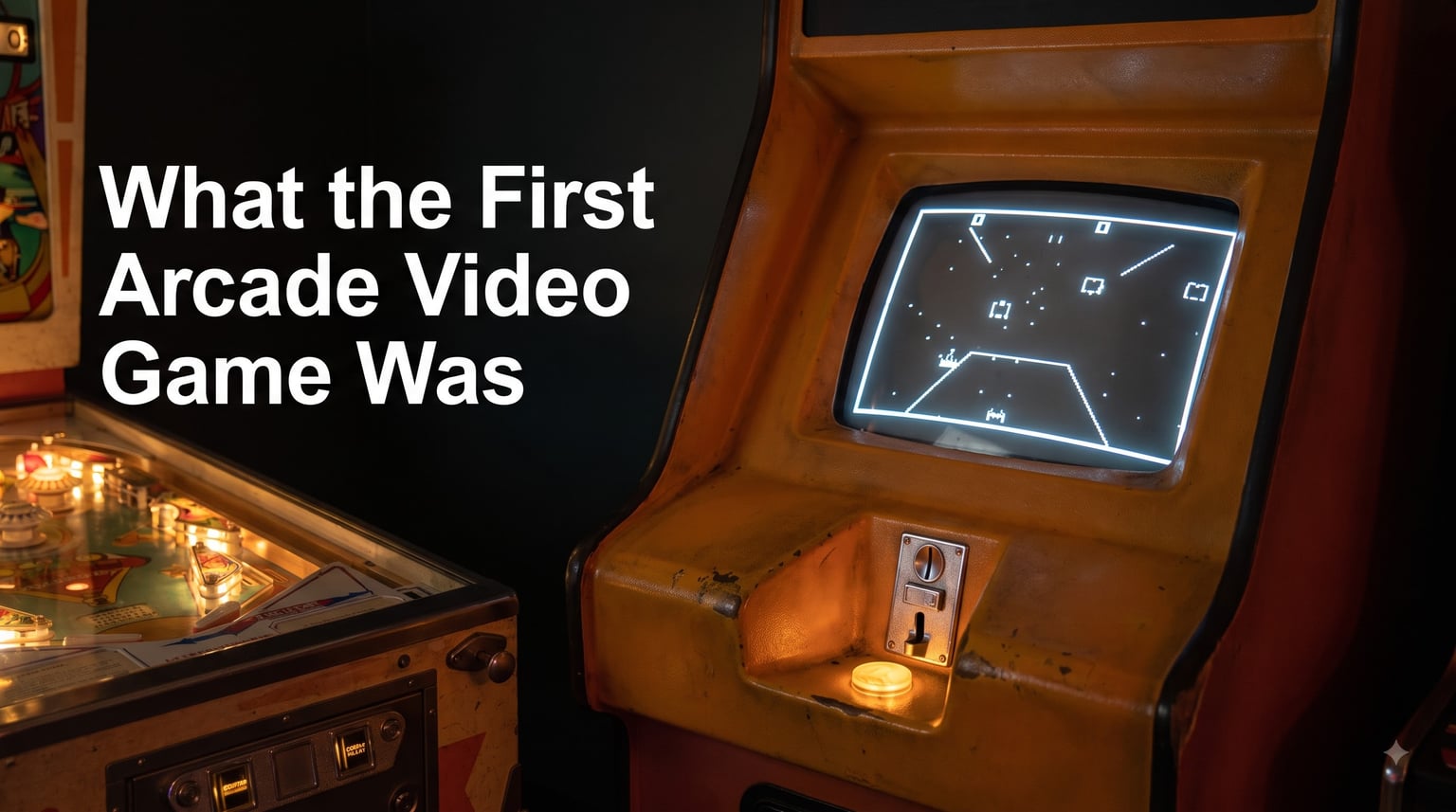
The first arcade video game was Computer Space, released in 1971. Nolan Bushnell and Ted Dabney built it as a coin-operated space combat game that let players pilot a rocket and shoot at a flying saucer on a CRT display. If you thought Pong came first, you are not alone. That is the most common misconception in all of gaming history.
Pong was the first commercially successful arcade game, but it arrived a year later in 1972. Computer Space beat it to market and established the template that every arcade cabinet would follow. The problem was that being first did not mean being successful.
In this guide, we cover what the first arcade video game was, who created it, why it failed commercially, and how it paved the way for the multi-billion-dollar gaming industry we know today. We also clear up the Pong confusion that trips up even seasoned retro gaming fans.
Table of Contents
The First Arcade Video Game: Computer Space
Computer Space was the first arcade video game ever sold commercially. It debuted in October 1971, roughly two months before Galaxy Game appeared at Stanford University. The distinction matters because Computer Space was produced for mass distribution while Galaxy Game was a single-unit installation.
The game itself was a one-player space combat simulation. You controlled a rocket ship using two side-mounted buttons and a control panel. Your rocket could rotate, thrust forward, and fire missiles at a pair of enemy flying saucers that moved across the screen. The saucers fired back, and the physics-based movement meant your ship drifted through space with momentum.
Behind the scenes, the hardware was remarkably clever. Bushnell and Dabney built Computer Space without a microprocessor because affordable ones did not exist yet. Instead, they used discrete logic chips, transistors, and diodes wired together to generate the video signal directly. The image you saw on screen was produced by custom circuitry sending signals to a standard CRT television tube at 60 frames per second.
That technical approach was genuinely groundbreaking. No one had figured out how to run a video game on consumer-grade hardware inside a coin-operated cabinet before. The fact that it worked at all is what earned Computer Space its place in history as the first arcade video game.
Nutting Associates manufactured the original cabinets. They produced roughly 1,500 units in two versions: a single-player model with the iconic fiberglass cabinet and a later two-player variant. Today, original Computer Space cabinets are extremely rare and sought after by collectors.
The Minds Behind It: Nolan Bushnell and Ted Dabney
Nolan Bushnell and Ted Dabney are the two people responsible for the first arcade video game. They met in the late 1960s while working at Ampex, an electronics company in California. Bushnell was an engineer with a passion for games, and Dabney was a skilled circuit designer who could make hardware do things others thought were impossible.
Before founding Atari, the two started a partnership called Syzygy Engineering in 1971. The name came from an astronomy term Bushnell liked, but they soon discovered another company had already trademarked it. When they incorporated their arcade game company in 1972, they chose the name Atari instead, borrowed from the board game Go.
Their inspiration came from Spacewar!, a program created at MIT in 1962. Spacewar! ran on a massive PDP-1 computer and let two players battle each other with spaceships. Bushnell had played it as an engineering student at the University of Utah and became convinced he could build a version that people would pay to play.
That conviction led directly to Computer Space. Bushnell handled the game design and business strategy while Dabney engineered the hardware that made it possible. Together, they proved that video games could exist outside university laboratories and enter the commercial world. Without their partnership, the arcade industry might never have been born.
Before Computer Space: The Pre-Arcade Era
To understand what the first arcade video game was, you have to understand what came before it. The arcade industry did not start with video games at all. For decades before 1971, arcades were filled with pinball machines, mechanical games, and novelty amusements.
Pinball dominated coin-operated entertainment from the 1930s onward. Early pinball machines had no flippers and relied purely on gravity and bumpers. Flippers were introduced in 1947, transforming pinball into the game most people recognize today. By the 1960s, pinball was a massive industry with manufacturers like Bally and Williams competing fiercely.
The conceptual ancestor of the first arcade video game was Spacewar!, developed in 1962 by Steve Russell and a group of students at MIT. It ran on the PDP-1, a computer that cost roughly $120,000 at the time. Only a handful of people ever played it because the hardware was so rare and expensive.
In 1971, a parallel effort produced Galaxy Game at Stanford University. Two students, Bill Pitts and Hugh Tuck, built a single coin-operated machine running a Spacewar! clone on a PDP-11 computer. Galaxy Game was installed in the Tresidder Union at Stanford and attracted players who paid 10 cents per game or three games for a quarter. It technically appeared slightly after Computer Space, but it was never mass-produced.
So when people ask what the first arcade video game was, the answer depends on the definition. Computer Space was the first commercially produced and distributed arcade video game. Galaxy Game was the first coin-operated video game installed in a public venue, but it remained a one-unit project. Both appeared in 1971, and both traced their roots back to Spacewar!.
Why Computer Space Failed Despite Being First
This is the question almost no competitor answers, and it is the most fascinating part of the story. Computer Space was a commercial failure despite being the first arcade video game. The reasons tell us a lot about what makes a game succeed.
The biggest problem was difficulty. Computer Space used real Newtonian physics, which meant your rocket ship drifted through space with inertia. If you thrust in one direction, your ship kept moving even after you stopped pressing the button. Players had to learn to rotate, thrust, and counter-thrust to control their ship, which felt natural to engineering students but deeply confusing to the general public.
The controls themselves were also unintuitive. Instead of a joystick, the cabinet used push buttons for rotation and thrust. Most people who walked up to a Computer Space cabinet had never played a video game before. They could not figure out the controls in the few seconds before their first game ended.
Bushnell himself acknowledged the problem. He later said the game was simply too complicated for bars and arcades, where people wanted something they could understand instantly after a drink or two. The learning curve was too steep for a casual audience in 1971.
Distribution was another issue. Nutting Associates placed about 1,500 units, but many ended up in locations where the audience had no interest in complex science fiction games. Bar owners and arcade operators did not know how to explain the game to customers. There were no instructions on screen and no tutorial mode.
The lesson Bushnell took from this failure shaped everything that came next. He realized that simplicity was the key to commercial success in arcades. That insight led directly to Pong, a game so simple that anyone could understand it in five seconds.
Pong: The First Commercially Successful Arcade Game
Pong was not the first arcade video game, but it was the first one that actually made money. Released by Atari in 1972, it took everything Computer Space got wrong and flipped it on its head.
The gameplay was dead simple. Two paddles, one ball, and a single rule: hit the ball past your opponent to score. There were no physics simulations, no complex controls, and no learning curve. You moved your paddle up or down with a single knob, and the game explained itself the moment you started playing.
The first Pong prototype was installed at Andy Capp’s Tavern in Sunnyvale, California. Within days, the machine stopped working because the coin mechanism was jammed with so many quarters. That is the kind of problem every arcade operator dreams about.
Atari could not build Pong cabinets fast enough. The company went from a small startup to a major force in the entertainment industry within a couple of years. Pong proved that arcade video games were not a novelty but a viable business. It spawned countless imitators and launched the arcade boom of the late 1970s and early 1980s.
The contrast between Computer Space and Pong is one of the most important lessons in game design history. Being first means nothing if the audience cannot engage with your product. Accessibility, not innovation, was what turned video games into an industry.
The Legacy of the First Arcade Video Game
Computer Space may have failed commercially, but its legacy is enormous. It proved that a video game could run on affordable hardware inside a coin-operated cabinet. Every arcade machine that followed, from Pong to Pac-Man to Street Fighter II, owes its existence to the technical breakthroughs Bushnell and Dabney achieved in 1971.
The first arcade video game also set the stage for the home console market. The success of Pong arcade cabinets led Atari to develop home versions, which eventually connected to the founding of the cartridge-based console era. The Atari 2600, released in 1977, brought arcade-style gaming into living rooms and created the home video game industry.
Modern arcades may look different from their 1970s ancestors, but the core concept remains. A coin-operated machine in a public place offering interactive entertainment started with Computer Space. That simple idea grew into an industry now worth over $200 billion globally.
FAQs
Which came first, Pong or Atari?
Atari came first. The company was founded in 1972 by Nolan Bushnell and Ted Dabney, and Pong was their first major product, released later that same year. Before Atari, Bushnell and Dabney built Computer Space in 1971 under the name Syzygy Engineering, making Computer Space older than both Atari and Pong.
What is older, Tetris or Pac-Man?
Pac-Man is older. Pac-Man was released in arcades in 1980, while Tetris was created by Soviet engineer Alexey Pajitnov in 1984. Both games came years after the first arcade video game, Computer Space, which debuted in 1971.
Was Atari or Nintendo first?
Atari was first by more than a decade. Atari was founded in 1972 and released the first arcade video game industry’s breakout hit, Pong. Nintendo did not enter the video game market until 1977 with the Color TV-Game series in Japan, and the original Nintendo company was founded in 1889 as a playing card manufacturer.
What came first, casinos or arcades?
Casinos came first by a wide margin. Gambling establishments date back centuries, with the first recognized casino opening in Venice, Italy, in 1638. Coin-operated amusement machines appeared in the late 1800s, pinball machines rose in the 1930s, and the first arcade video game, Computer Space, did not arrive until 1971.
Was Pong the first arcade game?
No, Pong was not the first arcade game. The first arcade video game was Computer Space, released in 1971. Pong was the first commercially successful arcade game, released in 1972. Many people confuse the two because Pong became famous while Computer Space failed commercially.
What came before Computer Space?
Before Computer Space, the main influence was Spacewar!, a computer game created at MIT in 1962 by Steve Russell. Also in 1971, Galaxy Game appeared at Stanford University as a coin-operated Spacewar clone, but it was never mass-produced. Pinball machines were the dominant coin-operated entertainment from the 1930s through the 1960s.
Conclusion
So what was the first arcade video game? The answer is Computer Space, built by Nolan Bushnell and Ted Dabney and released in 1971. It was a space combat game running on custom-built hardware inside a coin-operated fiberglass cabinet, and it proved that video games could work as commercial products.
The fact that most people guess Pong tells you everything about the difference between being first and being successful. Computer Space was too complex for its audience and failed commercially. Pong took the lessons from that failure, simplified everything, and launched an industry.
Understanding this history matters because it shows that accessibility, not technical innovation, is what made video games a global phenomenon. The same principle still applies today. The most popular games in 2026 are the ones anyone can pick up and play within seconds.
If you want to dig deeper into arcade history, start with the transition from Computer Space to Pong, then follow the golden age of arcade games through the late 1970s and early 1980s. That decade gave us Pac-Man, Donkey Kong, and the birth of the home console. It all traces back to a single rocket ship drifting through space on a CRT screen in 1971.
1 thought on “What the First Arcade Video Game Was (October 2026)?”