
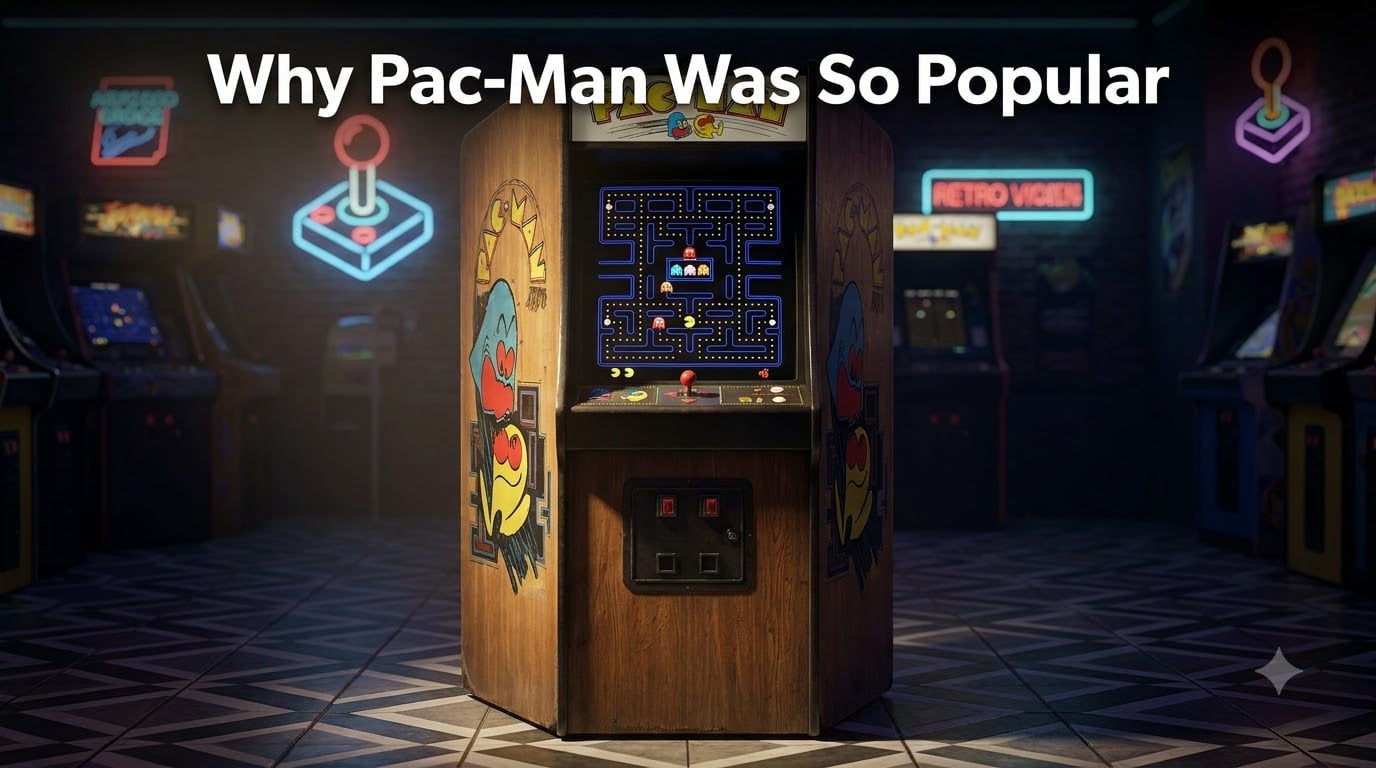
When Pac-Man arrived in arcades on July 3, 1980, nobody at Namco expected it would become the highest-grossing arcade game of all time. The game earned an estimated $14 billion in revenue across multiple formats and became a genuine cultural phenomenon that transcended gaming entirely. If you have ever wondered why Pac-Man was so popular, the answer involves a perfect storm of brilliant design, perfect timing, and a creator who set out to build something completely different from everything else in the arcade.
I have spent years studying arcade history, and Pac-Man stands out as the one game that fundamentally changed who played video games and how the public thought about them. Before Pac-Man, arcades were smoky rooms filled with shooting games and space shooters aimed squarely at teenage boys. After Pac-Man, arcades became family destinations. Couples went on dates to play it. Women lined up to play it. Kids begged their parents for quarters.
In this guide, I will walk you through the complete story of why Pac-Man captured the world. We will cover the legendary creation story, the deceptively simple gameplay, the groundbreaking appeal to new audiences, the iconic ghost characters, the massive cultural impact, and the Japanese design philosophy that made it all click together. By the end, you will understand exactly why this little yellow circle became one of the most recognizable characters in pop culture history.
Table of Contents
- The Creation Story: Toru Iwatani and the Pizza Legend
- Simple Yet Addictive Gameplay Mechanics
- Breaking the Mold: How Pac-Man Appealed to Women and Children
- The Ghost Gang: Four Characters With Real Personalities
- Cultural Impact and the Merchandise Empire
- Japanese Aesthetic Roots: Kawaii and Wabi-Sabi
- Legacy and Enduring Popularity
- FAQs
- Conclusion
The Creation Story: Toru Iwatani and the Pizza Legend
The story of why Pac-Man was so popular starts with a young Namco employee named Toru Iwatani. In 1977, at just 22 years old, Iwatani joined Namco with one driving ambition: he wanted to create a video game that would appeal to women, not just the young men who dominated arcades. At the time, the entire arcade industry was built around shooting aliens, blowing up tanks, and competing for high scores in aggressive, violent environments.
Iwatani spent nearly two years developing his concept. He wanted a game built around the idea of eating rather than destroying. He drew inspiration from the Japanese word “paku,” which mimics the sound of a mouth opening and closing rapidly. The name Pac-Man came directly from this onomatopoeia, capturing the rhythmic chomping that would become the game’s signature audio.
The most famous part of the creation story involves a pizza. Legend has it that Iwatani was staring at a pizza with one slice missing when the shape of Pac-Man suddenly came to him. The round yellow circle with the wedge-shaped mouth opening looked exactly like a pizza missing a slice. Iwatani himself has confirmed this story in multiple interviews over the decades, though some details have shifted in retelling. What is certain is that the simple circular shape became one of the most recognizable silhouettes in entertainment history.
Iwatani assembled a small team that included programmer Shigeo Funaki and sound designer Toshio Kai. Together they built a maze-chase game where the player navigated corridors eating dots while avoiding four colorful ghosts. The game was originally called Puck-Man in Japan when it launched in October 1979, but when Midway licensed it for American distribution in 1980, the name was changed to Pac-Man to prevent vandals from scratching the “P” into an “F” on arcade cabinets.
The decision to change the name turned out to be one of many smart moves. Pac-Man launched in the United States in late 1980 and exploded in popularity through 1981 and 1982. It became so ubiquitous that it generated its own cultural vocabulary, its own merchandise empire, and even its own chart-topping music. But none of that would have happened without the genius of the gameplay itself.
Simple Yet Addictive Gameplay Mechanics
If you want to understand why Pac-Man was so popular, look first at the controls. The entire game uses a single joystick. No buttons, no fire keys, no complex combinations. You move Pac-Man up, down, left, or right through a maze, and he automatically eats any dots in his path. That is the entire control scheme. This radical simplicity meant anyone could walk up to an arcade cabinet and start playing within five seconds.
But underneath that simplicity sat a layer of depth that kept players coming back. The maze has a specific layout with two tunnels on the sides that wrap around, allowing Pac-Man to escape from one side of the screen to the other. The ghosts cannot travel through these tunnels as quickly as Pac-Man, which creates strategic escape routes. Every corridor, every corner, and every dead end in the maze matters.
The game also introduced the concept of bonus fruit that appears periodically in the center of the maze. Cherries, strawberries, peaches, apples, grapes, and other fruits offer increasing point values, rewarding players who take risks to grab them while ghosts are nearby. This risk-versus-reward tension became a core part of the psychological hook.
What made the gameplay truly addictive was the escalating difficulty curve. Each level presents the same maze, but the ghosts move faster and their behavior patterns shift. Early levels are forgiving, giving new players a sense of accomplishment. Later levels become punishingly difficult, creating a challenge that competitive players could spend months trying to master. There is even a famous level 256 bug that corrupts the screen, creating an unbeatable level that became the ultimate achievement for the world’s best players.
The audio design deserves special mention too. The iconic “wakka-wakka-wakka” chomping sound that plays as Pac-Man eats pellets is instantly recognizable to this day. Sound designer Toshio Kai created audio feedback that made every pellet feel satisfying to consume. The sound of the power pellet activating, the escalating pitch of the siren as levels progress, and the distinctive death jingle all contribute to a sensory experience that kept players feeding quarters into the machine.
Breaking the Mold: How Pac-Man Appealed to Women and Children
Perhaps the single biggest reason Pac-Man was so popular was its audience. Before Pac-Man, arcade games like Space Invaders, Asteroids, and Defender attracted a primarily male teenage audience. The arcades themselves had a reputation for being rough, intimidating spaces that most adults and nearly all women avoided entirely. Iwatani saw this as a problem and an opportunity.
He deliberately designed Pac-Man to be nonviolent, colorful, and approachable. Instead of shooting enemies, you eat dots. Instead of explosions and warfare, you have a cheerful yellow character being chased through a vibrant blue maze by ghosts with cute rounded designs. The game has no blood, no weapons, and no threatening imagery. This was a revolutionary approach in an era where every successful arcade game was based on combat.
The strategy worked beyond anyone’s expectations. Women began showing up at arcades in numbers the industry had never seen. Market research from the early 1980s showed that Pac-Man’s player base was nearly evenly split between men and women, an almost unheard-of achievement at the time. The game also drew younger players, including children who found the controls easy enough to handle and the characters engaging enough to love.
Reddit discussions in retro gaming communities consistently highlight this nonviolent design as one of the most praised aspects of Pac-Man. Players value the simplicity as a genuine strength rather than a limitation. The fact that you could play a game about eating rather than killing made it feel wholesome and inviting in a way that nothing else in the arcade could match.
This broader demographic appeal transformed the economics of arcades. Operators who installed Pac-Man cabinets reported earnings that dwarfed their other machines. The game was so popular with general audiences that it expanded the entire arcade market, pulling in casual players who had never considered themselves gamers. By making video games acceptable to everyone, Pac-Man laid the groundwork for the mainstream gaming culture we take for granted today.
The Ghost Gang: Four Characters With Real Personalities
One of the most overlooked reasons Pac-Man was so popular is the ghost AI. The four ghosts that chase Pac-Man through the maze are not random or interchangeable. Each one has a distinct personality encoded into its movement patterns, and this was a genuine breakthrough in game design for 1980.
Blinky is the red ghost, and he is the most aggressive. His AI programming makes him chase Pac-Man directly, always heading toward the player’s current position. He is relentless and predictable, making him dangerous but manageable if you understand his pattern. Of the four ghosts, Blinky is the one that most directly threatens the player at all times.
Pinky is the pink ghost, and she is the strategist. Instead of chasing where Pac-Man currently is, Pinky targets four spaces ahead of where Pac-Man is heading. This means she tries to cut you off and ambush you, forcing players to think about where they are going, not just where they are. Experienced players learn to fake Pinky out by changing direction suddenly.
Inky is the cyan ghost, and his behavior is the most unpredictable. His movement is calculated based on a combination of Blinky’s position and Pac-Man’s position, creating a flanking behavior that is hard to anticipate. Inky essentially uses Blinky as a reference point, which means the two ghosts work together as a team without any explicit coordination programming.
Clyde is the orange ghost, and he is the oddball. Clyde chases Pac-Man when he is far away, but when he gets close, he retreats to the bottom-left corner of the maze. This back-and-forth behavior makes him less directly threatening than the others, but his unpredictability can still catch you off guard. Many players underestimate Clyde, which is exactly his advantage.
The genius of these four personalities is that they create emergent gameplay. Because each ghost behaves differently, the maze feels alive. You cannot simply memorize one pattern and win forever, because the interactions between four distinct AI behaviors create constantly shifting tactical situations. This is why competitive Pac-Man players spend hundreds of hours studying ghost patterns and why the game has maintained a tournament scene for decades.
The power pellet mechanic adds another layer. When Pac-Man eats a power pellet, the ghosts turn blue and become vulnerable. For a few seconds, the hunter becomes the hunted, and Pac-Man can eat the ghosts for bonus points. This reversal of power dynamics is psychologically satisfying in a way that never gets old. The ghosts flash white just before the power pellet effect wears off, creating a tense decision: do you risk chasing one more ghost or play it safe?
Cultural Impact and the Merchandise Empire
Pac-Man did not just dominate arcades. It became the first video game character to spawn a genuine merchandise empire. By 1982, the yellow circle’s face was on lunchboxes, t-shirts, stickers, board games, breakfast cereal, and even a Saturday morning cartoon show. There were Pac-Man plush toys, Pac-Man trading cards, and Pac-Man Halloween costumes. The character became as recognizable as Mickey Mouse, and he did it in a fraction of the time.
The merchandise explosion was unprecedented in the gaming industry. No video game before Pac-Man had generated this kind of cross-media presence. Atari games did not have characters you could put on a cereal box. Space Invaders did not have personalities that warranted a cartoon. Pac-Man was the first game character that people connected with on an emotional level, treating him almost like a pet or a mascot rather than just a collection of pixels.
The music world took notice too. In 1981, Buckner and Garcia released “Pac-Man Fever,” a novelty song about the obsession with the game. The track reached number nine on the Billboard Hot 100 and sold over one million copies. An entire album of video game-themed songs followed, cementing Pac-Man’s place in the broader pop culture landscape of the early 1980s. When a video game inspires a hit song, you know it has transcended its medium.
The financial numbers tell the story of just how massive Pac-Man’s popularity was. The game generated an estimated $14 billion in revenue across arcade cabinets, home console ports, and merchandise. By most measures, it remains the highest-grossing arcade game of all time. At the peak of its popularity, there were estimated to be over 400,000 Pac-Man arcade cabinets worldwide, making it nearly impossible to find an arcade, bar, or pizza restaurant that did not have one.
Ms. Pac-Man, released in 1982, became one of the best-selling arcade games in its own right and is considered by many players to be superior to the original. The sequel was originally developed as an enhancement kit by General Computer Corporation before being licensed to Midway. It introduced moving fruit bonuses, different maze layouts, and slightly smarter ghost AI. The fact that a Pac-Man spin-off became a massive hit speaks to the strength of the core concept.
The cultural impact extended into unexpected areas too. Scientists have used Pac-Man in research on spatial navigation and brain function, including studies with monkeys that demonstrated how the brain processes maze navigation. The game has appeared in films, television shows, and even art exhibitions. In 2010, Google replaced its homepage logo with a playable Pac-Man game, and users spent an estimated 4.8 million hours playing it, making it the most expensive Google Doodle in history in terms of lost productivity.
Japanese Aesthetic Roots: Kawaii and Wabi-Sabi
One angle that most coverage of Pac-Man misses is the Japanese cultural philosophy behind its design. Toru Iwatani did not just create a game in a vacuum. He was working within a distinctly Japanese aesthetic tradition that shaped every decision he made, from the character design to the color palette to the overall feel of the experience.
The concept of kawaii, which translates roughly to “cute” or “adorable,” was a major cultural force in Japan during the 1970s. It influenced fashion, product design, and increasingly popular media. Iwatani explicitly designed Pac-Man and the ghosts to be kawaii, with their rounded shapes, bright colors, and non-threatening appearance. This was not accidental. The cuteness was a deliberate strategy to make the game feel friendly and approachable, especially to audiences who found other arcade games intimidating.
The ghosts are a perfect example of kawaii design applied to enemies. Instead of scary monsters, the four ghosts are round, colorful, and almost cartoonish. Their googly eyes and smooth bodies make them feel more like playful rivals than genuine threats. Even when they catch Pac-Man, there is no violent death animation, just a simple deflation effect. This design choice keeps the game feeling lighthearted regardless of how intense the chase becomes.
Researchers at Sheffield Hallam University have connected Pac-Man’s design to the concept of wabi-sabi, a Japanese aesthetic philosophy that finds beauty in simplicity, imperfection, and understatement. Pac-Man is a yellow circle with a mouth. The maze is made of straight blue lines. The dots are small white circles. Every element is stripped down to its absolute minimum, yet the combination creates something that feels complete and satisfying. There is nothing you could remove without breaking the game, and nothing you need to add.
This wabi-sabi sensibility is a big reason why Pac-Man has aged so gracefully. The original game still looks good today because its visual design is fundamentally clean and purposeful. Compare it to other games from 1980 that tried to simulate realistic graphics with primitive hardware and now look dated. Pac-Man never tried to look realistic, so it never became dated. Its simplicity is timeless by design.
Legacy and Enduring Popularity
More than four decades after its release, Pac-Man remains one of the most recognized video game characters on the planet. The question of why Pac-Man is still popular today has several answers. Nostalgia plays a huge role, as players who grew up with the game now share it with their children and grandchildren. The simple controls and instant accessibility mean anyone can still pick it up and enjoy it without a tutorial.
The competitive Pac-Man scene is still active, with tournaments and world record attempts generating excitement in the retro gaming community. The pursuit of a perfect game, clearing 256 levels without losing a life, remains one of the most difficult achievements in arcade gaming history. Players like Billy Mitchell and David Race have become legends in this niche community for their Pac-Man accomplishments.
Bandai Namco has kept the franchise alive through dozens of sequels, reboots, and spin-offs. While some fans on retro gaming forums feel that Pac-Man does not always get the same respect as Mario or Sonic, the character’s cultural footprint remains enormous. In 2026, Pac-Man continues to appear in new games, collaborations, and media, proving that the original design has lasting power that transcends any single generation of gaming.
The forum community also offers some honest perspectives on Pac-Man’s decline from its 1980s peak. Many of the follow-up games were just variations on the original maze formula, and the character never fully transitioned into the narrative-driven gaming experiences that came to dominate the industry. But the core game itself is considered so perfectly designed that it needs no improvement. It is a complete, self-contained masterpiece of arcade gaming.
FAQs
What year was Pac-Man most popular?
Pac-Man reached its absolute peak popularity in 1981 and 1982. The game launched in Japanese arcades in October 1979 and hit the United States in late 1980, but it was during 1981 that the cultural explosion truly took hold. By 1982, Pac-Man Fever was a chart-topping song, merchandise was everywhere, and an estimated 400,000 arcade cabinets were in operation worldwide.
Why did Pac-Man become so popular?
Pac-Man became popular because of five key factors working together: its radical simplicity with a single-joystick control scheme, its nonviolent and colorful design that attracted women and children, its four ghosts with distinct AI personalities that created endlessly replayable gameplay, its kawaii Japanese aesthetic that made it universally approachable, and perfect timing in the early 1980s arcade boom when the public was hungry for something new.
Why isn’t Pac-Man popular anymore?
Pac-Man declined from its 1980s peak because most follow-up games were variations of the same maze formula rather than genuine innovations, and the character never transitioned into the narrative-driven gaming experiences that later dominated the industry. However, Pac-Man has never truly disappeared. The original game remains widely played, the character is still globally recognized, and Bandai Namco continues producing new Pac-Man content.
Who is Pac-Man’s worst enemy?
Blinky, the red ghost, is considered Pac-Man’s worst enemy because he is the most aggressive of the four ghosts. Blinky’s AI directly targets Pac-Man’s current position and chases relentlessly. In later levels, Blinky speeds up when few dots remain, earning him the nickname Cruise Elviro for his acceleration behavior. While all four ghosts are threats, Blinky is the one that poses the most direct and constant danger.
What is the Pac-Man death theory?
The Pac-Man death theory is a fan interpretation that suggests the game represents a cycle of life and death, where Pac-Man is trapped in an endless loop of consuming and being consumed. Some fans also point to the level 256 glitch, which makes the game unbeatable, as a metaphor for mortality and the limits of existence. These theories are not official lore but reflect how deeply players have engaged with the game’s themes.
Conclusion
Understanding why Pac-Man was so popular means recognizing that it was never just one thing that made the game special. It was a convergence of brilliant design decisions, each one reinforcing the others. Toru Iwatani set out to create a game for women and ended up creating a game for everyone. He stripped the experience down to a single joystick and a yellow circle, and in doing so, he created something that still feels perfect decades later.
The four ghosts with their distinct AI personalities gave the maze a sense of life that no other arcade game matched in 1980. The kawaii aesthetic and wabi-sabi simplicity made Pac-Man universally approachable, breaking down the demographic barriers that had kept gaming in a narrow niche. The merchandise empire and pop culture crossover proved that video games could be more than just quarter-eating machines in dark rooms.
If there is one lesson to take from the story of Pac-Man, it is that simplicity done right is timeless. The game has no story, no cutscenes, no dialogue, and no tutorial. And yet it has remained relevant for over 45 years while countless technologically superior games have been forgotten. The next time you see that yellow circle with the missing slice, remember that you are looking at one of the most important designs in entertainment history.
Whether you are a retro gaming enthusiast revisiting a childhood favorite or a newcomer curious about gaming history, Pac-Man deserves your attention. Find an arcade cabinet, load up a modern port, or try the countless browser versions available online. The best way to understand why Pac-Man was so popular is to experience it yourself.