
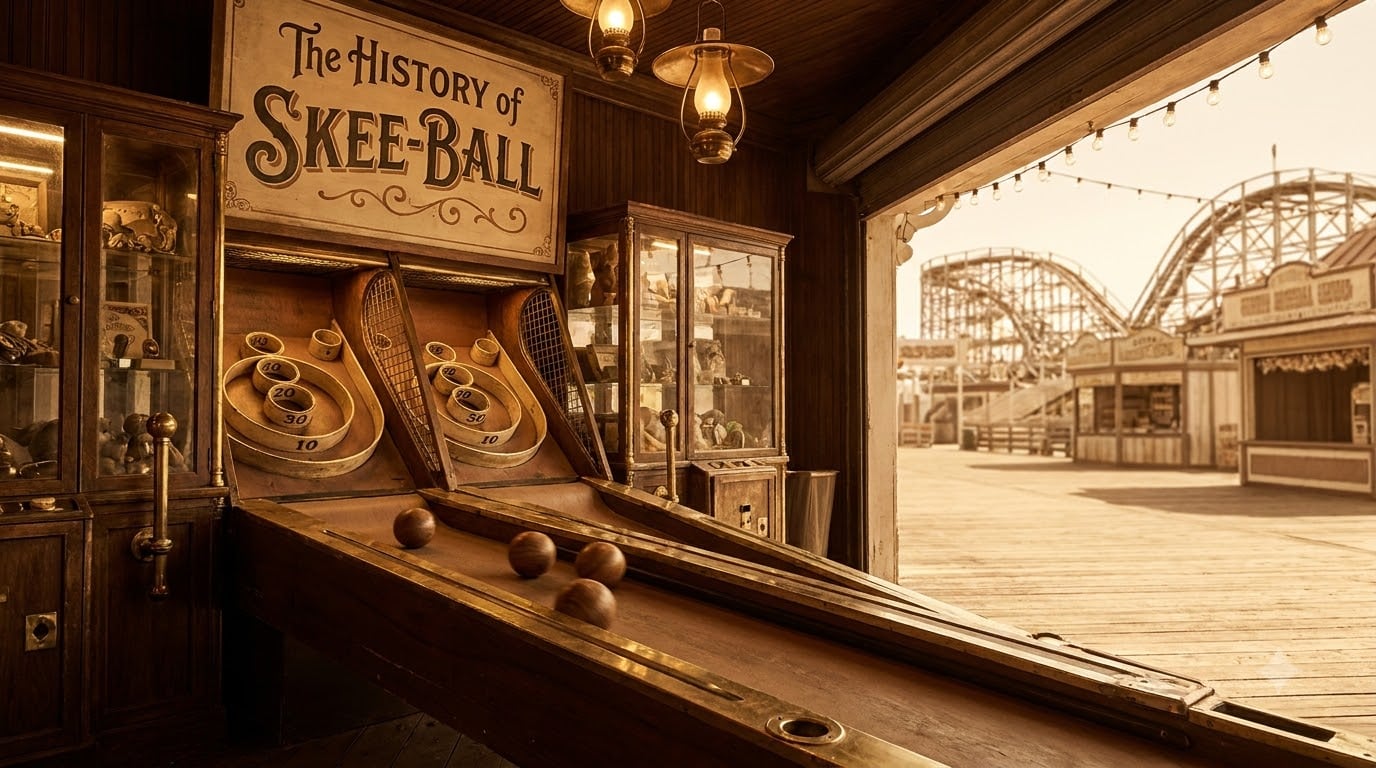
Picture a summer evening on the Jersey boardwalk. The smell of saltwater taffy mixes with the electric hum of arcade cabinets, and somewhere in the back corner, you hear the unmistakable sound of a wooden ball rolling up a ramp and dropping into a scoring ring. That game is Skee-Ball, and the history of Skee-Ball stretches back over 115 years to a workshop in Vineland, New Jersey.
If you have ever wondered who invented Skee-Ball, why it has that funny name, or how a simple ramp-and-ball game survived two world wars, the Great Depression, and the video game revolution, you are in the right place. I have spent years researching arcade history, and Skee-Ball’s story is one of the most fascinating in all of coin-operated gaming.
Skee-Ball came out in 1908. It was invented by Joseph Fourestier Simpson, a prolific inventor from Vineland, New Jersey, who received U.S. Patent 905,941 for his design. That single patent launched what would become one of the most recognizable arcade games in history and the first true redemption game.
Table of Contents
- Who Invented Skee-Ball?
- The Original Skee-Ball Alleys: 1908 to 1914
- J.D. Este and the Atlantic City Boom: 1914 to 1919
- The 1928 Alley Shortening That Changed Everything
- The First National Skee-Ball Tournament (1932)
- Corporate Ownership: From Wurlitzer to Bay Tek Games
- The Redemption Game Revolution
- Skee-Ball in the Modern Era: Leagues, Bars, and Home Arcades
- Skee-Ball in Pop Culture and Trivia
- Frequently Asked Questions
- Over a Century of Skee-Ball
Who Invented Skee-Ball?
Joseph Fourestier Simpson invented Skee-Ball. He was a career inventor living in Vineland, New Jersey, a small town in Cumberland County with a surprising history of innovation. Simpson held multiple patents and was always looking for his next breakthrough.
The idea came to him from two sources. He was inspired by traditional bowling, but he also drew from the ski jumps that were popular entertainment in the early 1900s. Simpson’s genius was combining the two concepts into something that could fit inside an arcade or amusement hall. He designed an inclined ramp with a raised bump in the middle that launched the ball upward toward a target board with scoring holes.
That bump is called the ball-hop, and it is the defining mechanical feature of Skee-Ball. Without it, the ball would just roll flat. With it, players had to develop real skill to get the ball airborne and into the high-scoring rings. Simpson received U.S. Patent 905,941 for his design on December 8, 1908.
As for the name, Simpson chose “Skee-Ball” as a nod to the ski jump inspiration. The word “skee” comes from the Old Norse word for ski, and the skiing connection made sense given the ball’s launching motion up the ramp. The name stuck, and it has been trademarked, defended, and licensed ever since.
The Original Skee-Ball Alleys: 1908 to 1914
The first Skee-Ball alleys were nothing like the compact machines you see in arcades today. Simpson’s original design used alleys that were 32 feet long. That is nearly the length of a bowling lane, and it meant the game required significant floor space. Only the largest amusement parks and boardwalk pavilions could accommodate them.
Simpson partnered with William W. Harper and John C. Nice to manufacture and distribute the game. Harper handled the financial side, while Nice oversaw production. Together they formed the Skee-Ball Company and began installing alleys along the New Jersey boardwalk, where the summer tourist trade provided a steady stream of players.
But the early years were not easy. The 32-foot alley was expensive to build and ship, and it took up so much room that few operators could justify the investment. The game was popular with players, but the business model was shaky. Simpson and his partners struggled to turn a consistent profit, and by the early 1910s, the company needed outside help to survive.
What saved Skee-Ball was a businessman from Philadelphia who saw the game’s potential and had the resources and connections to take it to the next level.
J.D. Este and the Atlantic City Boom: 1914 to 1919
In 1914, Jonathan Dickinson Este purchased the Skee-Ball Company. Este was a wealthy businessman from Philadelphia with strong ties to the amusement industry and the growing resort town of Atlantic City. He recognized that Skee-Ball needed better marketing, wider distribution, and a more accessible format to reach its potential.
Este immediately pushed the game onto the Atlantic City boardwalk, which in the 1910s was the premier entertainment destination on the East Coast. Millions of tourists visited each summer, and the boardwalk was lined with arcades, fortune tellers, and novelty attractions. Skee-Ball alleys became a fixture, and the game developed a loyal following among vacationers who returned year after year.
Este was also an aggressive marketer. He promoted Skee-Ball as a wholesome, skill-based game that the whole family could enjoy, distancing it from gambling-adjacent amusements that drew scrutiny from reformers. This positioning was smart for the era, when Progressive Era reformers were actively campaigning against slot machines and other games of chance.
Under Este’s leadership, Skee-Ball expanded beyond New Jersey. Alleys appeared at amusement parks and carnivals across the country. The game was no longer a novelty from a small New Jersey town. It was becoming a national brand.
Este’s most consequential decision, however, would come in 1928, and it would change the game forever.
The 1928 Alley Shortening That Changed Everything
In 1928, the Skee-Ball Company shortened the alley from 32 feet to 14 feet. This was the single most important design change in the game’s history, and it transformed Skee-Ball from a niche attraction into a mainstream sensation.
The shorter alley meant that a Skee-Ball installation required less than half the floor space. Arcades, boardwalk pavilions, and family entertainment centers that could never fit a 32-foot lane could now install multiple Skee-Ball alleys side by side. For operators, this meant more revenue per square foot. For players, it meant more chances to play.
The shorter alley also made the game accessible to children. A 32-foot lane required a full-grown adult to generate enough speed to get the ball over the hop. A 14-foot lane could be played by kids as young as six or seven, which opened up an entirely new demographic. Families with children became the core Skee-Ball audience, and the game developed the intergenerational appeal that has sustained it for nearly a century since.
This design change also coincided with the growing popularity of coin-operated amusement machines in the late 1920s. Skee-Ball was perfectly positioned to capitalize on that trend, and by the early 1930s, the game was ready for its next milestone.
The First National Skee-Ball Tournament (1932)
In 1932, the first national Skee-Ball tournament was held at the Atlantic City Skee-Ball Stadium. This was a major event that brought together the best players from across the country to compete for prizes and bragging rights. Atlantic City was still the center of the Skee-Ball world, and the tournament cemented the game’s reputation as a legitimate skill-based competition.
The tournament was a marketing triumph. It generated newspaper coverage, drew crowds of spectators, and gave players a reason to practice and improve. Competitive Skee-Ball was born, and the format would be replicated at amusement parks and arcades for decades to come.
However, this period was not without controversy. In 1931 and 1932, a legal dispute erupted over Skee-Ball’s intellectual property and distribution rights. The lawsuit tested the strength of Simpson’s original patent and the ownership claims that had been transferred through the Harper and Nice partnership and eventually to Este. The details of the case involved competing claims to the Skee-Ball name and design, and the outcome shaped how the game would be licensed and manufactured going forward.
The resolution of the lawsuit cleared the path for Skee-Ball to enter its next phase, one dominated by one of the biggest names in American manufacturing.
Corporate Ownership: From Wurlitzer to Bay Tek Games
Skee-Ball’s corporate history is a journey through some of the biggest names in the amusement and music industries. The game has changed hands multiple times, and each owner brought something different to the table.
1936 to 1940s: Wurlitzer. The Wurlitzer Company, famous for its jukeboxes and organs, acquired Skee-Ball in 1936. Wurlitzer brought mass-production expertise and a national distribution network. Under Wurlitzer, Skee-Ball machines became more standardized, and the game spread into skating rinks, movie theaters, and roadside attractions. Wurlitzer also began experimenting with coin mechanisms and scoring systems that would set the stage for later innovations.
1940s to 1985: Philadelphia Toboggan Company. The Philadelphia Toboggan Company (PTC), primarily known for manufacturing roller coasters and carousels, took over Skee-Ball production in the 1940s. PTC owned the game for roughly 40 years, making it the longest-tenured steward in Skee-Ball history. During the PTC era, Skee-Ball became a fixture in family entertainment centers and boardwalk arcades across America. PTC also oversaw a major technical innovation: the 1960 automatic ticket dispenser patent.
1960: The Ticket Dispenser Patent. In 1960, a patent was filed for an automatic ticket dispenser that would change how Skee-Ball and other arcade games operated. Instead of an attendant manually tracking scores and handing out prizes, the machine itself would dispense tickets based on the player’s score. This invention turned Skee-Ball into the model for what we now call a redemption game, and it spawned an entire industry of ticket-based arcade amusements.
1985 to 2016: Independence and Transition. After PTC, Skee-Ball passed through several owners. The game maintained its core design but adapted to changing arcade economics. The rise of video games in the 1980s and 1990s posed a threat to mechanical arcade games, but Skee-Ball’s tactile, physical gameplay gave it a durability that no video game could replicate.
2016 to Present: Bay Tek Games. In 2016, Bay Tek Games, a Wisconsin-based amusement manufacturer, acquired Skee-Ball. Bay Tek brought modern manufacturing techniques and a focus on the family entertainment center market. Today, Skee-Ball machines are manufactured in Pulaski, Wisconsin, and the game remains a top earner in arcades, bars, and entertainment venues worldwide. Bay Tek has also expanded into the home arcade market, producing smaller-scale Skee-Ball machines for residential use.
The Redemption Game Revolution
Skee-Ball is widely recognized as the first redemption game, and the concept it pioneered in the 1960s with the automatic ticket dispenser became the backbone of the arcade industry. A redemption game is any arcade machine that awards tickets based on a player’s performance, and those tickets can be exchanged for prizes at a redemption counter.
This was a breakthrough for arcade operators. Before redemption games, players paid to play and received nothing but the experience. With ticket redemption, players had a tangible reward that kept them coming back. The prize counter became a destination in itself, with stuffed animals, electronics, and novelty items displayed behind glass to tempt young players and their parents.
Skee-Ball set the template. Other manufacturers followed with their own redemption games, but Skee-Ball remained the gold standard. The combination of skill-based gameplay, satisfying physical feedback, and ticket rewards created a loop that has proven remarkably durable. Even today, in the era of smartphone games and virtual reality, Skee-Ball remains one of the highest-grossing redemption games on the market.
The redemption model also gave Skee-Ball a second life in bars and adult entertainment venues. In the 2000s and 2010s, barcades began popping up in cities across America, offering craft beer and classic arcade games. Skee-Ball was a natural fit, and the game found an entirely new audience of adults who remembered it from childhood boardwalk trips.
Skee-Ball in the Modern Era: Leagues, Bars, and Home Arcades
Skee-Ball is not just a nostalgic relic. It has a thriving modern competitive scene. Leagues have formed in cities across the country, with the most prominent being Brewskee-Ball, a national Skee-Ball league that started in Brooklyn, New York, and expanded to multiple cities. Players compete in weekly matches, and the top performers advance to national championships.
The competitive scene received national attention in 2019 when a Reddit AMA with the number-one ranked Skee-Ball player went viral. The player, who had won a national championship and a $10,000 prize, answered questions about technique, training, and the surprisingly deep world of competitive Skee-Ball. It was a moment that introduced many people to the fact that Skee-Ball is taken seriously by a dedicated community of players.
Vintage Skee-Ball machines have also proven remarkably durable. Forum discussions on Reddit’s r/cade and r/arcade regularly feature owners of 1940s-era machines that are still in working condition. The mechanical simplicity of the ball-hop design means that with basic maintenance, these machines can last for decades. Enthusiasts trade restoration tips, source replacement parts, and share photos of beautifully preserved vintage alleys.
The home arcade market has also grown significantly. Modern Skee-Ball machines designed for residential use are compact, electronic scoring systems, and built to fit through standard doorways. While full-size commercial machines remain expensive, the availability of home models has brought Skee-Ball into basements, game rooms, and man caves across the country.
Skee-Ball in Pop Culture and Trivia
Skee-Ball’s cultural footprint extends beyond the arcade floor. One of the most interesting connections is to the long-running game show “The Price Is Right,” which featured a pricing game called “Super Ball!!” that was directly inspired by Skee-Ball. Contestants rolled a ball up a miniature Skee-Ball-style ramp, and the game became a fan favorite during its run on the show.
The official Skee-Ball brand also created a mascot named Skeeter, a cartoon character that appeared in marketing materials, promotional events, and brand merchandise. Skeeter was part of a broader effort to position Skee-Ball as a family-friendly entertainment brand rather than just a piece of equipment.
Skee-Ball has appeared in movies, television shows, and music videos as a shorthand for nostalgia, childhood innocence, and summer fun. Its staying power in popular culture is a testament to how deeply embedded the game is in the American experience. Very few coin-operated machines have maintained cultural relevance for over a century.
Frequently Asked Questions
What year did Skee-Ball come out?
Skee-Ball came out in 1908. Joseph Fourestier Simpson of Vineland, New Jersey, received U.S. Patent 905,941 for the game on December 8, 1908. The original alleys were 32 feet long and installed along the New Jersey boardwalk.
Who invented Skee-Ball?
Joseph Fourestier Simpson invented Skee-Ball. He was a career inventor from Vineland, New Jersey, who was inspired by bowling and ski jumps to create a ramp-based arcade game with a ball-hop mechanism.
Why is it called Skee-Ball?
Skee-Ball is named after the ski jump that inspired its design. The word skee comes from the Old Norse word for ski, and Joseph Fourestier Simpson chose the name to reflect the ball’s launching motion up the inclined ramp.
What is the trick to Skee-Ball?
The trick to Skee-Ball is consistent technique. Aim for the 40-point ring by rolling the ball with a smooth, controlled motion rather than throwing hard. Many experienced players use a slight spin or aim for a specific spot on the ball-hop to get a predictable bounce. Practice and repetition are key.
What is the oldest arcade game?
Skee-Ball, invented in 1908, is one of the oldest coin-operated arcade games still in production. Other early arcade games include pinball, which traces its roots to the 1930s. Skee-Ball holds the distinction of being the first redemption game, awarding tickets for prizes based on player score.
Over a Century of Skee-Ball
The history of Skee-Ball is a story about a simple idea that refused to die. Joseph Fourestier Simpson patented a ball-and-ramp game in 1908, and through the efforts of J.D. Este, the Philadelphia Toboggan Company, Wurlitzer, and Bay Tek Games, that game has survived every shift in the amusement industry.
The 1928 alley shortening made it a family game. The 1960 ticket dispenser patent made it the first redemption game. And the rise of barcades, competitive leagues, and home arcade machines has given it a new audience in 2026. Not bad for an invention from a small New Jersey workshop.
Whether you are rolling balls on a vintage boardwalk alley, competing in a Brewskee-Ball league, or thinking about a home machine for your game room, you are participating in a tradition that spans over 115 years. The history of Skee-Ball is still being written, one roll at a time.