
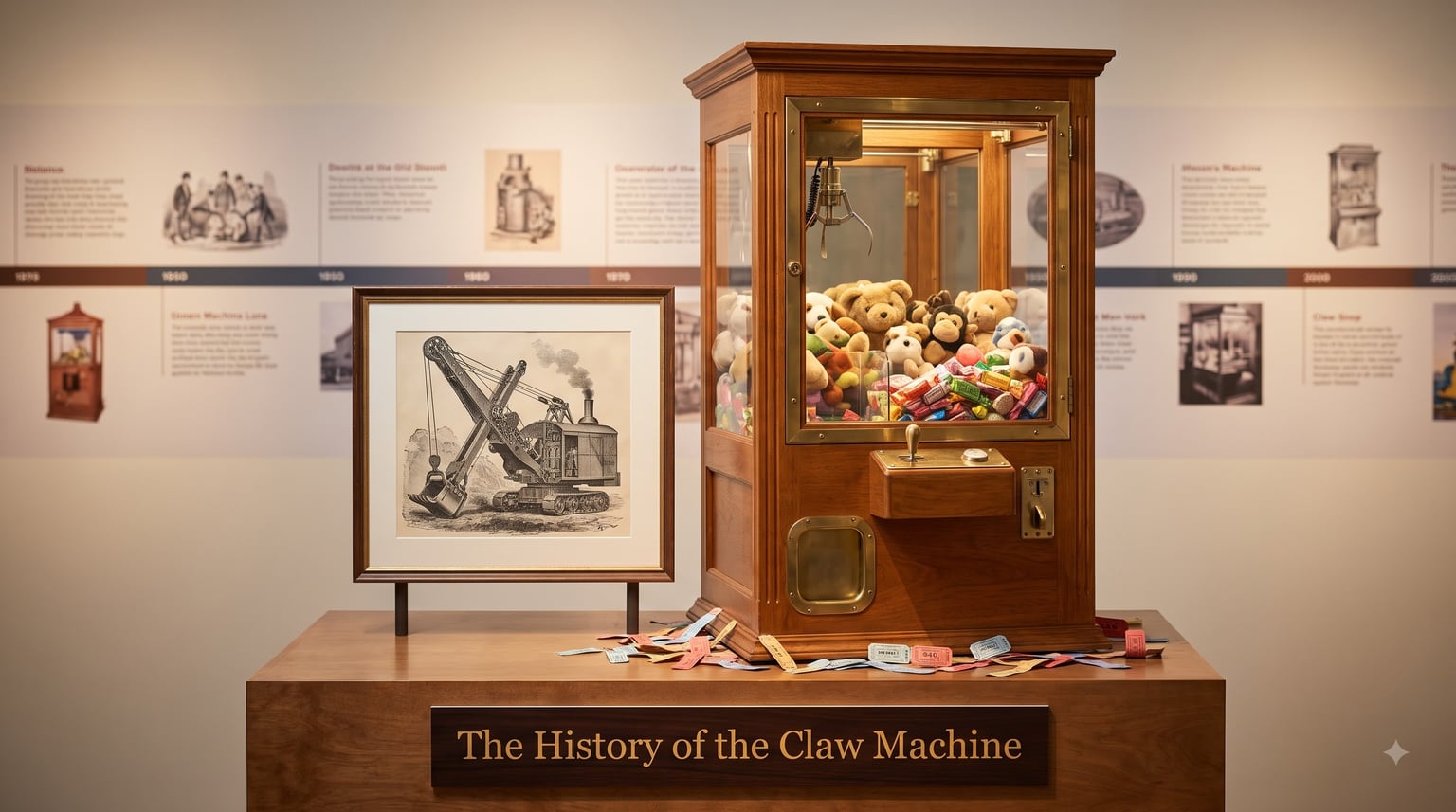
The claw machine was invented in the late 19th century and inspired by industrial steam shovels used to dig the Panama Canal. Before they were stuffed with plush toys, the earliest versions of these mechanical diggers were novelty devices designed to recreate the spectacle of heavy equipment. Over 130 years later, that same grabby little arm still anchors arcades, malls, and pizza restaurants around the world.
I have always been fascinated by how a machine built for fun could come from something so serious as a canal digger. After digging through patent filings, old carnival manuals, and oral histories from amusement collectors, I want to walk you through the full story. This is the history of the claw machine, told one decade at a time.
Table of Contents
- The 1890s: How Steam Shovels Inspired the First Claw Machine
- The 1920s: The Erie Digger and the Birth of the Carnival Claw Machine
- The 1930s to 1950s: Carnival Heyday and the Johnson Act Crackdown
- The 1970s to 1980s: Arcade Golden Age and Mall Domination
- The Global Phenomenon: Japan’s UFO Catcher and Asian Arcade Culture
- The Modern Era: Technology, Rigging, and Today’s Claw Machines
- FAQs
- Conclusion
The 1890s: How Steam Shovels Inspired the First Claw Machine
The first claw machines appeared in the late 1800s, riding a wave of public fascination with industrial equipment. Between 1881 and 1914, the United States dug the Panama Canal using massive steam shovels that could move hundreds of tons of earth per day. Crowds gathered just to watch them work, and that public appetite for spectacle is exactly what early coin-operated inventors tapped into.
Mechanics began building small wooden cabinets with hand-cranked mechanical arms designed to mimic the scoop motion of a steam shovel. Players deposited a coin, guided the arm with a lever, and tried to grab a prize. These early devices were not called claw machines yet. Most were simply called diggers or grabber games, and they lived at fairs, penny arcades, and curiosity exhibits.
One of the earliest documented inventors was William Bartlett, who filed patents for what he called a Nickel Digger around the turn of the 20th century. His design is widely considered the blueprint for the modern claw machine. He combined a coin receptor with a single mechanical claw and a clear prize bin, and the format stuck.
The 1920s: The Erie Digger and the Birth of the Carnival Claw Machine
The claw machine as we know it really took shape in 1926, when Erie Manufacturing Corp released the Erie Digger. The cabinet was a stunning piece of Art Deco craftsmanship, finished in walnut and mahogany with brass fittings. It looked less like a game and more like a piece of furniture, which is why bars and cigar lounges were happy to install them.
Inside that beautiful cabinet sat a single claw suspended from a track, with a joystick to move it left, right, forward, and back. Players aimed the claw, hit a button, and watched it plunge down to grab whatever sat below. Prizes were small: candy, gum, or cigarettes in some venues, which is why these machines were sometimes called candy dispensers in their earliest years.
By the end of the 1920s, the Erie Digger had spread to every major city in the United States. It proved that a coin-operated game could be both profitable and stylish, and it set the standard that every crane game would follow for the next century.
The 1930s to 1950s: Carnival Heyday and the Johnson Act Crackdown
During the 1930s and 1940s, claw machines became a fixture of American carnivals. Operators liked them because they made money in tight quarters and needed almost no supervision. Players liked them because they offered a tangible reward for a quarter. They were a perfect match for the carnival atmosphere.
That all changed in 1951, when the Johnson Act classified coin-operated amusement devices as potential gambling devices if a prize could be exchanged for cash. Suddenly, crane games across the country were at risk of being seized by the FBI. Between 1951 and 1974, federal agents destroyed thousands of machines, often right on the carnival floor.
The crackdown ended in the early 1970s when amusement operator Lee Moss challenged the law in court and won. The court ruled that claw machines were games of skill, not chance, so long as the prize was the item itself and not redeemable for cash. That ruling cleared the way for the arcade boom of the next decade.
The 1970s to 1980s: Arcade Golden Age and Mall Domination
Once the Johnson Act ruling was settled, claw machines exploded back into public life. The 1970s and 1980s were the arcade golden age, and the claw machine was right at the center of it. New manufacturers from Japan and Europe shipped updated cabinets with electronic circuit boards, brighter lights, and far more reliable joystick controls.
By the mid-1980s, claw machines had migrated out of arcades and into malls, movie theater lobbies, bowling alleys, and family restaurants. Pizza Hut famously installed them alongside their salad bars. The NBA even licensed team-branded plush toys for stadium arcades. Suddenly, every kid with a few quarters had a shot at walking away with a stuffed animal.
This was also the era when the rigging conversation started in earnest. Operators discovered they could adjust claw grip strength and payout frequency using a simple dip-switch panel inside the cabinet. By programming the claw to grip weakly most of the time and strongly only on certain plays, they kept players spending while still paying out often enough to feel fair.
The Global Phenomenon: Japan’s UFO Catcher and Asian Arcade Culture
No country has embraced the claw machine more than Japan. In the 1980s, SEGA released a variant called the UFO Catcher, and it became the centerpiece of Japanese arcade culture. UFO Catchers are technically the same machine, but Japanese operators treat them as a sport. Players line up, take turns, and treat every grab like a competitive event.
Japanese arcades also popularized a related format called gashapon, or capsule toy machines. Instead of a claw, players turn a knob and receive a random capsule. Both formats exist side by side in nearly every arcade in Tokyo, Osaka, and Sapporo.
Etiquette is strict in Japanese UFO Catcher halls. Players are expected to move quickly, not hog the machine, and never touch the prizes inside the glass. Winning is a social event, and the staff often cheer when a difficult grab finally lands.
The Modern Era: Technology, Rigging, and Today’s Claw Machines
Modern claw machines use electronic controls that let operators adjust claw strength, dropping speed, and payout cycle down to a percentage point. A typical setup might pay out one win every 8 to 12 plays, with full grip strength only on the winning attempt. This is why the skill versus chance debate never really dies: every play takes real aim, but the grip is often predetermined before you ever move the joystick.
One of the biggest recent shifts is the home and desktop claw machine trend. Brands like Arcade1Up now sell full-size arcade cabinets for living rooms, and tiny desktop claw machines are popular on TikTok and YouTube. Competitive players like Chen Zhitong, who has logged more than 15,000 documented wins, have turned the hobby into a serious sport.
Whether you call it a claw machine, a crane game, or a UFO Catcher, the format has outlasted every trend in arcade history. It began as a tribute to industrial steam shovels in the 1890s, survived an FBI crackdown in the 1950s, and now lives in millions of pockets in 2026.
FAQs
Why was the claw machine invented?
The claw machine was invented in the late 19th century as a way to bring the spectacle of industrial steam shovels, the same machines used to dig the Panama Canal, into penny arcades and fairs. Early inventors built small coin-operated cabinets that mimicked the scoop motion of heavy equipment and rewarded players with candy or small prizes.
When was the first claw machine invented?
The earliest claw machines date to the late 1890s, with William Bartlett’s Nickel Digger patent among the first documented designs. The format went mainstream in 1926 when Erie Manufacturing Corp released the Erie Digger, which became the standard for every crane game that followed.
Are claw machines illegal?
Claw machines are legal in most of the United States, but the Johnson Act of 1951 briefly classified them as gambling devices. A 1970s court victory by operator Lee Moss ruled that crane games are games of skill rather than chance, which cleared the way for the modern arcade industry. Local rules on payout percentages still vary by state.
Are claw machines luck or skill?
Claw machines are a mix of both. The aiming and timing require real skill, but most operators program the claw grip to be strong only on a set percentage of plays. So your aim matters, but the grip itself is often determined before you ever move the joystick.
Who invented the claw machine?
There is no single inventor. William Bartlett patented an early Nickel Digger at the turn of the 20th century, and Erie Manufacturing Corp refined the design into the Erie Digger in 1926. SEGA later adapted the format for Japan as the UFO Catcher in the 1980s.
Why are claw machines called crane games?
Claw machines are called crane games because the moving arm looks like a small construction crane. The terms are used interchangeably, with crane game more common in the United States and UFO Catcher the standard name in Japan.
Conclusion
The history of the claw machine is really a story about how a single mechanical idea survived a century of legal fights, technological shifts, and cultural changes. It started with steam shovels at the Panama Canal, became a candy-dispensing Art Deco showpiece in the 1920s, almost got banned in the 1950s, and now lives on as both a global arcade staple and a desktop gadget in 2026.
Next time you walk past a claw machine in a mall or an arcade, take a second to appreciate just how much history is packed into that little glass box. Drop in a quarter, line up your shot, and remember that the arm you are controlling has roots going back more than 130 years.