
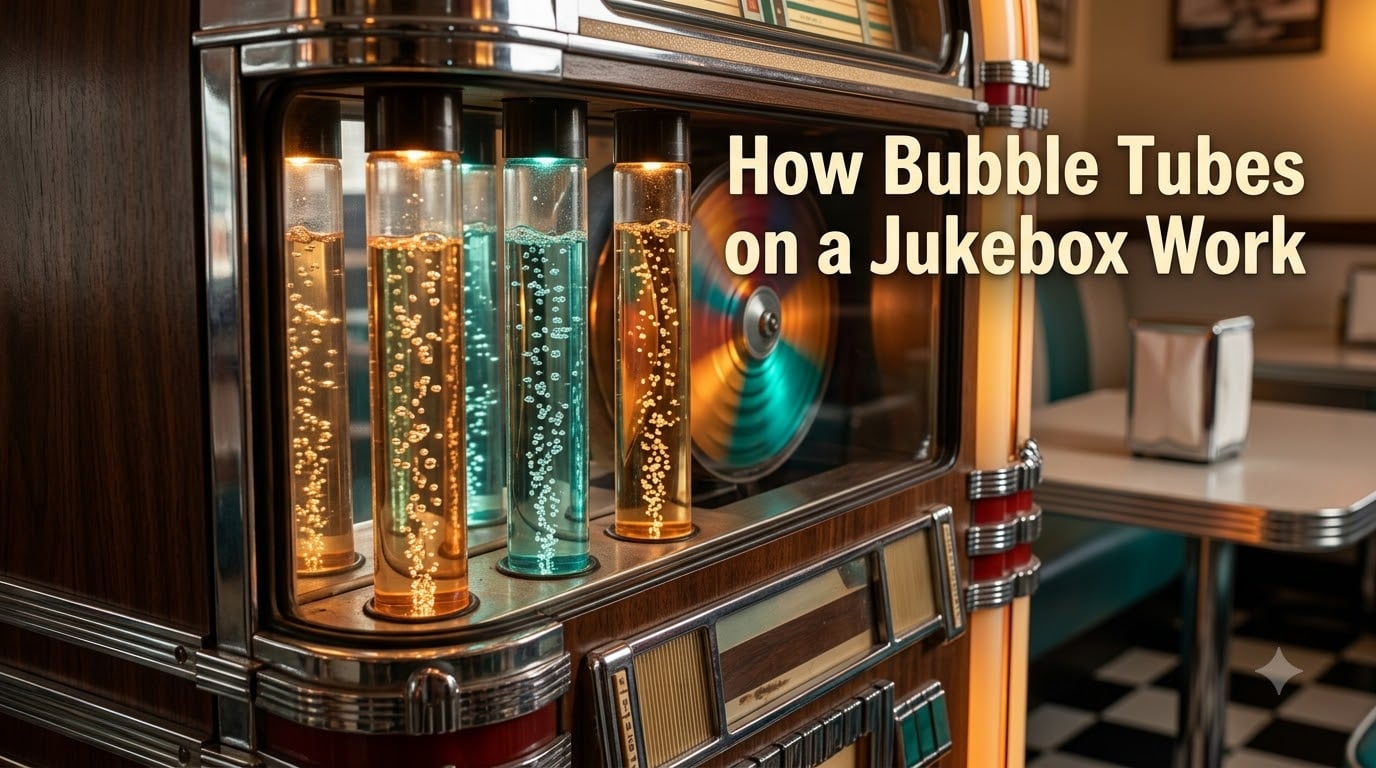
If you’ve ever stood in front of a classic Wurlitzer 1015 “Bubbler” jukebox, you already understand the magic. Streams of bubbles rise through tall glass tubes mounted along the cabinet while colored lights spin behind translucent arches. The effect is hypnotic, and it has defined the look of the American diner for nearly 80 years.
Bubble tubes on a jukebox work by heating a sealed low-boiling-point liquid (usually dichloromethane) inside a glass vial, causing it to vaporize into bubbles that rise, cool, condense, and fall back down in a continuous cycle. The visual effect is created entirely by physics, not air pumps, and the same technology powered 1950s Christmas bubble lights before jukebox manufacturers adopted it for the mid-century entertainment scene.
In this guide, our team breaks down the full mechanism: the chemistry inside the tube, the physics of why a sealed liquid boils at room temperature, the heating lamps that drive the cycle, and what to do when your own bubble tube stops bubbling.
Table of Contents
- What Are Jukebox Bubble Tubes?
- How Bubble Tubes on a Jukebox Work: The Core Mechanism
- The Physics of Low-Boiling-Point Liquids in a Sealed Tube
- The Liquid Inside: Methylene Chloride (Dichloromethane)
- The Wurlitzer 1015 “Bubbler”: The Most Famous Example
- Bubble Tube Designs Across Different Jukebox Manufacturers
- Why Your Bubble Tube Stopped Bubbling: Maintenance and Troubleshooting
- FAQs
- The Enduring Appeal of the Jukebox Bubble Tube
What Are Jukebox Bubble Tubes?
Jukebox bubble tubes are sealed glass vials filled with a low-boiling-point liquid that produces a continuous stream of bubbles when warmed. Each tube is closed at one end, partially filled with liquid, and contains a small amount of porous material (typically pumice or rock salt) that traps pockets of fluid against the heated bottom.
The tubes are mounted vertically on the jukebox cabinet, usually behind or beside the title strip area. A small incandescent lamp or heating element sits at the base of each tube. When the jukebox powers up, those lamps warm the bottom of the tube, the liquid vaporizes, and bubbles begin to climb toward the cooler top of the vial.
Most bubble tubes are made of borosilicate glass for thermal stability. The original Wurlitzer 1015 tubes (part number 45062) measure roughly 8 to 10 inches long and about half an inch in diameter. Reproductions for the same model are still sold today by specialty vendors.
The bubble tube has one job: visual entertainment. Combined with rotating color cylinders behind translucent plastic arches, the tubes created what designers in the late 1940s called the “liquid light” show. It was an early form of ambient visual effects built into a coin-operated machine.
How Bubble Tubes on a Jukebox Work: The Core Mechanism
The mechanism is a closed-loop thermodynamic cycle driven entirely by heat. There are no pumps, no moving parts inside the tube, and no electronics controlling the bubbles. Everything happens because the liquid inside wants to reach equilibrium with its surroundings.
Here is the step-by-step boiling cycle that runs continuously while your jukebox is powered on:
Heat input: An incandescent lamp or resistive heating element warms the bottom of the glass tube.
Vaporization: The porous material at the base (pumice or rock salt) holds pockets of dichloromethane against the hot glass. Once the temperature reaches the liquid’s boiling point, the pockets flash to vapor.
Bubble rise: The vapor bubbles detach and rise through the cooler liquid above them because vapor is far less dense than the surrounding fluid.
Condensation at the top: Near the sealed top of the tube, the vapor contacts cooler glass and condenses back into liquid droplets.
Liquid return: The condensed droplets fall back down through the tube, where they are again caught by the porous material and reheated.
Cycle repeat: The process continues indefinitely as long as the heater maintains the bottom of the tube above the liquid’s boiling point.
The result is a slow, steady column of bubbles that pulse up through the tube. Real Wurlitzer tubes typically produce bubbles at a rate of roughly one to three per second, depending on the lamp wattage and ambient temperature.
Watch Uncle Doug’s close examination of a real Wurlitzer bubble tube to see the manufacturing process and the boiling cycle in action. The video is one of the clearest demonstrations of the mechanism we have found online.
The Physics of Low-Boiling-Point Liquids in a Sealed Tube
Here is the part most casual observers miss: dichloromethane boils at about 104 degrees Fahrenheit (40 degrees Celsius) at standard atmospheric pressure. That is just above normal room temperature, which is why the jukebox’s small heating lamp is enough to make the liquid boil inside the sealed tube.
But jukebox bubble tubes are not at standard atmospheric pressure. They are vacuum sealed during manufacturing. When the tube is sealed, most of the air is drawn out, and the liquid inside experiences a partial vacuum. Under reduced pressure, the liquid’s boiling point drops even further.
This is why a bubble tube can start producing bubbles within seconds of the jukebox powering on. The reduced-pressure environment means the liquid is already very close to its boiling point even before the lamp heats it. A small temperature boost from a 25-watt bulb is enough to push pockets of the fluid past the vaporization threshold.
The porous material at the base of the tube plays a critical role in this physics. Pumice, rock salt, or similar materials trap small pockets of liquid and create many thin films with high surface area. Those thin films heat up quickly and vaporize almost simultaneously, producing the characteristic steady stream of bubbles rather than one large slug of vapor.
If the tube were filled only with liquid and no porous material, you would get violent boiling or a single large bubble, not the gentle, mesmerizing stream that makes bubble tubes so visually appealing.
The Liquid Inside: Methylene Chloride (Dichloromethane)
The chemical inside most vintage jukebox bubble tubes is methylene chloride, also called dichloromethane or DCM. It is a colorless, volatile solvent with a characteristically sweet aroma. Jukebox manufacturers chose it because it has the right combination of properties for the bubble effect.
Key properties that make DCM ideal for jukebox bubble tubes:
Low boiling point: 104 degrees Fahrenheit at atmospheric pressure, lower under vacuum
High vapor density relative to air: Bubbles rise cleanly through the liquid
Chemical stability: Does not react with glass, pumice, or metal hardware over decades
Low viscosity: Allows smooth bubble rise and liquid return
Some early bubble tubes used a similar chemical, dichloromethane being the modern preference. The same chemical family was used in 1950s Christmas bubble lights, which is why the visual effect feels familiar even if you have never seen a jukebox bubble tube up close.
Safety warning: Dichloromethane is a hazardous chemical. Prolonged inhalation can affect the central nervous system, and the liquid is absorbed through skin. If a bubble tube breaks and you need to clean up the fluid, work in a well-ventilated area, wear nitrile gloves, and dispose of the fluid according to your local hazardous waste regulations. Never heat DCM over an open flame.
If you are buying reproduction tubes, sealed units from reputable vendors are safe to handle and install. The risk only arises if a tube cracks or breaks in your cabinet.
The Wurlitzer 1015 “Bubbler”: The Most Famous Example
The Wurlitzer 1015, introduced in 1946, is the jukebox most people picture when they hear the term “bubble tubes.” It was nicknamed “The Bubbler” specifically because of the four bubble tubes mounted along the front of its cabinet.
Designed by Paul Fuller in the immediate post-war period, the 1015 combined bubble tubes with rotating color cylinders behind translucent plastic arches. The result was the “liquid light” effect that became the visual signature of the late-1940s diner. Wurlitzer produced about 56,000 units of the 1015, making it one of the most successful jukebox models in history.
The 1015’s bubble tubes used original part number 45062. The straight tubes mount on either side of the central record mechanism, while two curved tubes frame the title strip display. Each tube is heated by a dedicated low-wattage incandescent lamp mounted in a reflector cup at the base.
Because so many 1015s were produced and so many survive today in private collections and restorations, the Wurlitzer 1015 remains the reference design for understanding how bubble tubes work. The mechanism in a Rock-Ola, Seeburg, or Rowe jukebox follows the same physics, but the 1015 is where most enthusiasts encounter it first.
Our team has personally inspected several restored 1015s, and the effect still works as designed 80 years later, as long as the tubes are intact and the heating lamps are functional. The mechanism is genuinely one of the most durable visual effects in coin-op history.
Bubble Tube Designs Across Different Jukebox Manufacturers
While Wurlitzer defined the bubble tube look, other manufacturers adopted the technology with their own design choices. The core mechanism stays the same across brands, but the implementation varies.
Wurlitzer used four straight tubes on the 1015 and 1080 models, heated by incandescent lamps. Their tubes are tall, narrow, and mounted externally along the cabinet front.
Rock-Ola’s “Bubbler” models used a similar approach but with tubes mounted behind the title strip rather than along the sides. Seeburg favored fewer, larger tubes integrated into the cabinet’s central arch.
Rowe CD jukeboxes used a single horizontal tube system behind color-changing panels in later models. Crosley’s WR-18 tabletop jukebox uses smaller, lower-wattage tubes scaled down for a compact cabinet.
The 1015’s straight tubes are the most reproduced part, while curved arch tubes and reproductions for Rock-Ola and Seeburg models tend to be more specialized and harder to source.
Why Your Bubble Tube Stopped Bubbling: Maintenance and Troubleshooting
If your bubble tube has stopped bubbling, the cause is usually one of a few common issues. Start with the simplest checks before assuming the tube itself is broken.
Step 1: Check the heating lamp. The most common failure is a burned-out bulb at the base of the tube. Replace the lamp and test again. Most Wurlitzer 1015 tubes use a small bayonet-base bulb rated around 25 watts.
Step 2: Inspect the tube for cracks. Hairline cracks are nearly invisible on a sealed tube but will allow air to enter and disrupt the vacuum. Hold the tube up to a bright light and look for thin lines in the glass.
Step 3: Verify the porous material is still in place. If the tube has been shaken or dropped, the pumice or rock salt at the base may have shifted. Without the porous material, the liquid cannot form the steady vapor pockets needed for bubbles.
Step 4: Check for fluid discoloration. Over decades, the dichloromethane can yellow slightly, but heavy discoloration usually means the tube has been contaminated or the vacuum seal has failed.
Step 5: Consider ambient temperature. In a cold room, the heating lamp may not be able to push the liquid past its boiling point. Bubble tubes work best at normal room temperature, around 68 to 75 degrees Fahrenheit.
If all of the above checks pass and the tube still will not bubble, the vacuum seal has likely failed and the tube needs replacement. Reproduction tubes for the Wurlitzer 1015 (part number 45062) are available from specialty vendors including jukebox-world.de and victoryglass.com. Expect to pay roughly 70 to 160 dollars per tube depending on whether it is a straight or curved reproduction.
FAQs
How do bubble tubes work?
Bubble tubes work by heating a low-boiling-point liquid (usually dichloromethane) inside a sealed glass tube. The heat vaporizes pockets of the liquid held against the glass by a porous material like pumice. Vapor bubbles rise through the cooler liquid above, condense near the top of the tube, and fall back down to be reheated. This creates a continuous, gentle stream of bubbles without any moving parts.
What liquid is inside a jukebox bubble tube?
Most jukebox bubble tubes contain methylene chloride, also called dichloromethane or DCM. It is a colorless, volatile solvent with a boiling point of about 104 degrees Fahrenheit at atmospheric pressure, and even lower under the partial vacuum used in bubble tube construction. It is the same chemical family used in 1950s Christmas bubble lights.
Why is my bubble tube not bubbling?
The most common cause is a burned-out heating lamp at the base of the tube. Other causes include hairline cracks in the glass (which break the vacuum seal), shifted or missing porous material inside the tube, contaminated fluid, or a room temperature that is too cold for the heater to push the liquid past its boiling point. Replace the lamp first, then inspect the tube carefully if the problem persists.
Are jukebox bubble tubes safe?
Sealed, intact bubble tubes are safe to handle and display. The risk arises only if a tube breaks and the dichloromethane inside leaks out. Dichloromethane is a hazardous solvent: prolonged inhalation affects the central nervous system, and it absorbs through skin. If a tube breaks, ventilate the area, wear nitrile gloves, and dispose of the fluid as hazardous waste.
How long do jukebox bubble tubes last?
Original Wurlitzer 1015 bubble tubes from 1946 can still work today if they were never cracked and the vacuum seal held. In practice, most tubes last several decades before the lamp, the porous material, or the vacuum seal fails. Reproduction tubes use modern glass-sealing techniques and typically last as long as the originals when properly maintained.
Can you replace a broken bubble tube?
Yes. Reproduction bubble tubes for the Wurlitzer 1015 (original part number 45062) are available from specialty vendors. Straight tubes are most common and least expensive. Curved arch tubes and tubes for other jukebox brands like Rock-Ola or Seeburg are more specialized and harder to source. Expect to pay roughly 70 to 160 dollars per reproduction tube.
The Enduring Appeal of the Jukebox Bubble Tube
Bubble tubes on a jukebox work because of a simple, elegant piece of thermodynamics: a sealed liquid, a heat source, and a porous medium. There is no pump, no controller, no moving parts inside the tube. The mechanism is so reliable that original 1946 Wurlitzer tubes still bubble today when their heating lamps are replaced.
If you are restoring a classic jukebox, focus first on the heating lamps and the integrity of the glass before assuming the tube itself has failed. And if you do need a replacement, reproduction parts from established vendors will keep your machine’s liquid light show running for another generation of diners, collectors, and enthusiasts.