
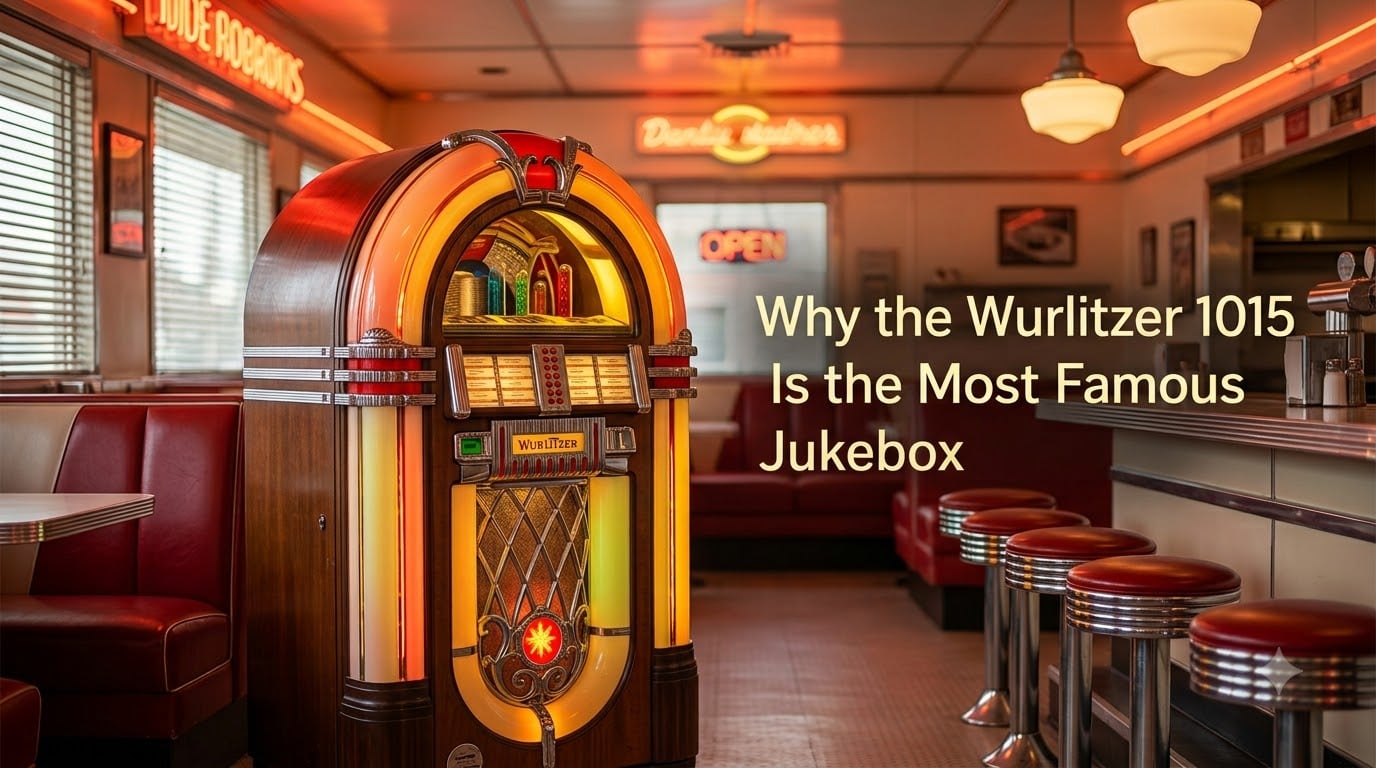
Walk into any retro diner, vintage arcade, or mid-century-themed lounge, and you will almost certainly spot the same machine glowing in the corner. The Wurlitzer 1015, better known as the “Bubbler,” is the most famous jukebox ever built, and it earned that title through a combination of timing, design genius, and sheer sales numbers that no other model has ever matched.
Introduced in 1946, the 1015 sold over 56,000 units in less than two years. That was more than five times the typical jukebox production run of its era. It became the visual shorthand for an entire era of American culture, the machine everyone pictures when they hear the word “jukebox.”
I have spent years researching coin-operated history, talking to collectors, and studying the design lineage of post-war music machines. The story of the 1015 is not just about a product that sold well. It is about how one designer, working at the right moment in history, created an object so visually perfect that it became immortal.
In this article, we will cover why the Wurlitzer 1015 became the most famous jukebox ever made, from its revolutionary bubble tube design to the post-war cultural moment that made it an icon. We will also dig into its technical specs, collector value, pop culture legacy, and how to tell an original from a reproduction.
Table of Contents
- Why the Wurlitzer 1015 Is the Most Famous Jukebox: The Short Answer
- The Birth of the Bubbler: Post-War America Meets Industrial Design
- What Makes the 1015 So Visually Iconic
- The Numbers Behind the Fame
- Technical Specifications of the Wurlitzer 1015
- The 1015 vs Its Competitors: Rock-Ola, Seeburg, and AMI
- The 1015 in Pop Culture: Movies, Television, and Advertising
- How to Identify an Authentic 1946 Wurlitzer 1015?
- Collector Value and Restoration
- Frequently Asked Questions
- Conclusion
Why the Wurlitzer 1015 Is the Most Famous Jukebox: The Short Answer
The Wurlitzer 1015 is the most famous jukebox because it sold over 56,000 units in under two years, making it the best-selling jukebox of all time. Its distinctive bubble tubes, rotating color cylinders, fire-engine red dome, and Art Deco arches created a visual identity so powerful that it became the universal symbol for the word “jukebox” itself. Designed by Paul Fuller and released in 1946, the 1015 captured the optimism of post-war America at the exact moment when diners, bars, and soda fountains were hungry for entertainment and spectacle.
No other jukebox before or since has matched its cultural penetration. The 1015 is the image people draw when asked to sketch a jukebox. It is the silhouette used in logos, advertisements, and retro-themed graphics worldwide. That level of recognition is why collectors, historians, and design enthusiasts all point to the same machine.
The Birth of the Bubbler: Post-War America Meets Industrial Design
To understand why the 1015 became a phenomenon, you have to understand what came before it and what was happening in the world when it arrived.
The Rudolph Wurlitzer Company: From Band Instruments to Jukeboxes
The Rudolph Wurlitzer Company was founded in 1856 by Rudolph Wurlitzer, a German immigrant who started by importing musical instruments. By the late 1800s, the company had expanded into pianos, organs, and eventually coin-operated instruments. Wurlitzer built its first coin-operated piano in the 1890s, establishing a foothold in the automated entertainment market that would define its future.
The company did not build its first jukebox until 1933, relatively late compared to competitors like AMI (Automatic Musical Instruments), which had been making coin-operated phonographs since the late 1920s. But Wurlitzer made up for lost time with aggressive innovation and a commitment to visual design that set it apart from the often utilitarian-looking machines of the early 1930s.
By the early 1940s, Wurlitzer had become one of the dominant jukebox manufacturers in America. Then World War II changed everything.
The Wartime Drought: Model 42 Victory and Production Restrictions
When the United States entered World War II in 1941, the government imposed strict restrictions on manufacturing materials. Metal, chrome, and plastics were redirected to the war effort. Jukebox production was severely curtailed, and manufacturers were forced to build what they could with limited resources.
Wurlitzer’s wartime offering was the Model 42 Victory, a stripped-down jukebox that reflected the austerity of the era. It was functional but visually plain. No bubble tubes, no rotating color cylinders, no chrome trim. It was a machine built for necessity, not spectacle.
Americans lived with these restrained machines for four years. When the war ended in 1945, there was enormous pent-up demand for color, luxury, and visual excitement. The country was ready to celebrate, and Wurlitzer was ready to give them something worth celebrating over.
Paul Fuller: The Designer Behind the Magic
The man most responsible for the 1015’s iconic look was Paul Fuller, Wurlitzer’s chief industrial designer. Fuller had been designing jukeboxes for Wurlitzer since the mid-1930s, and he understood something that many of his competitors did not. A jukebox was not just a music player. It was a piece of furniture that people gathered around, a social centerpiece that needed to be as visually exciting as the music it played.
Fuller’s philosophy was simple. When someone dropped a coin into a jukebox, they wanted to see something happen. The music was only part of the experience. The machine needed to perform visually, to reward the user with motion, color, and light that made the act of selecting a song feel special.
This insight drove every design decision in the 1015. Fuller did not just create a jukebox. He created a miniature theater of light and motion that happened to play records. And he timed its release for the exact moment when America was most ready to be dazzled.
What Makes the 1015 So Visually Iconic
The Wurlitzer 1015 did not become the most famous jukebox by accident. Every visual element was deliberate, engineered to create maximum impact in a dark bar or diner. Here is what makes the design so unforgettable.
The Bubble Tubes: How They Actually Work
The single most distinctive feature of the 1015, and the source of its “Bubbler” nickname, is the pair of bubble tubes that flank the central record selection area. These are tall, transparent columns filled with a liquid that bubbles continuously when the machine is turned on, creating a mesmerizing rising stream of colored light.
The mechanism is clever and surprisingly simple in concept. Each tube contains a liquid with a low boiling point, typically dichloromethane, sealed inside a glass or plastic column. A small heating element at the base of each tube warms the liquid just enough to cause it to boil gently. As the liquid vaporizes, it forms bubbles that rise through the column, cool at the top, and sink back down to repeat the cycle.
Behind the tubes sit rotating color cylinders, painted metal drums that spin slowly around a light source. As the cylinders rotate, they project shifting patterns of red, yellow, green, and blue light through the bubbling liquid. The effect is a continuously animated display of rising colored bubbles that looks almost alive.
In 1946, this was genuinely astonishing. Most people had never seen anything like it outside of a movie theater or carnival. The bubble tubes turned the jukebox from a machine into a spectacle, and they are the feature most people remember decades later.
Design Language and the Art Deco Influence
Beyond the bubble tubes, every other element of the 1015 was designed to grab attention. The machine features a large domed top in fire-engine red, translucent plastic arches that glow from internal lighting, and bright chrome trim that frames the entire cabinet. Musical note motifs dance across the front panel, reinforcing the machine’s purpose as a music device.
The overall shape is tall and commanding, standing about five feet high. It was designed to be visible from across a crowded room. The arches and curved lines reflect the Art Deco influence that dominated American industrial design through the 1930s and 1940s, blended with the bold, celebratory aesthetic of the post-war era.
The color palette was equally deliberate. Fuller chose fire-engine red for the dome because it was the most attention-grabbing color available, impossible to miss even in a smoke-filled bar. The combination of red, chrome, and shifting colored light created a visual package that was impossible to ignore.
This design language became the template. After the 1015, nearly every jukebox manufacturer tried to replicate its combination of motion, color, and chrome. None matched the original’s staying power.
The Numbers Behind the Fame
Design alone does not explain the 1015’s fame. The sales figures tell an even more compelling story. Wurlitzer produced 56,246 units of the Model 1015 between 1946 and 1947. In an industry where a typical successful model sold around 10,000 units, the 1015 sold more than five times the average.
The serial numbers tell the story precisely. Original 1015 units carry serial numbers ranging from approximately 1000001 to 1056000, which is how collectors verify authenticity today.
To put those numbers in context, consider that in the mid-1940s, the United States had approximately 700,000 jukeboxes in operation across the country. The 1015 alone represented a massive share of the market in just two years of production. Bars, diners, soda fountains, and social clubs all wanted the same machine.
Those 56,000 units were not just sold. They were placed in public spaces where millions of people saw them, heard them, and associated the experience of live music selection with this specific machine. The sheer volume of 1015s in circulation is what cemented the image of the Bubbler in the American consciousness.
Competitors like Seeburg and Rock-Ola sold respectable numbers of their own models, but none came close to 56,000 units in a comparable timeframe. The 1015 was not just a best-seller. It was a phenomenon that dominated the market for two straight years.
Technical Specifications of the Wurlitzer 1015
Behind the visual spectacle, the 1015 was a straightforward, reliable coin-operated phonograph. Here are the technical details that defined it.
The Wurlitzer 1015 played 78 RPM records exclusively, holding 24 records for a total of 24 selections. It used the Simplex record changer, a mechanism that selected and played one side of each record. This was standard technology for 1946, before the widespread adoption of 45 RPM singles and multi-speed changers.
The cabinet measured approximately 33.5 inches wide, 25 inches deep, and stood about 60 inches tall. It weighed roughly 360 pounds, making it a substantial piece of equipment that required professional installation and transport.
The coin mechanism accepted nickels, dimes, and quarters, with pricing configurable by the operator. A typical setting offered one play for a nickel or six plays for a quarter, though operators adjusted pricing based on location and clientele.
The amplifier delivered about 12 watts of audio output through a built-in speaker system, which was more than enough volume for a bar or diner environment. The sound quality was considered excellent for the era, with a warm, full tone that made the most of 78 RPM pressings.
Key specifications at a glance:
Manufacturer: The Rudolph Wurlitzer Company, North Tonawanda, New York
Year introduced: 1946
Production run: 1946 to 1947 (approximately)
Total units produced: 56,246
Serial number range: 1000001 to approximately 1056000
Record format: 78 RPM
Capacity: 24 records, 24 selections
Record changer: Simplex mechanism
Weight: Approximately 360 pounds
Dimensions: 33.5 inches wide, 25 inches deep, approximately 60 inches tall
Amplifier output: Approximately 12 watts
Designer: Paul Fuller
The 1015 vs Its Competitors: Rock-Ola, Seeburg, and AMI
Wurlitzer was not the only jukebox manufacturer in 1946. Three other major brands competed for the same market: Rock-Ola, Seeburg, and AMI. Each produced machines during the same period, but none achieved the lasting fame of the 1015.
Rock-Ola, founded by David Rockola, produced several attractive models in the mid-1940s. Their machines featured wood cabinets and colored lighting, but they leaned toward a more traditional furniture aesthetic. They lacked the theatrical bubble tubes and animated displays that made the 1015 impossible to ignore.
Seeburg was Wurlitzer’s most serious competitor. In the late 1940s, Seeburg introduced technological innovations that Wurlitzer did not match, including the ability to play both sides of a record and later the 100-selection mechanism. But Seeburg machines of the 1946 to 1947 era were visually conservative compared to the 1015. They were better engineered in some ways, but they did not capture the public imagination the way the Bubbler did.
AMI (Automatic Musical Instruments) had been in the coin-operated phonograph business since the 1920s and built solid, reliable machines. Their post-war models were well-made but visually understated, lacking the bold color and motion that defined the Wurlitzer aesthetic.
The lesson here is important. The 1015 was not the most technically advanced jukebox of its era. Seeburg models could hold more records. Other brands offered features the 1015 lacked. But the 1015 won the battle for cultural immortality because it was the most visually memorable. People did not remember the machine with the best mechanism. They remembered the one with the glowing bubble tubes and the fire-engine red dome.
The 1015 in Pop Culture: Movies, Television, and Advertising
The Wurlitzer 1015 transcended its status as a consumer product to become a cultural symbol. Its image appears across decades of film, television, advertising, and graphic design, often standing in for an entire era of American life without any need for explanation.
In cinema, the 1015 and its visual language appear in countless films set in the 1940s, 1950s, and 1960s. Directors use the Bubbler as instant visual shorthand for a period setting. When you see a jukebox glowing in the background of a diner scene, chances are the production designer chose something modeled on or directly referencing the 1015. Its silhouette is immediately recognizable even in silhouette.
Television followed the same pattern. Period dramas, nostalgic shows, and music documentaries all reach for the 1015 aesthetic when they want to evoke mid-century America. The machine has appeared in contexts ranging from historical retrospectives about the birth of rock and roll to fictional small-town dramas where the local diner needs a centerpiece.
In advertising and graphic design, the 1015 is arguably the most reproduced industrial object of the mid-century period. Its image appears on posters, restaurant menus, concert flyers, album covers, and corporate logos. Companies that have nothing to do with jukeboxes use a stylized Bubbler to signal “retro,” “classic,” or “American original.” The shape has been so widely copied that many people recognize the design without knowing what a Wurlitzer 1015 is.
The 1015 also played a real historical role in the spread of rock and roll. In the late 1940s and 1950s, jukeboxes were one of the primary ways Americans heard new music. The 56,000 units in circulation meant the 1015 was a distribution channel for rhythm and blues, early rock and roll, and country music. Songs that radio stations refused to play found their way onto 1015s in bars and diners, helping to break down racial barriers in popular music.
That cultural role, combined with its visual dominance, is why the 1015 is not just famous. It is the definitive jukebox, the one against which every other model is measured.
How to Identify an Authentic 1946 Wurlitzer 1015?
One of the most common questions I see in collector forums is how to tell an original 1015 from a modern reproduction. This is a genuine problem because Wurlitzer and other companies have produced several reproduction models over the decades, most notably the One More Time and Tribute editions. Some of these reproductions are excellent and valuable in their own right, but they are not the same as a 1946 original.
Here are the key ways to identify an authentic 1946 Wurlitzer 1015.
Check the serial number. Original 1015 units have serial numbers in the range of approximately 1000001 to 1056000. The serial number plate is typically located on the back of the cabinet or inside on the chassis frame. If the serial number falls outside this range, or if the plate looks newer than the rest of the machine, investigate further.
Examine the record changer. An original 1015 uses the Simplex record changer designed for 78 RPM records only. It holds 24 records and plays one side of each. Reproductions like the One More Time often use CD mechanisms or 45 RPM changers with much larger capacities. If the machine plays CDs or holds more than 24 records, it is not an original 1015.
Look at the cabinet materials. Original 1015 cabinets use period-appropriate materials: heavy gauge steel, original-style chrome plating, and vintage plastics. The translucent plastic arches on an original have a specific patina and color quality that modern reproductions struggle to replicate. Modern plastics tend to look too uniform and bright.
Inspect the bubble tubes. Original bubble tubes use sealed glass columns with dichloromethane or a similar low-boiling-point liquid. Reproductions may use different liquids, plastic tubes, or even LED simulations. An original bubble tube has a specific motion pattern and sound that experienced collectors can identify.
Check for period-correct components. The amplifier, coin mechanism, wiring, and speaker should all be consistent with 1946 manufacturing. Look for Wurlitzer-branded components, period-correct soldering techniques, and original-style hardware. Modern replacement parts are not necessarily a problem, as most surviving originals have been serviced, but the core components should match the era.
Weight and dimensions. An original 1015 weighs approximately 360 pounds and measures 33.5 inches wide. Reproductions are often lighter because they use modern materials and lack the heavy Simplex mechanism. If a supposed 1015 feels easy to move or looks smaller than expected, it may be a reproduction.
If you are considering a purchase, always ask for documentation. A documented service history, original sales receipt, or provenance records significantly increase both the value and the confidence that the machine is authentic.
Collector Value and Restoration
The Wurlitzer 1015 remains one of the most sought-after jukeboxes among collectors. Values have held strong and even appreciated over the years, driven by the machine’s cultural significance, finite supply of originals, and growing interest in mid-century Americana.
Current market values depend heavily on condition. An all-original, unrestored 1015 in good working condition typically sells in the range of $7,200 to $10,800. A fully restored example in pristine condition can command $14,000 to $18,500 or more, especially with documented provenance and original bubble tubes that still function. Project machines that need complete restoration sell for less, often in the $3,000 to $5,000 range, but restoration costs can quickly add up.
Restoration is a significant investment. Forum collectors and restoration specialists report that a full professional restoration typically costs between $5,000 and $13,000, depending on the starting condition and the extent of work needed. Common restoration challenges include rebuilding the Simplex record changer, rewiring the electrical system, re-chroming trim, and repairing or replacing the bubble tubes.
Bubble tube repair is the most common maintenance issue owners face. The sealed liquid inside the tubes can degrade over decades, and the heating elements can fail. Finding replacement tubes or rebuilding originals requires specialized knowledge. Fortunately, a network of jukebox restoration specialists and parts suppliers still exists, serving the active collector community.
Finding qualified repair technicians is a real challenge, especially outside major metropolitan areas. Forum users frequently report difficulty locating experienced 1015 mechanics in rural regions. The best resources are dedicated jukebox forums, Facebook collector groups, and regional vintage amusement equipment dealers who can refer qualified specialists.
Transportation is another consideration. At 360 pounds, the 1015 is heavy, tall, and fragile. Moving one without professional equipment risks damaging the cabinet, bubble tubes, or internal mechanisms. Professional movers experienced with vintage equipment are strongly recommended.
Despite these challenges, ownership satisfaction is extremely high among collectors. The 1015 is not just an investment. It is a working piece of American history that fills a room with light, motion, and music in a way no modern device can replicate. For many owners, that experience is worth every dollar and every hour of maintenance.
Frequently Asked Questions
What is the most iconic jukebox in the world?
The Wurlitzer 1015, nicknamed the Bubbler, is widely considered the most iconic jukebox in the world. Introduced in 1946, it sold over 56,000 units in under two years and its distinctive bubble tubes, fire-engine red dome, and Art Deco arches became the universal visual symbol for the word jukebox.
How much is a Wurlitzer 1015 jukebox worth?
A Wurlitzer 1015 is worth between $7,200 and $10,800 in good original condition, and $14,000 to $18,500 or more for a fully restored example in pristine condition. Project units needing restoration sell for $3,000 to $5,000. Value depends on working condition, originality of components, documented provenance, and whether the bubble tubes still function.
How much does a Wurlitzer 1015 weigh?
The Wurlitzer 1015 weighs approximately 360 pounds. It measures about 33.5 inches wide, 25 inches deep, and stands roughly 60 inches tall. Its substantial weight means professional equipment and experienced movers are strongly recommended for transport.
Are Wurlitzer jukeboxes still made?
The Wurlitzer brand still produces jukeboxes today, including modern models like the One More Time CD jukebox that is styled after the original 1015 Bubbler. However, these are modern reproductions using CD or digital technology, not the original 1946 78 RPM mechanism. The original 1015 was produced only from 1946 to 1947.
How many Wurlitzer 1015 jukeboxes were made?
Wurlitzer produced 56,246 units of the Model 1015 between 1946 and 1947. Serial numbers range from approximately 1000001 to 1056000. This was more than five times the typical jukebox production run of the era, making it the best-selling jukebox of all time.
Who designed the Wurlitzer 1015?
The Wurlitzer 1015 was designed by Paul Fuller, Wurlitzer’s chief industrial designer. Fuller believed a jukebox should be a visual spectacle as well as a music player, and his design philosophy drove the 1015’s iconic bubble tubes, rotating color cylinders, and bold Art Deco styling.
Conclusion
The Wurlitzer 1015 earned its title as the most famous jukebox through a combination of factors that converged perfectly in 1946. Paul Fuller’s visionary design gave it bubble tubes, rotating colors, and a fire-engine red dome that made it impossible to ignore. The end of World War II gave it an audience desperate for color and celebration. And a production run of 56,246 units gave it the cultural saturation needed to become the image everyone associates with the word jukebox.
No competitor matched its sales. No reproduction has matched its soul. And no other coin-operated machine has embedded itself so deeply in American visual culture that its silhouette alone communicates an entire era.
If you are interested in coin-operated history, vintage design, or American mid-century culture, the 1015 is the machine that started it all. Whether you encounter one in a diner, see one at a collector show, or dream of restoring one yourself, you now know exactly why the Wurlitzer 1015 is the most famous jukebox ever built.