
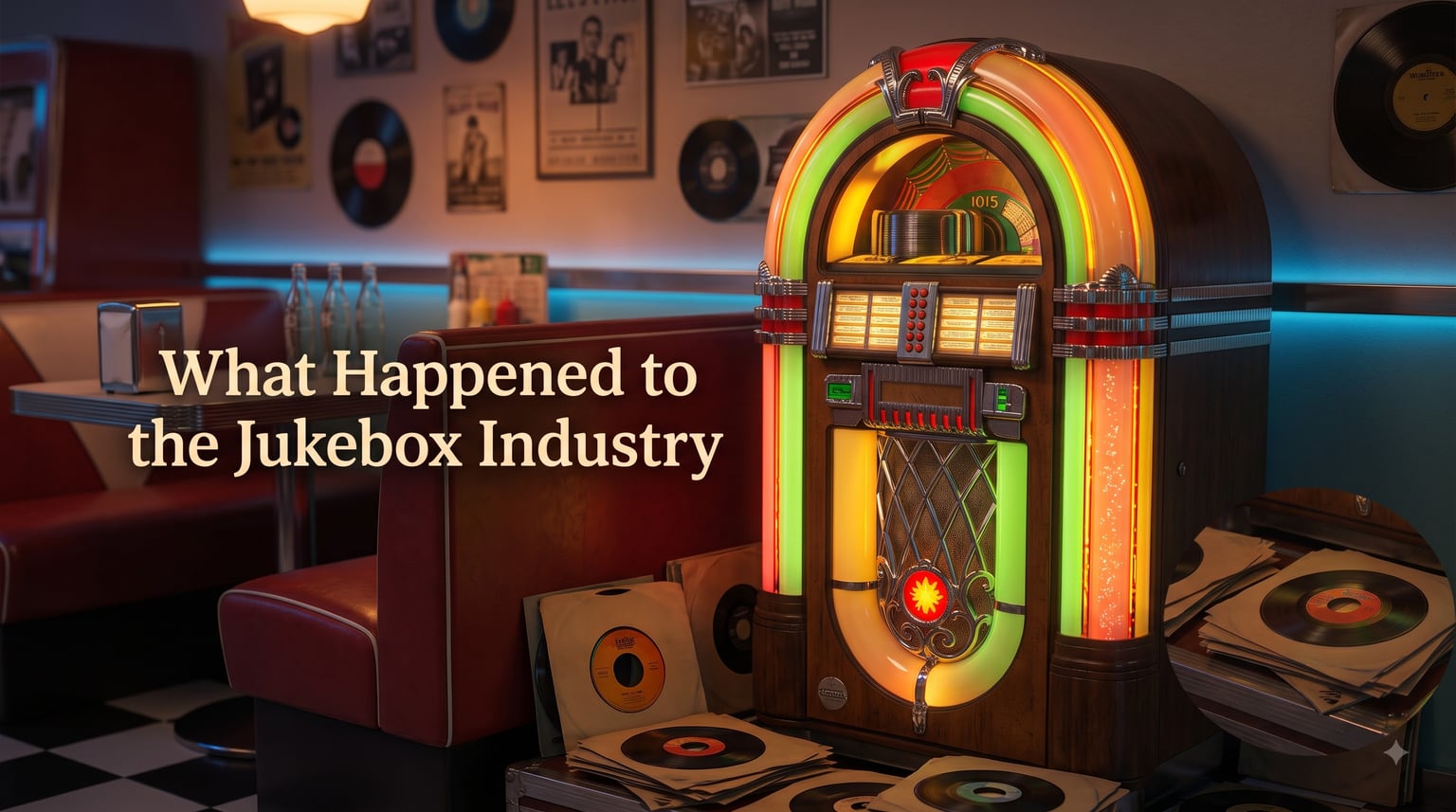
The jukebox industry collapsed because technology moved on, consumer habits shifted, and new forms of entertainment replaced the coin-operated phonograph in bars and diners. At its peak in the late 1940s and 1950s, the jukebox was the heartbeat of American social life, sitting in over 400,000 locations and generating millions of dollars in annual revenue. Radios got cheaper, records moved into living rooms, and eventually, everyone walked around with a music library in their pocket.
But that headline only scratches the surface. The real story of what happened to the jukebox industry involves post-war teenage culture, the rise and fall of legendary manufacturers, organized crime, the broader coin-operated amusement industry, and a digital revival that few people saw coming. As a site dedicated to coin-op history, we have a particular interest in how jukeboxes fit into the larger ecosystem of arcade games, pinball machines, and other coin-operated entertainment that defined mid-century America.
I have spent years researching coin-operated machines, talking to route operators, and reading through industry trade publications to understand this story. The jukebox decline was not a single event but a slow erosion spanning four decades, with multiple overlapping causes that each chipped away at the industry’s foundation. Let me walk you through exactly what happened, decade by decade, manufacturer by manufacturer, and technology by technology.
Whether you are a coin-op enthusiast, a music history buff, a bar owner wondering about the business model, or simply someone who feels nostalgic when they see a Wurlitzer glowing in the corner of a diner, this article will give you the complete picture of what happened to the jukebox industry.
Table of Contents
- The Birth of the Jukebox: From Nickel-in-the-Slot to Coin-Operated Phonograph (1889-1930s)
- The Golden Age: When Jukeboxes Ruled American Culture (1940s-1950s)
- The Four Horsemen: Key Manufacturers That Built the Industry
- The Decline: What Happened to the Jukebox Industry (1960s-1990s)
- The Jukebox and the Coin-Op Industry Connection
- The Dark Side: Mafia Connections and Jukebox Wars
- The Digital Revival: Are Jukeboxes Still Made? (2000s-Present)
- Physical vs Digital Jukeboxes: What Changed
- Collecting Vintage Jukeboxes: What Are Old Jukeboxes Worth Today?
- FAQs
- Conclusion
The Birth of the Jukebox: From Nickel-in-the-Slot to Coin-Operated Phonograph (1889-1930s)
The jukebox story begins in 1889, when Louis Glass installed the first coin-operated phonograph at the Palais Royale Saloon in San Francisco. For a nickel, patrons could listen to a single song through a listening tube, since the machine had no amplifier or speakers. It was a simple concept but a revolutionary one: for the first time, anyone could pay to hear recorded music in a public place.
Those early machines used wax cylinders and Edison technology, which meant limited song selection and fragile media. Operators had to physically swap cylinders to change the available music. Despite these limitations, the nickel-in-the-slot machines were enormously profitable. Some locations reportedly earned hundreds of dollars per month in the early 1890s, which was extraordinary money at the time.
The big breakthrough came in the 1920s when electric amplification made it possible for multiple people to hear a record at the same time. Instead of one person pressing a tube to their ear, a whole room could hear the music. This single technological shift transformed the coin-operated phonograph from a curiosity into a social device. The machines moved from being solo entertainment to the center of a gathering space.
That shift also created a new word. The term “jukebox” comes from “juke joint,” which itself derives from the Gullah word “juke” or “jook,” meaning disorderly or rowdy behavior. Juke joints were informal gathering places in the American South where working-class people, particularly African Americans, could socialize, dance, and hear music. The coin-operated phonographs in those establishments became known as jukeboxes, and the name stuck.
By the early 1930s, several companies had entered the market. The Great Depression was ravaging the economy, but coin-operated entertainment thrived because it offered cheap escapism. A nickel for a song was affordable even when money was tight. Manufacturers like Wurlitzer, Seeburg, Rock-Ola, and AMI all recognized the opportunity and began building increasingly sophisticated machines with better sound, more record capacity, and eye-catching designs.
These early commercial jukeboxes could hold and select from multiple records, typically using a mechanical system where the user pressed buttons corresponding to numbered songs. The machine would then rotate a record carousel, lift the selected disc, place it on a turntable, and play it through an amplified speaker system. The entire mechanism was a marvel of electro-mechanical engineering.
The Golden Age: When Jukeboxes Ruled American Culture (1940s-1950s)
The jukebox Golden Age began during World War II and exploded in the post-war years. By 1946, the industry was producing tens of thousands of machines annually, and they appeared in diners, bars, bowling alleys, drugstores, and social clubs across America. The Wurlitzer 1015, introduced in 1946, became the iconic jukebox design that most people picture today, with its glowing bubble tubes, Art Deco styling, and colorful lights.
Wurlitzer sold over 56,000 units of the Model 1015 alone, making it the best-selling jukebox of all time. The machine cost about $750 new, which translates to roughly $10,000 in 2026 dollars. Operators placed them in locations on a revenue-sharing basis, typically splitting income with the venue owner. A single machine in a popular spot could earn $50 to $100 per week in its prime.
The real driver of the Golden Age, though, was a demographic shift. The post-war baby boom created the first true “teenager” demographic, young people with disposable income and a desire for independence. Jukeboxes gave teenagers a reason to gather at the local diner, drugstore counter, or malt shop. They could drop a nickel, pick a song, and claim a small piece of cultural territory for themselves. This was the birth of the jukebox as a “third space,” a social environment that was neither home nor work.
The jukebox also transformed the music industry itself. During the Great Depression, record sales had collapsed from over 100 million units annually in 1927 to just 6 million by 1932. The jukebox single-handedly revived the industry. By the late 1940s, jukeboxes consumed an estimated 13 million records per year and accounted for a significant portion of total record production. Record labels began specifically pressing singles designed for jukebox play, and Billboard magazine tracked jukebox plays as a key metric for measuring a song’s popularity.
Rock and roll was arguably born on the jukebox. When major labels hesitated to promote rhythm and blues and early rock, jukeboxes in bars and clubs became the distribution channel that broke those genres to a wider audience. White teenagers heard artists like Fats Domino, Little Richard, and Chuck Berry on jukeboxes in their local hangouts, creating a cross-racial musical exchange that would have been difficult through mainstream radio at the time. The jukebox became a quiet force for cultural integration.
The music industry recognized this power. Trade publications tracked “coin machine plays” alongside radio airplay and record sales. A song that did well on jukeboxes could become a national hit even without radio support. This gave jukebox operators outsized influence in breaking new artists and shaping musical trends throughout the 1950s.
At the peak of the Golden Age, an estimated 750,000 jukeboxes operated across the United States. They generated over $500 million in annual revenue, which equates to roughly $6 billion today. The industry employed thousands of route operators, technicians, and service personnel who kept the machines stocked and running. It was a genuine economic ecosystem.
The Four Horsemen: Key Manufacturers That Built the Industry
Four companies dominated the jukebox industry during its Golden Age. Each brought something different to the market, and each met a different fate as the industry declined. Understanding these manufacturers is essential to understanding what happened to the jukebox industry as a whole.
Wurlitzer was the design icon. Founded in 1856 as a manufacturer of stringed instruments, the Rudolph Wurlitzer Company entered the jukebox market in 1933. The company hired industrial designer Paul Fuller, who created the flowing Art Deco lines, bubble tubes, and color-changing lights that defined the classic jukebox aesthetic. Wurlitzer peaked in the late 1940s with the Model 1015 but struggled to adapt to changing technology in the 1960s. The company ceased jukebox production in 1974.
Seeburg was the technology leader. Founded in 1902 as a manufacturer of pianos and coin-operated pianos, Seeburg made a pivotal innovation in 1948 by introducing the first jukebox designed for 45 rpm records, the M100A. This machine held 50 records and could play both sides, giving users 100 song selections. That was a massive leap from the 24 selections offered by competing 78 rpm machines. Seeburg also pioneered the wallbox, a remote selector unit that let customers pick songs from their table or bar stool. The company dominated the 1950s but filed for bankruptcy in 1979 and was liquidated.
Rock-Ola was the scrappy survivor. Founded in 1927 by David C. Rockola (note the original spelling had one “c”), the company produced its first jukebox in 1935. Rock-Ola never achieved the market share of Wurlitzer or Seeburg but built a reputation for solid engineering and distinctive designs. The company is notable for being the only major Golden Age manufacturer that still exists in some form, continuing to produce nostalgic jukeboxes for the collector market.
AMI (Automatic Musical Instrument Company) was the pioneer. AMI built the first commercially successful electrically amplified jukebox in 1927, establishing the template that all others would follow. The company was known for conservative but reliable designs and eventually evolved into AMI Entertainment Network, which operates digital jukeboxes today. AMI is the only one of the four that successfully made the transition from mechanical to digital.
The fate of these four companies tells the story of the broader industry. Wurlitzer and Seeburg, the two giants, could not adapt to the digital age and disappeared. Rock-Ola survived by going niche. AMI survived by reinventing itself entirely. The pattern of dominant players failing to adapt while smaller or more flexible companies pivoted is one we see repeatedly in the coin-op amusement industry.
The Decline: What Happened to the Jukebox Industry (1960s-1990s)
The decline of the jukebox industry was not caused by a single event. It was a slow, multi-decade erosion driven by overlapping technological shifts, changing consumer behavior, and new competition for entertainment dollars. Here are the key factors that killed the jukebox, roughly in the order they hit.
Factor 1: The transistor radio and portable music (1960s). When transistor radios became cheap and widely available in the late 1950s and early 1960s, teenagers no longer needed to go to a jukebox to hear music. They could carry a radio anywhere. The device that had given teenagers their first taste of musical independence was replaced by a device that gave them even more independence. The social function of the jukebox, gathering around a machine with friends to listen, began to erode.
Factor 2: Home stereos and LP records (1960s-1970s). As record players and stereo systems became affordable, the living room replaced the diner as the primary place to listen to music. Albums, with their longer playing time and curated track listings, offered a different listening experience than the single-song jukebox. Why pay a nickel for one song when you could own the whole album for a dollar and play it at home?
Factor 3: Cassette tapes and the Walkman (1970s-1980s). The cassette tape made music truly portable. With a Walkman or a car tape deck, people could create their own playlists and take them anywhere. This further reduced the need for public music sources. The Walkman, introduced in 1979, was particularly devastating because it made music consumption a private, individual experience rather than a shared, communal one.
Factor 4: Video games and the coin-op invasion (late 1970s-1980s). This is the factor most directly relevant to our audience at Coin-OP Games. In the late 1970s, video arcade games began appearing in the same bars, restaurants, and bowling alleys that had been prime jukebox territory. A single Space Invaders or Pac-Man machine could earn as much as or more than a jukebox. Venue owners began replacing low-earning jukeboxes with arcade cabinets, which had higher per-play revenue. You can see this shift documented in our retrospective on the 1978 coin-op industry, where the jukebox share of coin-op revenue began its long decline.
Factor 5: CDs and personal music collections (1980s-1990s). The compact disc further accelerated the shift to home and personal listening. CD changers could hold 100 or more discs, giving listeners more selection than a jukebox without needing coins. Bars and restaurants that had kept jukeboxes for ambiance began to see them as relics taking up valuable floor space.
Factor 6: The MP3 and streaming revolution (2000s-present). By the time iPods and then smartphones arrived, the jukebox had already been in decline for decades. But streaming services like Spotify and Apple Music delivered the final blow. Why pay to select a song in a bar when everyone already has every song on their phone?
The financial perspective from venue owners and route operators tells a critical part of this story. On Reddit forums, bar owners explain that jukeboxes are evaluated purely on revenue. If a machine does not earn enough to justify its floor space, it gets pulled. One Reddit user who operates a bar described a 50/50 revenue split with their jukebox provider, where the provider covers fees and provides background music service. That arrangement works for their venue, but many others found the economics increasingly unfavorable as music became more accessible elsewhere.
The route operator business model also came under pressure. Operators who once maintained routes of dozens of jukeboxes across multiple venues saw their income shrink as machines earned less. Servicing mechanical jukeboxes required skilled technicians, and as revenue declined, the cost of maintaining aging machines became unsustainable. Many operators simply walked away, leaving machines to gather dust in corners of bars that could not be bothered to have them removed.
By the 1990s, the traditional mechanical jukebox industry was essentially dead. Wurlitzer had stopped production. Seeburg was bankrupt. The machines still in operation were aging relics, and very few new ones were being made. The industry that had once generated hundreds of millions in annual revenue had become a curiosity.
The Jukebox and the Coin-Op Industry Connection
To fully understand what happened to the jukebox industry, you have to see it as part of the broader coin-operated amusement industry. Jukeboxes were not standalone devices. They were the cash cows of a distribution network that also handled pinball machines, arcade games, slot machines, and other coin-operated equipment. Route operators who serviced jukeboxes often serviced these other machines too.
In the 1950s and 1960s, jukeboxes were the most reliable earners in the coin-op world. A jukebox in a busy location could generate steady income day after day, year after year. Pinball machines had their fans, but jukeboxes had universal appeal because everyone wanted music. This made jukeboxes the financial backbone of many route operators’ businesses.
The shift began in the mid-1970s. Pinball machines had a resurgence, and then video arcade games arrived and changed everything. When Pong, Space Invaders, and Pac-Man started appearing in bars and restaurants, they earned significantly more per square foot than jukeboxes. A single arcade game could earn $200 to $400 per week in a good location, while a jukebox in the same spot might earn $30 to $50. The math was obvious to venue owners and operators alike.
As documented in our retrospective on the 1978 coin-op industry, this was the pivotal year when the coin-op landscape shifted dramatically. Arcade games commanded premium floor space, and jukeboxes were pushed to less prominent locations or removed entirely. Route operators who had built their businesses around jukeboxes scrambled to add video games to their routes.
The broader coin-op industry actually thrived in the 1980s even as jukeboxes declined. Pinball had a golden age. Arcade games exploded. But jukeboxes, which had been the stable, reliable foundation of the industry, were quietly being marginalized. The industry did not die, it simply evolved past the jukebox. New machines took the floor space, and the technology that had once been the pride of coin-op became a legacy product.
This coin-op context is something most articles about jukebox decline completely miss. They focus on music technology and consumer habits but ignore the physical and business reality of how these machines were distributed, serviced, and monetized. For the coin-op community, the jukebox decline was part of a larger story about how the entire industry transformed in the space of a decade.
The Dark Side: Mafia Connections and Jukebox Wars
There is a chapter of the jukebox story that most manufacturers and enthusiasts prefer not to discuss. The jukebox industry, particularly in the mid-20th century, had significant connections to organized crime. Because jukeboxes generated steady cash revenue and operated in bars and clubs that were themselves sometimes connected to organized crime, the machines became a natural target for Mafia involvement.
Distribution territories were everything in the jukebox business. A route operator who controlled the jukeboxes in a particular neighborhood or city had a guaranteed revenue stream. These territories were sometimes established and defended through intimidation and violence, earning the conflicts the name “jukebox wars.” Operators who tried to move into someone else’s territory could face threats, vandalism, or worse.
The Mafia’s interest in jukeboxes was straightforward. Cash businesses are ideal for money laundering, and jukeboxes generated significant cash. Additionally, controlling the jukeboxes in a territory meant controlling what music was promoted, which had value for record labels and artists who wanted their songs played. This connection between organized crime and the music distribution system is explored in depth by clicktrack.fm’s investigation into the dark history of the jukebox.
The Scopitone machine, a 1960s jukebox that played music videos on film, represents an interesting footnote in this history. Scopitone Inc. filed for Chapter 11 bankruptcy in 1967 and shut down completely in 1969, partly due to financial mismanagement and questionable business practices. The machines were sold off, and some found second lives in different markets. The Scopitone story is a reminder that the jukebox industry was not just about music and technology, it was also a rough-and-tumble business with more than its share of shady operators.
These Mafia connections likely accelerated the industry’s decline in some markets. When law enforcement cracked down on organized crime in the 1970s and 1980s, some jukebox distribution networks were disrupted. Route operators who had benefited from Mafia protection or territorial agreements found themselves exposed to competition they were not prepared for. The underworld infrastructure that had supported parts of the jukebox industry was dismantled, and the legitimate parts of the business were not always strong enough to fill the gap.
The Digital Revival: Are Jukeboxes Still Made? (2000s-Present)
Yes, jukeboxes are still made, but they bear almost no resemblance to the mechanical machines of the Golden Age. The digital jukebox revival began in the late 1990s and early 2000s, led by companies like TouchTunes and AMI Entertainment Network. These machines replaced physical records with hard drives and internet connections, giving users access to millions of songs instead of the 100 or so selections on a traditional machine.
TouchTunes, founded in 1998, pioneered the internet-connected jukebox. Their machines feature touchscreen interfaces, massive digital music libraries, and the ability for users to select songs from their smartphones via a mobile app. You can walk into a bar, open the TouchTunes app, browse millions of songs, and queue up your choices without leaving your seat. AMI Entertainment Network, the successor to the original Automatic Musical Instrument Company, offers similar technology through its Adloc and Pulse platforms.
The business model for digital jukeboxes is fundamentally different from the mechanical era. Instead of pressing 45 rpm records and physically swapping them out, operators update machines remotely over the internet. Songs can be priced dynamically, with premium pricing for new releases or popular tracks. Some machines offer a “play next” feature where users can pay extra to jump the queue, adding a new revenue layer.
Venue owners still operate on a revenue-sharing model, but the economics have shifted. Digital jukeboxes require less maintenance than mechanical ones because they have no moving parts in the playback system. However, they require internet connectivity, software updates, and licensing fees for the music they stream. The overall revenue per machine is generally lower than in the Golden Age, which is why fewer venues have them.
The digital revival has not been without controversy. On Reddit and other forums, users frequently complain that digital jukeboxes have degraded the bar experience. Common grievances include expensive song pricing, long queues when someone has already loaded up dozens of songs, and the impersonal nature of app-based selection. One recurring complaint is what users call “enshittification,” the idea that each generation of jukebox technology offers more features but delivers a worse social experience.
There is a valid point buried in those complaints. The traditional jukebox created a shared experience. You put in your coin, selected your song, and everyone in the room heard it together. The physical act of walking to the machine and making a selection was a social ritual. Digital jukeboxes, while offering vastly more selection, have made the experience more private and transactional. The technology improved, but something human was lost in the process.
Despite these criticisms, the digital jukebox market persists. TouchTunes operates over 70,000 machines across the United States, and AMI serves a similar number of venues. These are not the cultural icons their predecessors were, but they keep the concept alive. The jukebox did not die, it evolved into something different.
Physical vs Digital Jukeboxes: What Changed
The transition from physical to digital jukeboxes represents one of the most significant shifts in the history of the coin-operated amusement industry. Understanding the differences helps explain why the industry declined even as a version of it survived. Here is how the two eras compare.
Selection. A Golden Age jukebox held 50 to 100 records, offering 100 to 200 song selections. A modern digital jukebox offers access to millions of tracks. The improvement in selection is massive, but it comes with a trade-off. When a physical jukebox had limited selection, the music in a bar was curated by the operator for that specific venue. Regulars knew the machine and its songs. Digital jukeboxes, with their infinite libraries, can lead to chaotic, disjointed playlists that do not match the venue’s atmosphere.
Social experience. The physical jukebox required you to get up, walk to the machine, and make your selection in a public space. Other people could see what you chose. There was a social pressure and a social pleasure in the ritual. Digital jukeboxes, especially those with smartphone apps, let you select songs without moving or interacting with anyone. The communal aspect of music selection has been largely eliminated.
Sound quality. Modern digital jukeboxes generally offer cleaner, more consistent sound than their mechanical predecessors. However, some audiophiles argue that the warm, analog sound of a 45 rpm record played through a tube amplifier has a quality that digital cannot replicate. This is the same vinyl-versus-digital debate that persists in the broader music world.
Revenue model. Physical jukeboxes charged a flat rate per play, typically a nickel in the 1940s rising to a quarter or fifty cents by the 1970s. Digital jukeboxes use dynamic pricing, charging more for popular songs, new releases, or queue-jumping features. Some users find this pricing model frustrating, especially when a song they want costs significantly more than others.
Maintenance and operation. Physical jukeboxes required regular servicing by skilled technicians who could fix mechanical components, clean styluses, and swap records. Digital jukeboxes require minimal physical maintenance but depend on internet connectivity, software updates, and licensing agreements. The skill set needed to keep them running has completely changed.
Ambiance and nostalgia. This is where physical jukeboxes win decisively. The glow of bubble tubes, the mechanical clunk of a record being selected and placed on the turntable, the visible workings of a complex machine, these elements created an atmosphere that a touchscreen simply cannot match. Many bars and collectors keep vintage jukeboxes running specifically for this ambiance, even when they are not the most practical music source.
Collecting Vintage Jukeboxes: What Are Old Jukeboxes Worth Today?
While the jukebox industry as a commercial force has largely faded, a thriving collector market keeps vintage machines alive. If you are wondering what old jukeboxes are worth today, the answer depends heavily on the model, condition, and provenance. Here is a general guide to vintage jukebox values.
The Wurlitzer 1015 (1946) is the holy grail for collectors. A fully restored model in excellent condition can sell for $12,000 to $20,000 or more. This is the machine most people picture when they think of a classic jukebox, and its iconic design keeps demand high. Unrestored models in working condition typically sell for $5,000 to $8,000.
Seeburg models from the 1950s, particularly the M100C and the V200 (the first 200-selection jukebox), are also highly collectible. Prices range from $3,000 for unrestored models to $10,000 or more for fully restored examples. Seeburg’s technological innovations make their machines particularly interesting to collectors who appreciate engineering.
Rock-Ola machines from the 1940s and 1950s, such as the Model 1422 and 1438, typically sell for $3,000 to $8,000 depending on condition. Rock-Ola machines are valued for their distinctive designs and solid build quality.
AMI models from the Golden Age generally range from $2,000 to $6,000. They are less sought after than Wurlitzer and Seeburg but are still respected by serious collectors.
For anyone interested in getting into jukebox collecting, the National Jukebox Exchange community is an excellent starting point. They provide resources for finding, restoring, and maintaining vintage machines. Their National Jukebox Exchange archive contains historical documentation that is invaluable for identifying and authenticating vintage models.
Restoration is a significant part of the collector market. Professional jukebox restoration services can cost $3,000 to $10,000 depending on the extent of the work needed. Many collectors learn to do their own restoration, which has created a community of hobbyists who share knowledge, parts sources, and technical advice. This community keeps the mechanical knowledge alive that would otherwise be lost as the original technicians retire.
FAQs
Does anyone still make jukeboxes?
Yes, jukeboxes are still manufactured, but they are entirely digital. Companies like Rock-Ola continue producing nostalgic-styled jukeboxes for the collector market, while TouchTunes and AMI Entertainment Network produce commercial digital jukeboxes for bars and restaurants. These modern machines use touchscreens, internet connectivity, and streaming music libraries rather than physical records.
When did jukeboxes lose popularity?
Jukeboxes began losing popularity in the 1960s with the rise of transistor radios and home stereo systems. The decline accelerated through the 1970s as cassette tapes and portable music players reduced the need for public music sources. By the 1990s, traditional mechanical jukeboxes had largely disappeared from most venues, replaced by digital versions or removed entirely.
How much are old jukeboxes worth today?
Vintage jukebox values vary widely by model and condition. A fully restored Wurlitzer 1015 can sell for $12,000 to $20,000. Seeburg models from the 1950s range from $3,000 to $10,000. Rock-Ola machines typically sell for $3,000 to $8,000. Unrestored or project machines in any brand can be found for $1,000 to $3,000 but require significant restoration work.
How do jukeboxes work?
Traditional jukeboxes work through a mechanical system: the user inserts a coin to activate the machine, presses buttons to select a numbered song, and the internal mechanism rotates a record carousel to find the correct disc. A mechanical arm lifts the record, places it on a turntable, and a stylus plays the track through an amplified speaker system. Modern digital jukeboxes replace this mechanism with a touchscreen, hard drive, and internet connection.
Why did jukeboxes decline?
Jukeboxes declined due to six main factors: the transistor radio giving teenagers portable music, affordable home stereos, cassette tapes and the Walkman making music personal, video arcade games taking over coin-op floor space, CDs and personal collections, and finally streaming services making unlimited music available on smartphones. Each factor chipped away at the jukebox’s role as a shared public music source.
What replaced jukeboxes in bars?
Jukeboxes in bars were replaced by a combination of digital jukeboxes (TouchTunes, AMI), home music systems brought into venues via smartphones and Bluetooth speakers, and background music subscription services. Some bars simply removed jukeboxes entirely and rely on curated playlists streamed through their sound systems. In the 1970s and 1980s, many jukeboxes were physically replaced by video arcade games that earned more revenue per square foot.
Conclusion
What happened to the jukebox industry is a story of technological obsolescence meeting cultural change. The industry rose because coin-operated phonographs filled a gap: they provided affordable, shared music in public spaces at a time when recorded music was not easily accessible. When that gap closed, the industry shrank. Radios, home stereos, cassette tapes, CDs, MP3 players, and smartphones each removed a reason for people to put a coin in a machine to hear a song.
The jukebox industry also fell victim to the broader transformation of the coin-op amusement world. Video arcade games and pinball machines took the floor space that jukeboxes once dominated, and they earned more money doing it. Route operators shifted their investments to more profitable machines. Manufacturers like Wurlitzer and Seeburg, who could not adapt to digital technology, disappeared. Only AMI and Rock-Ola survived in some form.
Today, the jukebox industry exists as a shadow of its former self. TouchTunes and AMI keep digital versions running in thousands of bars and restaurants. Collectors preserve vintage machines and the mechanical knowledge needed to keep them playing. And for those of us in the coin-op community, the jukebox remains the original coin-operated success story, the machine that proved people would pay a coin for entertainment and built an entire industry on that simple idea.
The jukebox may never again be the cultural force it was in the 1940s and 1950s, but its legacy lives on every time someone selects a song in a bar. The technology changed completely, but the fundamental idea, paying to choose the music in a shared space, turned out to be one of the most durable concepts in the history of entertainment.