
I have been to both Dave & Buster’s and Chuck E. Cheese more times than I can count, between my own kids’ birthday parties, cousin hangouts, and a few adult nights out. Every time someone asks me which one to pick, my answer changes depending on who is going.
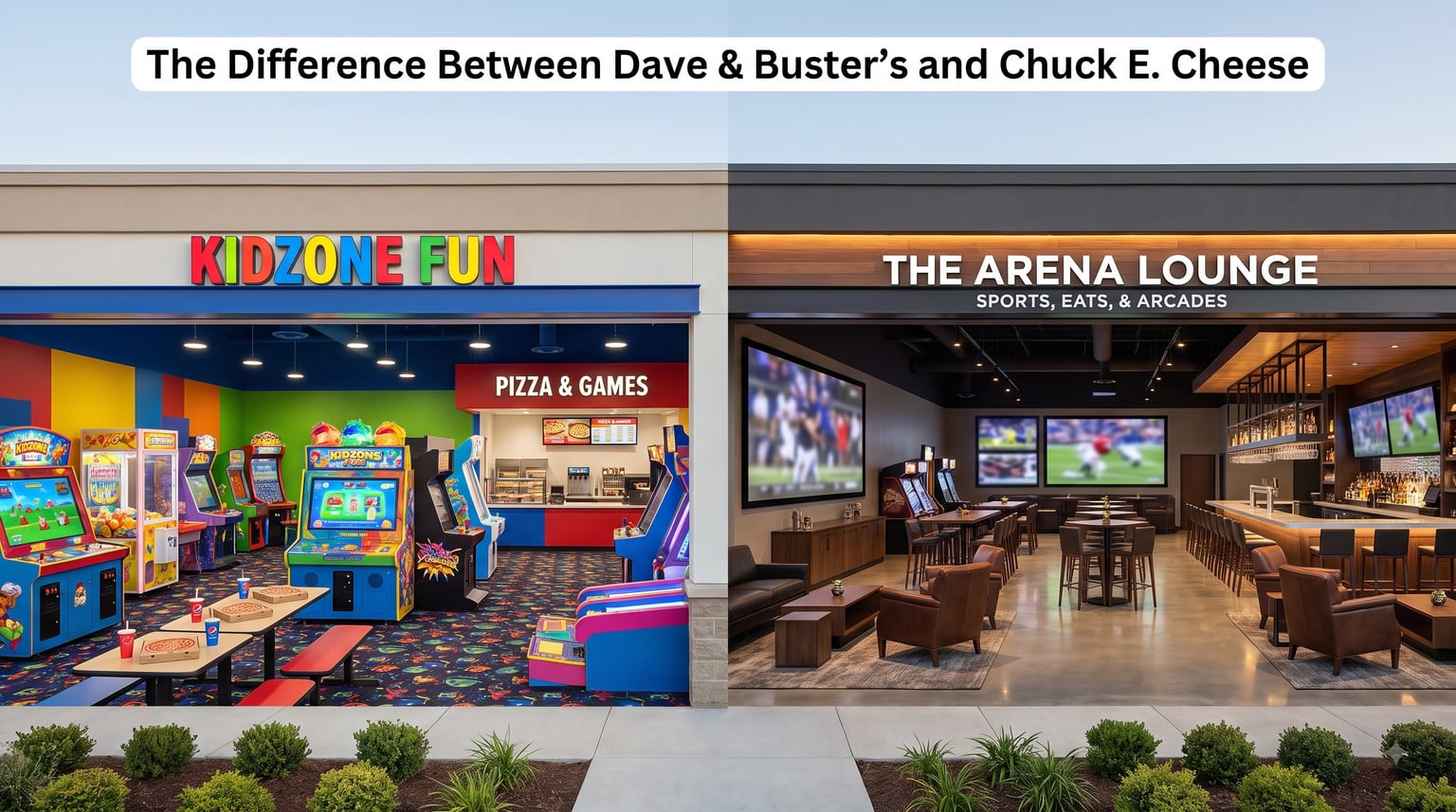
The difference between Dave & Buster’s and Chuck E. Cheese comes down to this: Chuck E. Cheese is built for young children (roughly ages 2 to 12), while Dave & Buster’s is an adult-oriented sports bar and arcade that welcomes older kids and teens. Everything else, from the food to the pricing model to the prize counter, flows from that core distinction.
If you are trying to decide which one is right for your next outing, I will break down every category that actually matters. No fluff, just the real differences based on what these two family entertainment centers actually offer in 2026.
Table of Contents
- Quick Answer: Which Is Right for You?
- Target Audience and Atmosphere
- Game Selection and Types
- Food and Beverage Options
- Pricing and Value: Power Card vs Play Pass
- Prize Redemption Systems
- Age-Appropriateness Breakdown
- Safety Features and Sensory Options
- Birthday Parties and Group Events
- Tips for Maximizing Value at Each Venue
- FAQs
- What’s better, Dave and Busters or Chuck E. Cheese?
- Is Dave and Buster’s the adult version of Chuck E. Cheese?
- Is Dave and Buster’s appropriate for a 5 year old?
- How many games can you play at Dave and Buster’s for $25?
- Why does no one go to Chuck E. Cheese anymore?
- What is the Dave and Buster’s 25 rule?
- Conclusion
Quick Answer: Which Is Right for You?
Here is the short version. Chuck E. Cheese is the right pick if you have kids under 10, want a safe enclosed space, and care about affordable pizza and kid-focused games. Dave & Buster’s is the better choice for teens, adults, date nights, or families with older kids who want a bigger game selection, better food, and a full bar.
Chuck E. Cheese is a purpose-built family entertainment center where everything from the game heights to the pizza is designed for small children. Dave & Buster’s is essentially a grown-up arcade with a restaurant, bar, and big-screen sports viewing area that happens to allow kids.
The venue you pick should match your group. A 5-year-old’s birthday party and a 25-year-old’s night out are not the same event, and these two places reflect that.
Target Audience and Atmosphere
This is the biggest difference, and it shapes everything else. Chuck E. Cheese designs every detail around children. The mascot, the animatronic show, the bright colors, the low tables, and the party rooms all exist to make young kids feel like the center of attention.
Dave & Buster’s goes in the opposite direction. The lighting is dim, the music is louder, the bar is front and center, and the crowd skews adult. One parent on Reddit described it well: D&B is “loud, dark and complicated for little ones.” That is not a flaw, it is intentional design for a different audience.
Many people call Dave & Buster’s the adult version of Chuck E. Cheese, and that is a fair shorthand. But it is more accurate to say they serve completely different demographics that happen to both have arcade games in common. Think of CEC as a kids’ party venue that has games, and D&B as a bar and restaurant that has games.
The atmosphere difference matters for planning. At Chuck E. Cheese, you expect chaos, running children, and a pizza-focused menu. At Dave & Buster’s, you expect sports on TV, a wait staff bringing drinks, and an environment where adults relax while older kids play.
Game Selection and Types
Both venues run large arcades with a mix of video games, redemption games, and interactive experiences. But the game selection differs in scale and target age.
Chuck E. Cheese stocks around 50 to 80 games per location, almost all sized for smaller bodies. You will find Skee-Ball, basketball toss, Whack-A-Mole, coin-pushers, driving games at kid height, and a few ticket redemption games that are easy enough for a 4-year-old to play. The store also runs its “Adventure World” interactive floor projection games at many locations.
Dave & Buster’s typically has 100-plus games per location, many of which are full-size arcade cabinets, racing simulators, VR experiences, and shooting games designed for teens and adults. The skill ceiling is higher. A forum user noted that D&B games are “more age appropriate” for older kids and offer more variety.
Redemption Games at Each Venue
Both chains operate a ticket redemption loop where you earn e-tickets from games and exchange them at the prize counter. The difference is in what you can win. Chuck E. Cheese prizes lean heavily toward small toys, stickers, and plush items that appeal to young children. Dave & Buster’s prizes include higher-value electronics, gaming accessories, and branded merchandise.
Forum users consistently report that D&B has a better ticket payout rate. One Reddit commenter mentioned getting 600 tickets for a plush at D&B versus needing thousands of tickets for a similar item at Chuck E. Cheese. That said, CEC’s prize counter is designed to be attainable for kids who play casually, not optimize for ticket efficiency.
Food and Beverage Options
Food is where the two chains diverge sharply. Chuck E. Cheese is essentially a pizza restaurant with an arcade attached. The menu centers on pizza, wings, a salad bar, and kid-friendly snacks like mozzarella sticks and fries. The pizza is actually decent, and the All You Can Play combos often bundle food with game time.
Dave & Buster’s runs a full restaurant kitchen with a much broader menu. You get steaks, burgers, pasta, seafood, shareable appetizer platters, and a wide selection of desserts. The food quality is closer to a casual dining chain like TGI Fridays or Buffalo Wild Wings than a kids’ party venue.
The Bar Difference
This is a major factor for many adults. Dave & Buster’s has a full bar with beer, wine, and cocktails, plus big-screen TVs showing live sports. It is genuinely a place adults go for a night out. Chuck E. Cheese serves beer and wine at most locations, but the selection is limited and the setting is not conducive to hanging out with a drink.
If your outing is as much about the adults having fun as the kids, D&B wins this category easily. If you want a quick pizza lunch and games for the kids, CEC is simpler and cheaper.
Pricing and Value: Power Card vs Play Pass
Both chains use card-based payment systems, but they work differently and have different hidden costs.
Chuck E. Cheese uses the Play Pass, a reloadable card loaded with time or points. Their most popular option is the All You Can Play model, where you pay a flat rate for a set amount of time (usually 30 to 120 minutes) and play unlimited games during that window. This is straightforward and easy to budget for.
Dave & Buster’s uses the Power Card, a chip-based card loaded with points where each game deducts a point value. A $20 Power Card gives you roughly 16 games, assuming an average of about 6 to 8 chips per game. There is a catch: D&B charges a $3 activation fee for new Power Cards, which frustrates a lot of customers based on forum feedback.
Real Cost Comparison
At Chuck E. Cheese, a typical family visit with the All You Can Play option plus pizza runs about $40 to $70 for a family of four, depending on how long you play and what food package you choose. The time-based model means your cost is predictable.
At Dave & Buster’s, a similar family of four can easily spend $80 to $150 or more, especially if you add food, drinks, and extra game credits. One Reddit user shared that their child burned through $20 in 15 minutes on the hammer game alone. The per-game model can add up fast if you are not paying attention.
The best value hack for D&B is Wednesday half-price games, which several forum users called out as the smartest time to go. Chuck E. Cheese frequently runs coupons and online deals, so checking their website before you go can save 20 to 30 percent.
Prize Redemption Systems
Both venues use digital ticket systems, so no more paper tickets stuffed in pockets. Chuck E. Cheese loads e-tickets directly onto the Play Pass card, and Dave & Buster’s does the same with the Power Card.
The real difference is in prize value and accessibility. Chuck E. Cheese’s prize counter is designed so that even a casual visit nets a kid something. Prices start low, and kids can walk away with a bouncy ball, stickers, or a small plush after an hour of play. This keeps younger kids motivated and happy.
Dave & Buster’s prizes are geared toward an older audience. The counter includes higher-end items like Bluetooth speakers, gaming headsets, and branded apparel. These require significantly more tickets, which means either a longer visit or higher spending. For adults and teens who enjoy the thrill of saving up for a big prize, this system works well. For a 6-year-old who just wants something tangible, it can feel out of reach.
Age-Appropriateness Breakdown
This is the question I get asked most: which place is right for what age? Here is how I break it down after visiting both repeatedly.
Ages 2 to 5: Chuck E. Cheese is the clear winner. The games are at the right height, the redemption loop is simple, and the environment is enclosed and kid-focused. Dave & Buster’s can be overwhelming for toddlers. The dark lighting, loud sounds, and large crowds make it hard for small children to navigate, and many games are physically out of reach or too complex.
Ages 6 to 9: Both work, but Chuck E. Cheese still holds the edge for pure kid enjoyment. The games hit the sweet spot for this age group, and the atmosphere is designed for them. Dave & Buster’s starts to become viable, especially if parents want better food.
Ages 10 to 12: This is the transition zone. Many kids this age start to feel Chuck E. Cheese is too babyish and want the bigger, more exciting games at Dave & Buster’s. A tween will likely have more fun at D&B.
Teens and adults: Dave & Buster’s, without question. The full bar, sports viewing, bigger game library, and adult-oriented atmosphere make it a legitimate entertainment destination for grown-ups. Chuck E. Cheese is not designed for this audience.
Safety Features and Sensory Options
Chuck E. Cheese has a significant safety advantage for parents of young children. The Kid Check system stamps every adult and child in the party with matching UV numbers, and staff verify these stamps when you leave. This prevents anyone from walking out with a child who is not theirs. The layout is also enclosed and visible, making it easy to keep an eye on kids from most spots in the building.
Dave & Buster’s does not have an equivalent check-out system. The venue is larger, darker, and harder to track kids across. Forum users with young children consistently mention the difficulty of keeping tabs on kids in the bigger D&B footprint. If safety supervision is a top concern with small children, CEC is better equipped for it.
Sensory-Friendly Options
Chuck E. Cheese runs Sensory Sensitive Sundays at participating locations, opening early on the first Sunday of the month with reduced lighting and noise, trained staff, and a calmer environment for children with autism or sensory sensitivities. This program has been widely praised by special needs families.
Dave & Buster’s does not offer a comparable sensory-friendly program. The inherently loud, dark, and busy atmosphere can be challenging for sensory-sensitive children. If your child has sensory processing needs, CEC’s dedicated program makes it the safer bet.
Birthday Parties and Group Events
Both chains are popular birthday party destinations, but they cater to different celebrations.
Chuck E. Cheese is built around kids’ birthday parties. Packages typically include a reserved table or party room, pizza, drinks, game time, a visit from the Chuck E. character, tickets for the birthday child, and a ticket blaster finale. Prices start around $25 to $35 per child, and the whole experience is turnkey for parents.
Dave & Buster’s offers group and party packages too, but they are geared toward older kids, teens, and corporate events. You get food, drinks, and game cards loaded with credits in a party area. There is no mascot or character appearance. The vibe is more “fun dinner out” than “kids’ party production.”
For a 6-year-old’s birthday, CEC is the obvious pick. For a 14-year-old’s birthday or a team celebration, D&B is more appropriate and feels more grown-up.
Tips for Maximizing Value at Each Venue
After enough visits to both, I have picked up some reliable ways to get more for your money.
At Dave & Buster’s:
Go on Wednesdays for half-price games. This is the single best value hack and stretches your Power Card significantly.
Buy Power Card credits online or through the app before arriving to avoid wasting time in line and to sometimes catch online-only bonus chip offers.
Ask about Eat & Play combos, which bundle a meal with game credits for less than buying separately.
Return your Power Card on a future visit instead of buying a new one to avoid paying the $3 activation fee again.
At Chuck E. Cheese:
Always check the website for coupons before going. CEC regularly runs online deals that can cut your total cost by 20 to 30 percent.
Choose the All You Can Play time-based option over the points-based option if your kids play fast. More games for a flat rate beats rationing points.
Visit during off-peak hours (weekday afternoons or early weekend mornings) for a calmer experience and better access to popular games.
Look for the Fun Pass or membership options if you plan to go multiple times in a year, as these reduce the per-visit cost.
FAQs
What’s better, Dave and Busters or Chuck E. Cheese?
It depends on your group. Chuck E. Cheese is better for families with young children (ages 2 to 10) because it is purpose-built for kids with safety features, age-appropriate games, and affordable pizza. Dave and Buster’s is better for teens, adults, and families with older kids who want a bigger game selection, better food, and a full bar.
Is Dave and Buster’s the adult version of Chuck E. Cheese?
Yes, that is a common and fairly accurate description. Dave and Buster’s is an adult-oriented entertainment venue with a full sports bar, restaurant-quality food, and a large arcade, while Chuck E. Cheese is designed specifically for young children. Both have arcade games, but the target audiences are completely different.
Is Dave and Buster’s appropriate for a 5 year old?
It can be, but it is not ideal. Dave and Buster’s is loud, dark, and designed for older kids and adults. Many games are too tall or too complex for a 5-year-old, and there is no enclosed safety system like Chuck E. Cheese’s Kid Check. Chuck E. Cheese is generally the better choice for children that young.
How many games can you play at Dave and Buster’s for $25?
A $25 Power Card at Dave and Buster’s gives you roughly 20 to 24 games, assuming an average cost of about 6 to 8 chips per game. Keep in mind there is a $3 activation fee for new cards, and some premium games cost more chips. Going on half-price Wednesdays can nearly double the number of games you get.
Why does no one go to Chuck E. Cheese anymore?
Chuck E. Cheese did see declining attendance in recent years, partly due to changing entertainment habits, increased competition from trampoline parks and other family entertainment centers, and pandemic-related closures. However, the chain has been remodeling locations, adding new games, and expanding the Adventure World experience to attract families back. It remains a popular choice for young children’s birthday parties.
What is the Dave and Buster’s 25 rule?
The Dave and Buster’s age policy requires that anyone under 18 (or under 21 at some locations) must be accompanied by an adult who is at least 25 years old. The specific age threshold can vary by location and time of day, so it is best to check your local venue’s policy before visiting with teenagers.
Conclusion
The difference between Dave & Buster’s and Chuck E. Cheese is really about who the venue is built for. Chuck E. Cheese is a family entertainment center designed from the ground up for young children, with safety features, age-appropriate games, and kid-focused food. Dave & Buster’s is an adult arcade and sports bar with better food, bigger games, and a grown-up atmosphere.
If you are planning a day out, match the venue to your group. Young kids mean Chuck E. Cheese. Teens and adults mean Dave & Buster’s. Either way, check for coupons, pick the right pricing plan, and you will get the most out of whichever arcade you choose.