
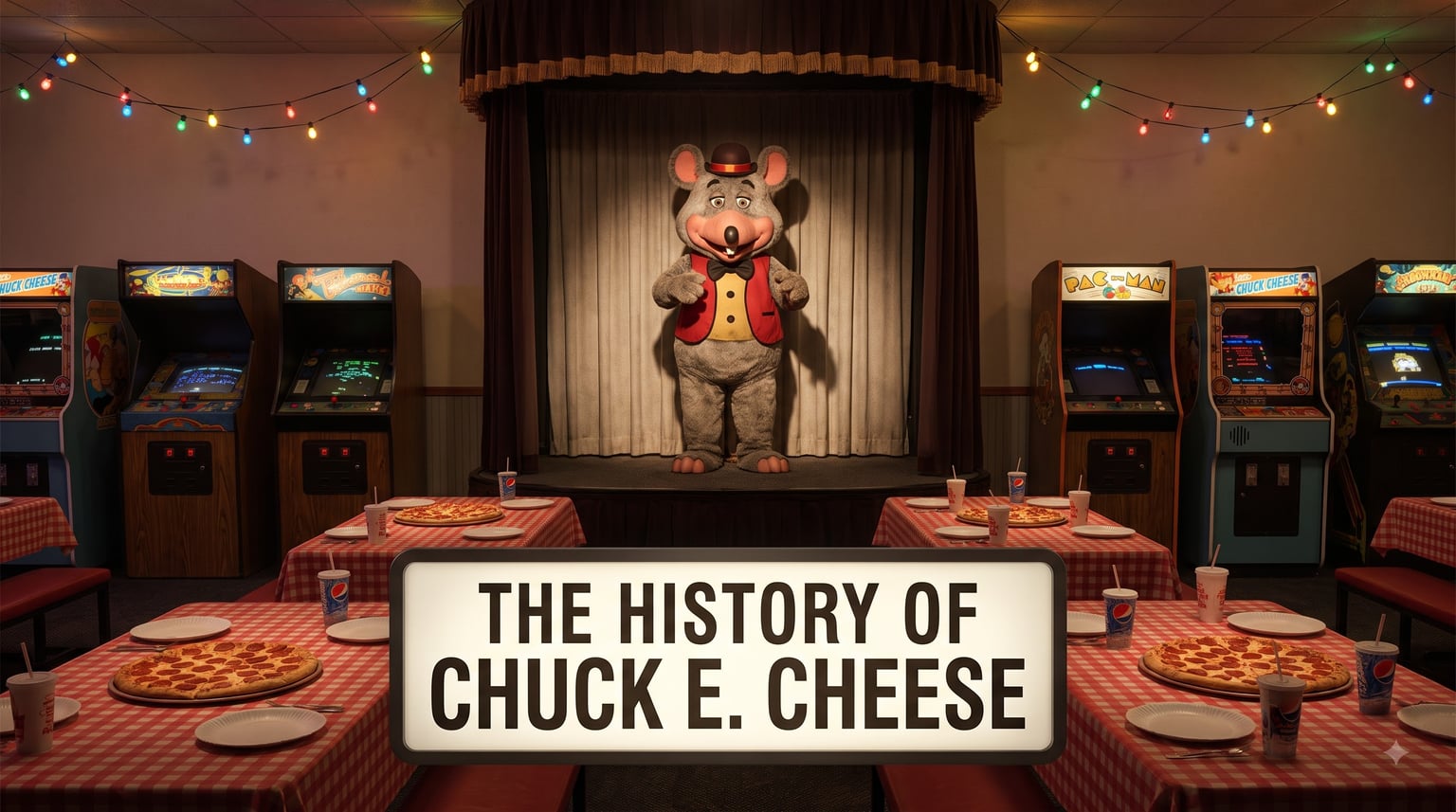
Chuck E. Cheese was founded on May 17, 1977, by Nolan Bushnell, the co-founder of Atari, as the first restaurant to combine pizza, arcade games, and animatronic entertainment under one roof. That single location in San Jose, California, launched what would become a cultural phenomenon that defined childhood birthday parties for decades. The History of Chuck E. Cheese is really the story of how the video game industry, the restaurant business, and robotic theater collided to create something entirely new.
I have spent years researching coin-operated entertainment, and few stories are as wild as this one. There are corporate bankruptcies, mascot identity crises, bitter rivalries, animatronic pizza wars, and not one but two Chapter 11 filings. The brand survived the video game crash of 1983, the Great Recession, and a global pandemic.
What makes this story worth telling in 2026 is that Chuck E. Cheese is still here. After everything, the chain still operates hundreds of locations and continues to shape how we think about family entertainment. This guide walks through the complete history, from the Atari connection to the modern Play Pass era, covering the milestones, the drama, and the cultural legacy that still resonates today.
Table of Contents
- The Atari Connection: How Nolan Bushnell Built the Concept?
- May 17, 1977: The First Pizza Time Theatre Opens
- The Golden Age of Animatronic Entertainment
- The Pizza Wars: Chuck E. Cheese vs. ShowBiz Pizza Place
- The 1984 Bankruptcy and ShowBiz Merger
- The History of Chuck E. Cheese Character Evolution
- Modern Era: Rebranding, Technology, and the 2020 Bankruptcy
- Cultural Impact: Why Chuck E. Cheese Matters
- FAQs
- Conclusion
The Atari Connection: How Nolan Bushnell Built the Concept?
The Chuck E. Cheese story does not start with pizza or even with restaurants. It starts with a man named Nolan Bushnell and a company called Atari. Bushnell co-founded Atari in 1972 and essentially launched the commercial video game industry with PONG, the simple table-tennis arcade game that became a sensation. Before PONG, Bushnell had also created Computer Space, widely considered the first commercially sold arcade video game.
By the mid-1970s, Atari was booming. Arcade cabinets were popping up in bars, restaurants, and bowling alleys across America. But Bushnell noticed something. Adults had places to play games, but kids did not. He saw an opportunity to create a dedicated space where families could eat, play, and be entertained together. The idea was deceptively simple: combine a pizza restaurant with an arcade and add a stage show featuring animatronic characters performing songs and comedy.
The concept made perfect business sense too. Bushnell owned Atari, so he could stock his new restaurant with Atari arcade games at cost. Every quarter a kid dropped into a cabinet would flow right back into his own company. The vertical integration was brilliant. He was not just creating a restaurant, he was creating a distribution channel for his gaming hardware.
Bushnell pitched the idea as a place where “a kid can be a kid.” He wanted the atmosphere to feel electric, noisy, and alive, the opposite of a quiet sit-down dinner. Pizza was the food choice because it was universally loved by children, easy to mass-produce, and profitable. The animatronic show was the hook that would keep families staying longer and spending more.
Of course, Bushnell eventually left Atari after selling the company to Warner Communications in 1976. But he kept the vision for his restaurant concept. He poured his energy and resources into what he would call Pizza Time Theatre, and the family entertainment industry would never be the same.
May 17, 1977: The First Pizza Time Theatre Opens
The first Chuck E. Cheese’s Pizza Time Theatre opened its doors on May 17, 1977, at 370 S. Winchester Boulevard in San Jose, California. It was the first family restaurant in history to integrate food, arcade games, and animated entertainment into a single experience. Nothing like it had existed before.
The original location featured a main dining area, a dedicated arcade filled with Atari cabinets, and a theater section where animatronic characters performed live shows on a stage. The star of the show was Chuck E. Cheese himself, a rat character who wore a vest and bowtie and interacted with the audience. Alongside him was a supporting cast of animatronic performers including Helen Henny, Jasper T. Jowls, Mr. Munch, and Pasqually.
The characters performed songs, told jokes, and put on birthday shows. For a kid in 1977, this was mind-blowing. Robotic animals singing and cracking jokes while you ate pizza and played video games was unlike anything else available. The concept was a revelation.
Interestingly, the mascot almost was not a rat at all. Early concept art and planning referenced a coyote character, and there are accounts that the original costume head ordered for promotional appearances was actually a rat head, which led to the character being redesigned and named accordingly. The rat identity stuck for decades before later being softened into a mouse.
The San Jose location proved the concept worked. Families showed up, kids played games for hours, and pizza sales exceeded expectations. Bushnell and his team quickly moved to expand, and within a few years, Pizza Time Theatre locations were opening across the country. The company went public in 1981, riding a wave of enthusiasm for what felt like the future of family dining.
The Golden Age of Animatronic Entertainment
The animatronic shows were what made Chuck E. Cheese truly special. In the late 1970s and early 1980s, these robotic performances were genuinely cutting-edge entertainment. Each character was a sophisticated mechanical puppet with moving eyes, mouths, arms, and heads, all synchronized to prerecorded audio tracks. For the era, this was impressive technology.
The shows were not just random movements. They were fully scripted productions with original songs, comedy routines, and storylines. The main stage show typically featured the full cast performing together, while smaller cabaret stages in some locations featured solo performances by characters like Helen Henny singing covers of popular songs. Kids would stare at the stage in amazement, eating pizza while these robotic characters performed just feet away.
The animatronics were built to a level of detail that made them feel alive. Jasper T. Jowls played a banjo, Pasqually pounded on drums, and Mr. Munch played a keyboard. Chuck E. Cheese served as the frontman, introducing acts and riffing with the audience. Each character had a distinct personality and voice that kids came to know and love.
Behind the scenes, maintaining these shows was a serious engineering challenge. Each animatronic contained dozens of pneumatic and mechanical components that needed regular calibration, lubrication, and repair. Technicians would work overnight to keep the characters performing smoothly. When a show broke down during operating hours, it was a noticeable event that staff had to work around.
The animatronic shows became a defining feature of the brand and a source of deep nostalgia for anyone who grew up during this era. Many adults today still talk about the first time they saw Chuck E. Cheese perform on stage as kids. For an entire generation, these robotic characters were their first experience with live entertainment in a theatrical setting.
Over the years, the shows evolved with new stages, new characters, and updated music. But the core formula remained: robotic performers, catchy songs, pizza, and arcade games. It was a combination that proved remarkably durable, at least until outside pressures began to threaten the entire business model.
The Pizza Wars: Chuck E. Cheese vs. ShowBiz Pizza Place
The success of Pizza Time Theatre did not go unnoticed. In 1980, a rival concept called ShowBiz Pizza Place launched, and it kicked off what fans and industry insiders refer to as the Pizza Wars. ShowBiz was backed by Robert L. Brock, who operated a chain of Holiday Inn franchises and saw the potential in the family entertainment restaurant model that Bushnell had pioneered.
ShowBiz Pizza Place partnered with a company called Creative Engineering, founded by Aaron Fechter, to provide its animatronic shows. Fechter and his team created the Rock-afire Explosion, a band of animatronic characters that many fans consider superior to the Chuck E. Cheese cast. The Rock-afire Explosion featured characters like Billy Bob Brockali, Looney Bird, Fatz Geronimo, Mitzi Mozzarella, and Dook LaRue performing rock and country covers on a stage that was technically more advanced than what Pizza Time Theatre offered.
The rivalry was intense. Both chains targeted the same families, the same birthday party market, and the same weekend crowds. ShowBiz leaned into a country-western aesthetic with Billy Bob the bear as its mascot, while Chuck E. Cheese maintained its urban rat cabaret vibe. Kids and parents developed strong loyalties to one brand or the other, and playground arguments about which was better were common.
Creative Engineering’s animatronic programming was particularly impressive. The Rock-afire characters had a wider range of motion, more expressive faces, and shows that featured detailed storylines and character interactions. Aaron Fechter was a perfectionist who pushed the boundaries of what animatronic entertainment could do. His shows included original songs, themed story arcs, and holiday specials that kept families coming back.
For a few years in the early 1980s, the two chains competed fiercely. Both expanded rapidly, opening new locations and fighting for market share. The competition drove innovation in both camps, with each trying to outdo the other on show quality, game selection, and food offerings. It was a golden era for kids who loved arcade games and robotic performers.
The irony of the Pizza Wars is that both competitors would end up in serious financial trouble within just a few years. The rapid expansion that defined this period would ultimately prove unsustainable, and economic pressures would bring both brands to the brink of collapse before they were forced to join forces.
The 1984 Bankruptcy and ShowBiz Merger
The trouble started in 1983. Pizza Time Theatre had expanded too fast, burning through cash to open new locations while revenue growth slowed. The video game industry crashed in 1983, devastating arcade revenues across the board. Atari, the company Bushnell had founded and whose games filled Pizza Time Theatre locations, was in freefall. The entire ecosystem that Chuck E. Cheese depended on was collapsing simultaneously.
In March 1984, Pizza Time Theatre filed for Chapter 11 bankruptcy. The company had over 200 locations but was drowning in debt. Nolan Bushnell was pushed out, and the company struggled to restructure. It was a stunning fall for a brand that had gone public just three years earlier.
ShowBiz Pizza Place was not doing much better. The same economic pressures, rising costs, and declining arcade revenues hit both chains hard. In 1985, ShowBiz acquired the assets of Pizza Time Theatre out of bankruptcy in a complex deal brokered by Brock Hotel Corporation. The merger brought the two rivals under one corporate roof, though initially they continued operating under their separate brand names.
The consolidation was painful. Overlapping locations were closed, staff was reduced, and the combined company had to figure out how to merge two different show systems, two different mascots, and two different brand identities. ShowBiz locations had the Rock-afire Explosion from Creative Engineering, while former Pizza Time Theatre locations had the Chuck E. Cheese cast.
This split continued until 1990, when the company launched something called Concept Unification. This was a corporate initiative to convert all remaining ShowBiz locations into Chuck E. Cheese restaurants. The Rock-afire Explosion stages were torn out and replaced with new Chuck E. Cheese animatronic shows. Billy Bob was retired, and Chuck E. Cheese became the sole mascot across the entire chain.
Concept Unification was the end of ShowBiz Pizza Place as a distinct brand, and it remains a sore subject for fans of the Rock-afire Explosion to this day. Many people who grew up with ShowBiz consider the conversion a loss of something special. But from a corporate perspective, unifying under one brand made the remaining locations easier to manage and market.
The History of Chuck E. Cheese Character Evolution
The Chuck E. Cheese character has gone through more transformations than any restaurant mascot in history. Understanding the History of Chuck E. Cheese means understanding how the character himself changed over the decades, because those changes reflect the broader shifts in the brand.
Originally, Chuck E. Cheese was a rat. He had a somewhat gruff, New Jersey cab-driver personality and a cigar in early iterations. The original animatronic and walkaround costume versions were unmistakably rodent-like, with a long snout and sharp features. Over time, the character was softened to be more kid-friendly, but the rat identity persisted well into the 1990s.
In the late 1990s and early 2000s, the character underwent gradual changes. The cigar was dropped, the personality became more cheerful, and the design started shifting from rat to mouse. By the time the company was acquired by private equity firm Apollo Global Management in 2014 for about $1.3 billion, the transformation was well underway.
The biggest controversy came in 2012, an event that fans call Funnergate. The company changed Chuck E. Cheese’s voice actor and gave the character a new, younger, edgier personality. The mascot was officially rebranded as a rock star, and promotional materials showed him as a slimmed-down, guitar-wielding mouse. Long-time fans and employees were outraged by the change, and the term Funnergate became shorthand for the dissatisfaction many felt about the direction the character was taking.
The Funnergate backlash highlighted something important about the brand. People had deep emotional connections to these characters. Changing the voice and personality felt to many fans like losing a childhood friend. The controversy also revealed tension between corporate attempts to modernize and the nostalgia that formed the core of the brand’s appeal.
Despite the pushback, the rock star redesign stuck around for several years. The animatronic shows were updated to feature the new personality and music style. Eventually, the character was softened again to be more approachable for younger children, reflecting the ongoing challenge of balancing modernization with the brand’s beloved heritage.
Modern Era: Rebranding, Technology, and the 2020 Bankruptcy
The modern era of Chuck E. Cheese has been defined by technology upgrades and financial turbulence. In 2014, Apollo Global Management took the company private in a deal that restructured its debt and aimed to modernize the brand. The company invested heavily in what it called CEC 2.0, a renovation program that updated locations with modern decor, improved food offerings, and new technology.
One of the biggest changes was the elimination of tokens. For decades, Chuck E. Cheese operated on a coin-based system. Kids would carry plastic cups of tokens to feed into arcade machines. In 2016, the company introduced the Play Pass card system, replacing physical tokens with magnetic cards loaded with credits. Paper E-Tickets from redemption games were also phased out, with winnings tracked electronically on the same cards.
The move to Play Pass was controversial among nostalgia purists. Forum discussions are filled with people mourning the loss of tokens, which they remember as a tactile part of the experience. The sound of coins clattering into machines and the ritual of counting E-Tickets at the prize counter were core memories for generations of visitors. But from an operational standpoint, the digital system reduced costs, eliminated counterfeiting, and provided valuable data on customer behavior.
The company also began removing animatronic shows from many locations. As part of the CEC 2.0 renovation, old stages were replaced with large video screens showing animated Chuck E. Cheese content. By 2026, only a small number of locations still feature functioning animatronic shows. For fans of the original concept, this represents the end of an era. The robotic performers that defined the brand for decades are now largely a thing of the past.
Then came 2020. The COVID-19 pandemic forced Chuck E. Cheese to close locations worldwide, devastating revenue. In June 2020, the parent company CEC Entertainment filed for Chapter 11 bankruptcy for the second time in its history. The filing listed hundreds of millions in debt. Some locations closed permanently, but the company emerged from bankruptcy later that year after restructuring.
As of 2026, Chuck E. Cheese operates over 600 locations across dozens of countries. The brand has adapted to the modern entertainment landscape with mobile apps, party booking platforms, and expanded food menus. But the question of whether the modern version captures the magic of the original Pizza Time Theatre is something fans and former employees continue to debate.
Cultural Impact: Why Chuck E. Cheese Matters
Beyond the corporate drama and financial filings, the real story of Chuck E. Cheese is about its cultural impact. This was the first place that treated children’s entertainment as a destination experience. Before Chuck E. Cheese, there was no dedicated venue where a kid could eat pizza, play video games, watch a robot show, and win prizes all in one visit.
The concept influenced an entire industry. Dave and Buster’s, Main Event, and countless regional entertainment centers all owe a debt to the formula that Nolan Bushnell pioneered. The idea that families would pay a premium for an experiential dining environment, where the food was secondary to the entertainment, was genuinely new in 1977.
For Generation X and older Millennials, Chuck E. Cheese is woven into the fabric of childhood. The smell of pizza, the sound of tokens hitting arcade slots, the thrill of winning enough tickets for a prize, and the slightly uncanny experience of watching animatronic animals perform, these are shared cultural memories that millions of people carry into adulthood. The nostalgia is powerful and persistent.
Forum discussions on Reddit reveal the depth of this connection. People in r/GenX and r/chuckecheese share photos from childhood birthday parties, debate ShowBiz versus Chuck E. Cheese preferences, and express genuine sadness about the removal of animatronic shows and ball pits. Former employees swap behind-the-scenes stories about maintaining the characters and working the prize counters. There is a real community around this brand.
The brand has also embedded itself in popular culture through references in movies, television shows, and internet memes. The 2012 voice change controversy generated widespread coverage. The concept of a pizza restaurant filled with arcade games and robotic characters has become a recognizable cultural trope that extends far beyond the brand itself.
Whether the current version of Chuck E. Cheese lives up to its legacy is debatable. But the historical significance is not. This company changed how America thought about family entertainment, and its influence is still visible in every arcade, entertainment center, and family restaurant that followed.
FAQs
What is the dark history of Chuck E. Cheese?
The dark history refers to the chain’s turbulent corporate past, including the 1984 Chapter 11 bankruptcy, the removal of founder Nolan Bushnell, the death of the ShowBiz Pizza Place brand through Concept Unification, and a second bankruptcy filing in 2020. Some also reference the somewhat unsettling nature of early animatronic characters and various legal issues the company has faced over the decades.
What is the real story behind Chuck E. Cheese?
Chuck E. Cheese was created by Nolan Bushnell, co-founder of Atari, who wanted to build a family restaurant that combined pizza, arcade games, and animatronic entertainment. The first Pizza Time Theatre opened on May 17, 1977, in San Jose, California. Bushnell saw that kids had no dedicated place to play video games and designed the concept around vertical integration with Atari hardware.
What happened to Chuck E. Cheese in 1983?
In 1983, Pizza Time Theatre faced a financial crisis driven by rapid overexpansion and the broader video game industry crash. Arcade revenues plummeted across the country. By March 1984, the company filed for Chapter 11 bankruptcy. ShowBiz Pizza Place acquired the assets in 1985, eventually merging the two brands under the Chuck E. Cheese name.
How many Chuck E. Cheese locations still exist?
As of 2026, Chuck E. Cheese operates over 600 locations across more than 40 countries. The exact number fluctuates as locations open and close, but the chain remains one of the largest family entertainment center operators in the world despite two bankruptcy filings and significant restructuring.
Why did Chuck E. Cheese remove their animatronics?
Chuck E. Cheese removed most animatronic shows as part of the CEC 2.0 renovation program, replacing them with large video screens and interactive digital displays. The company cited maintenance costs, changing customer preferences, and the desire to create a more modern entertainment environment. Only a small number of locations still feature functioning animatronic stages.
Who owns Chuck E. Cheese today?
Chuck E. Cheese is owned by CEC Entertainment, which emerged from Chapter 11 bankruptcy restructuring in late 2020. The company was previously taken private by Apollo Global Management in 2014. After the 2020 restructuring, ownership transferred to a group of creditors and investors as part of the bankruptcy agreement.
Conclusion
The History of Chuck E. Cheese spans nearly five decades, from a single restaurant in San Jose in 1977 to a global chain that has weathered bankruptcies, mergers, mascot controversies, and pandemics. Nolan Bushnell’s vision of combining food, games, and animatronic entertainment created an entirely new category of family business that still influences the industry today.
While the modern version of Chuck E. Cheese looks very different from the original Pizza Time Theatre, the core idea remains the same. Kids still eat pizza, play games, and celebrate birthdays there. The animatronics may be gone from most locations, but the memories they created persist across generations.
Whether you remember dropping tokens into arcade cabinets in the 1980s, debating ShowBiz versus Chuck E. Cheese at recess, or experiencing the Funnergate controversy firsthand, the story of this brand is ultimately about the enduring power of making kids feel like the main character. That was Bushnell’s original vision, and in some form, it is still alive today.